Vanderbilt Institute for Global Health (VIGH) Archive — Page 6 of 6

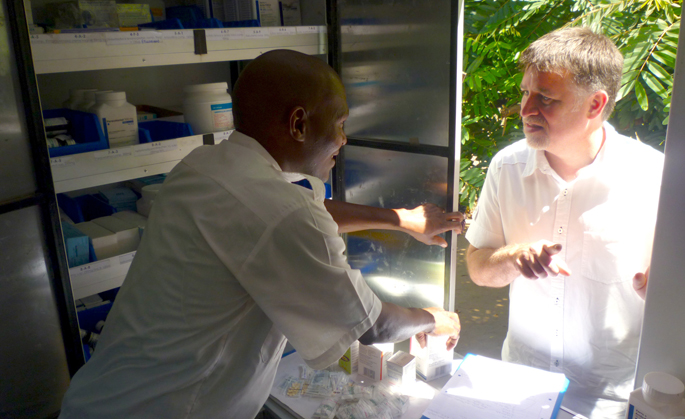
Two healthcare workers converse beside open shelves stocked with medicines and supplies; one stands inside a pharmacy or dispensary area while the other stands outdoors.
October 25, 2012

HIV/AIDS-related efforts in Africa get $7 million boost

Vanderbilt University has received a major federal grant — just more than $7 million in the first year — to extend HIV/AIDS-related technical assistance and training in the rural province of Zambézia, Mozambique.

Two men stand together indoors near marked exit doors; one wears a green shirt and tie, and the other wears glasses and a light-colored shirt.
October 4, 2012

Grant helps expand health care, education programs in Zambia

Vanderbilt University is dramatically expanding its health care and education activities in the southern African nation of Zambia.

July 26, 2012

Six VUSN, VUSM students selected for global health effort

Three students in Vanderbilt University School of Nursing’s Master of Science in Nursing program and three rising fourth-year Vanderbilt University School of Medicine students have been selected as 2012 Frist Global Health Leaders.

Close-up of a Scrabble board with red tiles spelling “HIV,” “AIDS,” and “SEX.”
June 27, 2012

Spelling out HIV risk in urban China

Research reveals clues to HIV risk in Chinese men who have sex with other men.

Overlapping printed statistical charts, including multicolored bar graphs, line graphs, and a blue-to-red surface plot; some labels and values are visible but too small to read reliably.
June 12, 2012

Making order out of ordinal data

A new statistical tool developed by Vanderbilt biostatisticians will help medical researchers make sense of a commonly encountered – but hard-to-analyze – type of data.

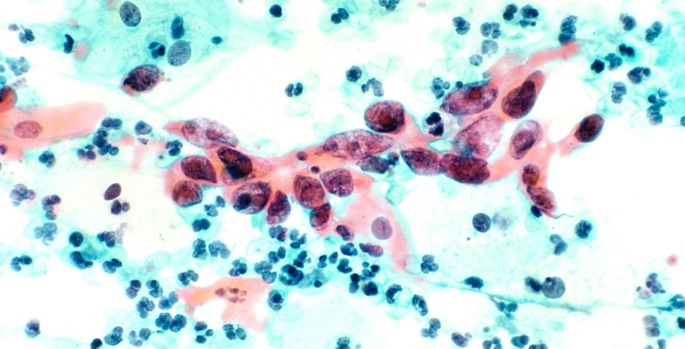
Microscopic cytology slide showing clusters of pink-stained cells with dark purple nuclei amid many smaller blue-stained cells and cellular debris.
February 21, 2012

‘Acid test’ for cervical cancer

An inexpensive, low-tech test for cervical cancer may be a good option for screening for the disease among HIV-infected women in developing countries.