



The enteric nervous system (ENS) regulates essential functions of the gastrointestinal tract, including motility, nutrient absorption, and removal of waste from the body. The loss or absence of ENS nerve cells has been linked to a host of problems that make it difficult to empty one’s stomach or have a bowel movement.
Hirschsprung disease is a congenital disorder that occurs in approximately 1 in 5,000 babies. Caused by a lack of ENS neurons in the muscles of the colon, Hirschsprung disease disrupts gut motility, resulting in bowel obstruction, and if it is not treated promptly, it can lead to bowel rupture or lethal enterocolitis (inflammation of the intestinal wall).
Currently the only treatment for Hirschsprung disease is surgery to remove the diseased portion of the colon. Because of frequent postoperative complications, including constipation and incontinence in children, researchers have developed — in animal models — methods of transplanting ENS stem cells into the gut to replace the missing neurons.
During development, transcription factors in the transient neural crest direct the differentiation of ENS progenitor or stem cells into different subtypes of nerve cells that, in balance, “orchestrate” GI function. Before stem cell transplants can be tested clinically, researchers must learn more about these transcription factors and normal ENS development.
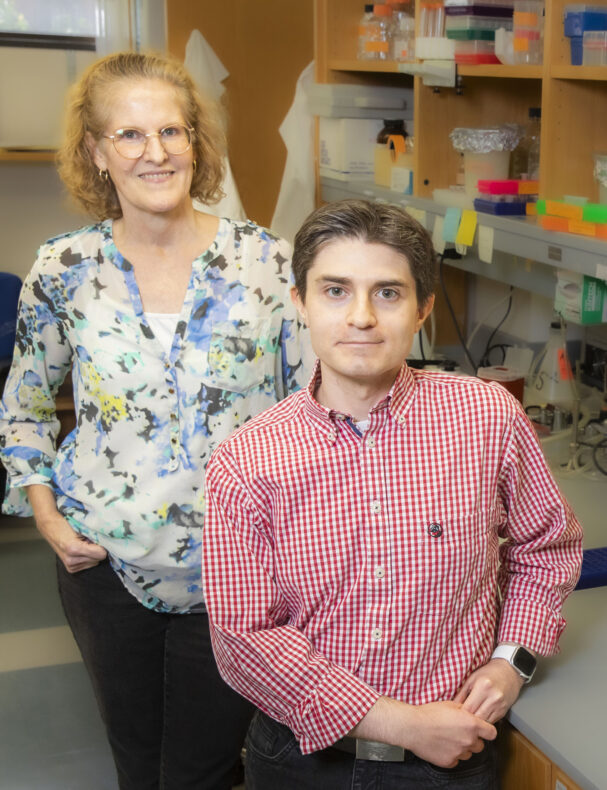
This is where Michelle Southard-Smith, PhD, and her trainees and colleagues at Vanderbilt University Medical Center have made substantial contributions. Their latest paper, which was published online in Cellular and Molecular Gastroenterology and Hepatology, a journal of the American Gastroenterological Association, brings nonsurgical treatment for Hirschsprung disease a step closer.
The paper focuses on Sox10, a transcription factor that Southard-Smith has been studying since she was a fellow at the National Human Genome Research Institute, part of the National Institutes of Health. At the NIH she identified a mutation in theSox10 gene as the underlying cause of neural crest disorders, including Hirschsprung disease, in mice.
In the current study, the researchers used a technique called single-cell RNA sequencing to detect changes in the expression of transcription factors, not only in progenitor cells but — surprisingly — in developing enteric neurons as well.
“The presence of mutant forms of Sox10 in early forming enteric neurons leads to very early shifts in ‘neuronal trajectories,’” said Southard-Smith, professor of Medicine in the Divisions of Genetic Medicine and Clinical Pharmacology. “It appears that this early shift is what leads to later imbalance in neuron types.”
In addition, the early developing enteric neurons expressed Hox genes, including Hoxa6, which had not been detected before in the ENS. The shift in neuronal trajectories observed in cells expressing Sox10 mutants was accompanied in these cells by reduced Hoxa6 expression.
Hox transcription factors play roles in cell growth, differentiation and motility.
“We expect that the genes we’ve uncovered through these deep sequencing studies of early neuronal progenitors will be key factors that must be switched on to form specific types of neurons for transplantation into the GI tracts of patients with Hirschsprung disease or other motility disorders,” Southard-Smith said.
The paper’s co-first authors are Justin Avila, PhD, now at the Stowers Institute for Medical Research in Kansas City, Missouri, and Joseph Benthal, a graduate student in the Southard-Smith lab who plans to defend his doctoral dissertation in August.
Other co-authors are Jenny Schafer, PhD, research associate professor of Cell and Developmental Biology, and David Flaherty, managing director of the VUMC Flow Cytometry Shared Resource.
The research was supported in part by NIH grants R01DK127178, P30DK058404, T32HD007502 and F31DK137637, and by a Howard Hughes Medical Institute Gilliam Fellowship.


