



Lainey Mathis, 22, of Dalton, Georgia, was sitting in the waiting room of a neurosurgery clinic when her husband, Caden, said three words that changed her life forever: “That’s Dr. Lee.”
Right place, right time
Mathis’ visit happened to fall on a surgery day for the center’s director, Ryan Lee, MD, so at first she was worried he wasn’t available.
In pain and running out of options, Mathis worried there might not be anywhere left to turn. But amid her fatigue from years of an intense battle with Chiari malformation, a disorder in which an excess of tissue at the base of the brain blocks the flow of cerebrospinal fluid (CSF), she found her way to Vanderbilt Health’s new Hydrocephalus, Chiari and CSF Disorders Center.
But fate would see to that. Lee walked across the waiting room and Caden immediately recognized him.
“You’ve got to tell him my story,” Mathis recalled telling her husband. “You’ve got to tell him we need help.”
Caden caught Lee’s attention and explained his wife’s deterioration.
“He just stopped and listened to my husband for a second,” Mathis said. “He wanted to hear from me. He took his lunch break to see me. … There’s something really special about that.”
Lee’s listening ear paid off for Mathis. From the imaging, he said, it was clear that she just needed a surgery to correct the issue.
“I was very interested in her case,” said Lee. “I was heartbroken that she was suffering so much.”
Lee added that atypical symptoms likely resulted in a yearslong delay for Mathis being correctly diagnosed with Chiari malformation. But that delay was coming to an end.
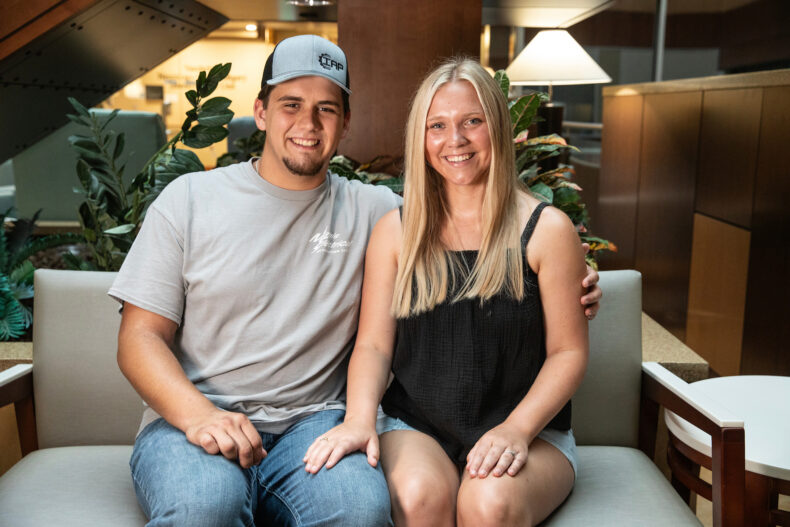
Timing is everything
Lee, assistant professor of Neurological Surgery, joined Vanderbilt University Medical Center in October 2024, just four months before he met Mathis.
“The timing is everything,” said Mathis. “It’s crazy; it’s God divine for sure. … It was really urgent for me to get the help I needed because I was declining so fast. He’s only been here since October, and I met him in February. It was like he came here just for me.”
The CSF center treats a variety of conditions involving fluid buildup around the spinal cord and brain, including syringomyelia, hydrocephalus, intracranial hypertension and CSF leaks.
“These are all bits and pieces of different neurosurgeons’ practices, but it’s unusual for one neurosurgeon on the adult side to specialize in all of them,” said Lee. “For a lot of patients, it’s been a total game changer. … We’ve given them a home for complex conditions.”

The center is staffed by physicians with specialized expertise as well as a nurse practitioner and a dedicated research fellow. The goal is to understand what causes CSF conditions and find new treatment techniques, emphasizing those that are less invasive. Lee said the center sees 40-50 patients each week, and that number is growing.
“It’s amazing to see all the ways this center has paid off for patients already,” said Reid Thompson, MD, the William F. Meacham Professor of Neurological Surgery and chair of the department. “Our patients are fortunate to have Dr. Lee and his amazing team here at Vanderbilt. It’s rare to have a single center with this expertise. Patients are seeking him out from across the country.”
Surgeon, scientist, advocate
Mathis came to VUMC because of her disease, but it was Lee’s bedside manner and determination that made all the difference for her.
“One of my professors once told me that there are physicians who are interested in diseases that people happen to have, and physicians who are interested in people who happen to have those diseases,” said Thompson. “Ryan is both. Every patient is in good hands with him.”
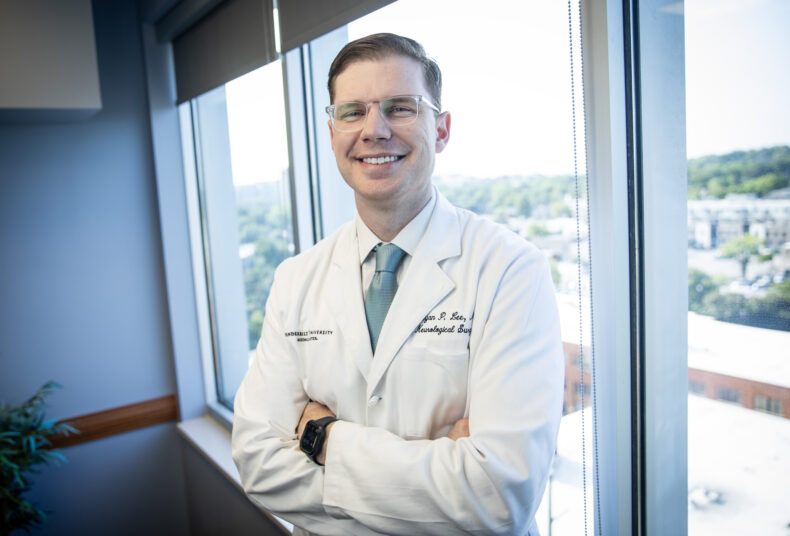
Mathis’ surgical journey wasn’t all smooth sailing, though.
When it was time for surgery, Mathis’ immune system was “so out of whack” that it wasn’t safe for the operation to progress beyond anesthesia, Lee said. The surgical team woke her up before the procedure even began.
Mathis found herself awake in the OR with Lee holding her hand, reassuring her it would be OK: “I’m going to get you through this, and we’re going to find a way.”
Four days later, Mathis was back in the OR. Just hours after that, she felt brand new. She quickly ditched her wheelchair and walked for the first time in months.
“The second surgery went without a hitch,” said Lee. “She healed perfectly. Now she’s essentially back to being a normal mom, a normal wife and a normal person living a good life.”
Mathis praised Lee’s commitment to finding a solution to a problem that had kept her down for so long.
“An advocate for your health is the best thing you can have,” she said. “Dr. Lee was there to protect me. He was my safety in the OR.”
“The first time I ever felt hope”
Through it all, Mathis just wanted someone to listen to her.
After visiting countless doctors without ever discovering the real issue behind his wife’s autonomic dysfunction, Caden said it’s an unfortunate reality that many patients are told there is no cure for their diseases and are left to cope without proper investigation.
But in Lee, they found a great listener.
“That a surgeon takes time to really care … that just meant the world to me,” said Mathis. “After everything I’ve been through, him saying ‘I’m going to find something to do for you…’ that’s the first time I ever felt hope.”
It was evident to Lee that Mathis had the fortitude to preserve that hope and keep fighting.
“She’s an incredible person with an incredible support system,” said Lee. “I think her journey would’ve broken many people … they would’ve given up hope. So I think it speaks volumes about her character, about her family, about her drive to get better.”


