


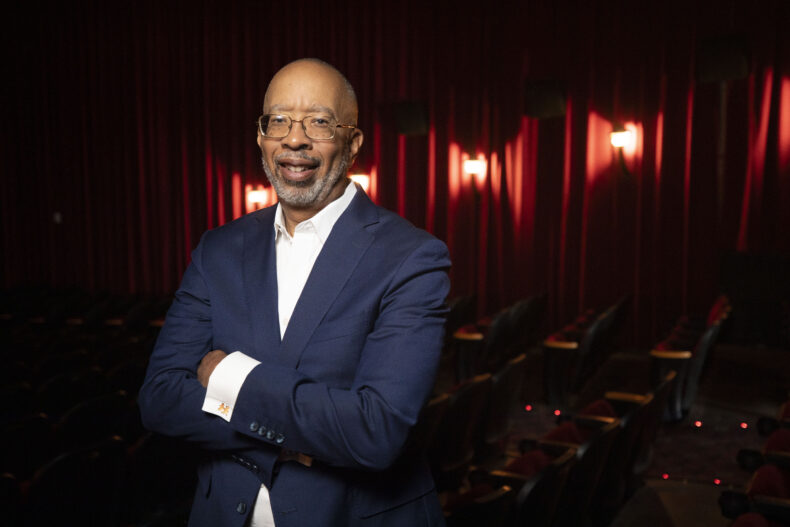
 Jeffrey Upperman at one of his favorite places, the Belcourt Theatre. (photo by Susan Urmy)




Jeffrey Upperman, MD, FACS, professor and chair of the Department of Pediatric Surgery and surgeon-in-chief of Monroe Carell Jr. Children’s Hospital at Vanderbilt, loves movies.
That’s not an overstatement.
He serves on the board of the Belcourt Theatre, a beloved, historic neighborhood theater within walking distance of the hospital. Nashville’s home for independent films, the Belcourt has been a film house since 1925.
Upperman also judges entries to one of the longest running film festivals in the United States, the Nashville Film Festival, and has done so for several years.
And whether you call it a hobby, a passion project or even service to the community, it adds up to watching about 150 movies a year.
“It’s heavy lifting. It’s time consuming,” Upperman said, but he added that it’s work he enjoys. He even views his work pre-screening films as a service to the local art community.
“You get these proprietary links and watch the films,” he explained. “After you watch, you have to give them scores, categorize them and give them a very brief critique.”
On a workday, Upperman said he can get in viewing three short films or one feature. On weekends, he tries to carve out time to screen two features.
Sticking with a steady rhythm of viewing is the only hope a pre-screener has of not being consumed by the time commitment, as he has learned from experience.
“I planned better this year, and I didn’t feel like I was being overwhelmed, but it was a lot of film watching,” he said.
He was so busy pre-screening films for the festival he didn’t have time to visit the Belcourt for a few months. He missed it, both for the enjoyment of the films themselves and for the experience of being in the audience with others.
“Independent theaters help to round out our human experience in a way that’s very personal, very emotional, very relatable. I can’t imagine a world without independent film and independent theaters.”
Vision and connections
Upperman is a New Jersey native and a retired lieutenant colonel in the United States Army Medical Corps. He arrived at VUMC in November 2019, coming to Nashville from the USC Keck School of Medicine, Children’s Hospital Los Angeles.
Upperman considers himself an introvert, although you might not know it from the way he warmly interacts with everyone he meets. As many an introvert will agree, movies are a great way to escape and experience the world without the usual social expectations.
“Growing up, visual things were a driver for me,” said Upperman, adding that his interest in film is a natural extension of being a visual learner. Also, being a surgeon with a strong interest in film is an understandable combination, as surgeons constantly depend on their visual and tactile senses, he added.
Beyond that, he sees deep connections in the collaborative nature of both surgery and filmmaking.
“In an administrative role, the combination of producer and executive producer is kind of what you do,” he said. “You’re making things happen for your faculty and for patients, coordinating among services and getting resources there to make those things happen.
“And the director side comes out in the operating room. We have the staff who are supporting it all, so putting them in the right position to work with you — to hold the tissue in a particular way or set up a view in a particular way. That’s a director working with their cast.”
Synonymous with life
As his involvement with the film community and understanding of the power of the medium has grown, Upperman has taken some lessons with him. He specifically applauds how athletes use film study as a tool to improve skills.
“I was a high hurdler and ran track,” he said. “If I had had video of hurdling back when I was doing it, I think I would’ve been even more effective. Because you feel it, but you don’t know what it looks like.”
And he noted, video could be useful for surgeons improving their skills, too.
“One of the things I’ve been doing lately is telling junior surgeons to slow down, telling them to move much more slowly than they think they need to move,” Upperman said. “I’d love to video it, to show them how much smoother they look when they’re moving slowly, than when they’re trying to look like they’ve got everything under control.”
He sees so many connections between the art and science of surgery, the art and science of filmmaking, and life in general.
“Art, in so many ways, is synonymous with life,” Upperman said.
“I take care of children. And what is a child’s job? To play, to be creative, to bring joy to their families even before they can speak. So being able to inject science into that life through a surgical intervention — you can’t have that life without science, just as you can’t have the creative vision of a film without highly scientific mechanisms like the type of film you’re shooting on, the lighting, the soundscape and all those things that can be broken down into physics. The science is clearly meshed with the art.
“I think that they’re closer than one might imagine,” he said.
The Nashville Film Festival is Sept. 18-24, with the weeklong event showcasing more than 150 films from filmmakers from around the globe.


