




When Alexander Bick, MD, PhD, associate professor of Medicine, came to Vanderbilt University Medical Center in 2020, he was an early-career physician-scientist with big plans for human genomics research using novel genetic sequencing technologies.
Like many of his peers, he was eager to probe questions and unlock answers around how and when gene mutations occur, factors that contribute to these changes, and how this knowledge could then be used to prevent diseases such as cancer and to develop better treatments.
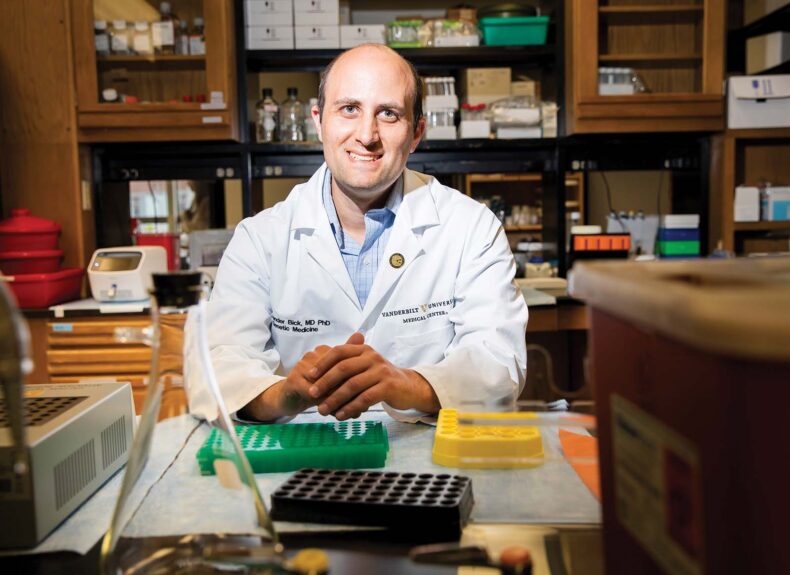
Today, Bick is the head of the Division of Genetic Medicine and Clinical Pharmacology. His investigations are advancing the understanding of somatic (noninherited) mutations in blood stem cells that can trigger an explosive growth of abnormal cells called clonal hematopoiesis of indeterminate potential, or CHIP.
Bick and his colleagues have demonstrated that this abnormal growth of cells is virtually absent in adults under 40 but is found in more than 10% of adults over 70 and confers a tenfold increased risk of blood cancers, a twofold increased risk of heart attack and a 1.5-fold increased risk of death.
Bick is now internationally recognized for his groundbreaking research, and his lab’s gene sequencing expertise is sought out by other researchers to support their investigations.
“There are groups all over the world who come to us and ask us to help them with their sequencing,” he said. “The sequencing we’ve developed is now being run on about 100,000 people’s blood samples every year. We’ve scaled it up, and now this is a tool that’s helping not just us, but blood cancer research around the globe.”
Bick joined VUMC from Massachusetts General Hospital and the Broad Institute of MIT and Harvard. In 2021, he was named the first VUMC Discovery Scholar in Health and Medicine, funded in part by the Brock Family Directorship in Career Development Endowment to support the recruitment and development of talented early-career, basic scientists.
“When I came to Vanderbilt, I discovered we actually have a time machine here,” Bick said. “That time machine is a program called BioVU in which all patients seen at VUMC are invited to contribute their blood left over from testing to this repository.”
Bick’s ability to unlock the potential of BioVU’s 350,000-plus samples for his investigations was expedited in 2022 when he received a $50,000 Vanderbilt-Ingram Cancer Center (VICC) Ambassador Grant. These grants support high-risk, high-reward basic and clinical research at Vanderbilt-Ingram and act as “seed” funding.
Seed or discovery grants fill in funding gaps faced by researchers, especially early in their careers. These grants are catalysts for discovery, allowing scientists to test hypotheses, gather preliminary data and refine their research designs. The resulting findings often lead to securing sizable research funding from national resources for further investigations. The Vanderbilt-Ingram Ambassadors award approximately two grants of $50,000 annually.
For Bick and his colleagues, the VICC Ambassador Grant allowed them to develop a new gene sequencing tool, which they then tested on a few hundred BioVU samples.
“What the Ambassador Grant let us do for the first time was to prove that we could go back in time, and we could measure mutations in people’s blood from when they were healthy,” Bick said. “Then we can measure mutations in their blood later in time, either when they’re starting to show signs of blood abnormalities or ultimately when they develop cancer.”
BioVU includes de-identified electronic health records linked to the samples, so Bick also began looking at the medications individuals who developed blood cancers were prescribed for other conditions, such as ibuprofen for joint pain or biologic medications for autoimmune diseases. He wanted to trace their impact on the trajectory of the cancer.
“We were fortunate after our initial studies to then get a much larger investment of around $6 million from the National Institutes of Health to do this with samples from thousands of individuals, and that’s what we’ve done,” he said. “It’s amazing to see how a small investment at a really critical time in my career as a new investigator really changed the arc of what we’ve done and what we’re going to do.”
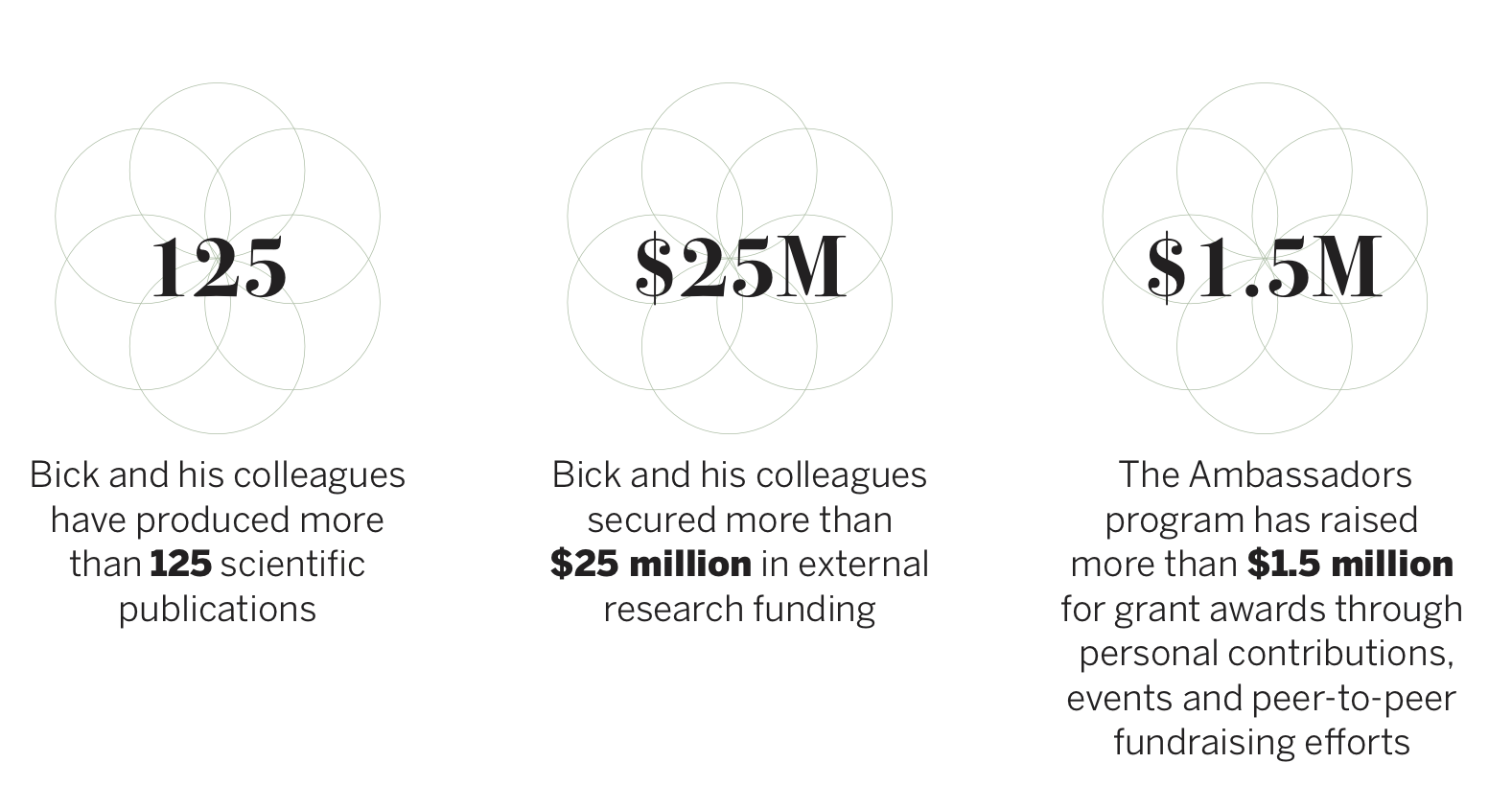
Bick and his colleagues have since produced more than 125 scientific publications and secured more than $25 million in external research funding to further unwind the genetic drivers of blood and other cancers and diseases. And his Ambassador Grant, like many others, has resulted in extending tendrils of research innovation to the laboratories of investigators throughout the world. Which means the program is doing exactly what it is intended to do.
The Vanderbilt-Ingram Ambassadors program is a volunteer group of young professionals that raises money to award grants for high-risk, high-reward cancer research to promising investigators. The group has raised more than $1.5 million for grant awards through personal contributions, events and peer-to-peer fundraising efforts.
Early-stage research supported by the Ambassadors has led to hundreds of publications and more than $45 million in funding from the National Cancer Institute and other external resources.
With the support of the Vanderbilt-Ingram Board of Advisors, and its chair, Orrin H. Ingram II, the VICC Ambassadors program was co-founded in 2009 by Emily Blake (E.B.) Jackson and her husband, Todd Jackson. Todd Jackson had been diagnosed with a brain tumor, and the couple wanted to engage other young professionals in the fight against cancer. The group awarded its first grants in 2010. Todd Jackson was subsequently treated in 2013 for a glioblastoma. He died in 2014.
The Vanderbilt-Ingram Ambassadors worked closely with Vanderbilt-Ingram Director Ben Park, MD, PhD, the Benjamin F. Byrd Jr. Professor of Oncology, and faculty champion Scott Hiebert, PhD, professor emeritus of Biochemistry. Park and Hiebert selected the researchers who present their grant proposals for consideration each year.

Hiebert, who has served as faculty champion since the founding of the Vanderbilt-Ingram Ambassadors, retired Aug. 1. The Scott W. Hiebert, PhD, Ambassador Award has been established in his honor. An award recipient will be selected based on research proposals submitted by investigators at Vanderbilt-Ingram. Douglas Johnson, MD, MSCI, professor of Medicine, holder of the Susan and Luke Simons Directorship and associate director for Translational Research at Vanderbilt-Ingram, and David Cortez, PhD, chair of the Department of Biochemistry, the Richard N. Armstrong, PhD, Professor of Innovation in Biochemistry, and associate director of Basic Research at Vanderbilt-Ingram, have been named to share this role.
“The VICC Ambassadors are truly the next generation of philanthropists who are committed to turning the tide against cancer through awarding grants to promising young researchers at Vanderbilt-Ingram Cancer Center,” said Hiebert. “These grants allow the pursuit of discoveries in basic and clinical science to further our understanding of disease processes.
“For Vanderbilt physicians and scientists, this funding not only yields early results, it also helps develop the ideas that then grow to large federally funded projects and collaborative investigations which ultimately result in transformative breakthroughs in care and prevention.”
Tiffany Holland, a business development officer at Ascend Federal Credit Union, chairs the Vanderbilt-Ingram Ambassadors, a community service role that is especially close to her heart.
“My family unfortunately has a history of cancer,” she shared. “I lost my dad to colon cancer when I was 18. My mom had breast cancer twice. Three of the four of my grandparents passed away from some type of cancer. Sadly, I feel like everyone has had cancer touch them in some way, so it resonates with everyone.
“I was invited to the VICC Ambassadors’ breakfast in November 2019 and loved it. By January, I knew I wanted to be a part of this group. I’m not in the medical field, so this is my way of trying to do something. There has been an amazing expanse of work funded with this ‘seed for research,’ and I’m just so grateful that these researchers are able to receive this support.”
Holland said listening to researchers talk about proposed investigations as the Ambassadors select the projects for funding and then later as they share their results is exciting and rewarding, and she invites others to engage with the Vanderbilt-Ingram Ambassadors.
“It’s inspiring to hear what these researchers can do and everything that has come from their investigations,” she said. “We want them to know that we 100% are behind them and want them to be successful in their research. It’s so important for us to be a stepping stone for the investigators.
“We would love to get more people involved with the Ambassadors. The more investigators we can fund, the more we can help fight cancer with the knowledge gained by this science.”
For Bick, his investigations centered on BioVU continue to grow as his lab analyzes additional commonly used medicines taken by millions to determine their impact on the development and progression of blood cancers.
“As we keep working through some of these top medicines, we’re testing them out, not just in the computer but at the lab bench and in animal models,” Bick said. “I think over the next three years we’ll go full circle back to patients and run clinical trials here at Vanderbilt-Ingram to test whether these common medicines can really change the trajectory of pre-blood cancer.”
The Scott W. Hiebert, PhD, Ambassador Award has been created following his retirement. To donate visit: give.vanderbilthealth.org/hiebert

