


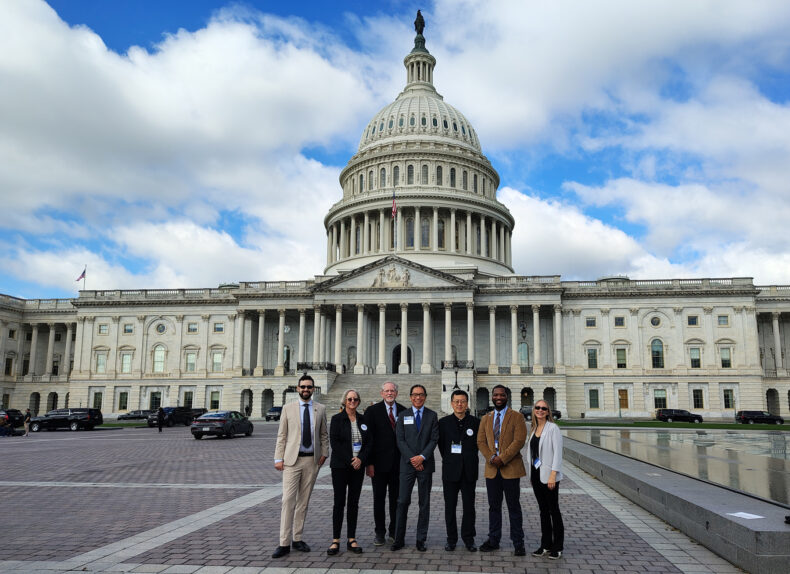
 Among those in Washington, D.C., were, from left, Nicholas Warren, PhD, Shelagh Mulvaney, PhD, Alvin Powers, MD, Patrick Hu, MD, PhD, Hyun Song, PhD, Ronald McMillan, PhD, and Sara Kavanaugh.




Since 2013, the annual Rally for Medical Research has brought scientists and patients from across the United States to Washington, D.C., to advocate for robust funding for the National Institutes of Health (NIH), the largest medical research funding agency in the world.
On Sept. 18, five scientists from Vanderbilt University Medical Center and Vanderbilt University joined five other advocates from Tennessee to share why continued bipartisan support for NIH is important to them.
Nearly every medical advance has been supported by funding from NIH, providing hope for patients with life-threatening diseases as well as developing evidence-based disease prevention interventions. Between 2010 and 2019, the development of 354 of 356 drugs approved by the Food and Drug Administration was supported by NIH funding.
Additionally, NIH funding is a core driver of the U.S. economy, with every dollar of funding yielding $2.56 in economic activity annually. In 2024 alone, NIH funding resulted in $94.58 billion in economic activity in the U.S., including $2.2 billion in Tennessee.
Between 2015 and 2023, NIH received consistent bipartisan funding increases from Congress, raising the agency’s funding from $30.3 billion in fiscal year (FY) 2015 to $47.7 billion in FY2023. When adjusting for inflation, this strong bipartisan support returned NIH funding to levels last experienced in 2005. However, momentum has waned with NIH funding at $47.1 billion for both FY2024 and FY2025. FY2026 funding for NIH has not yet been decided by Congress.
The Rally for Medical Research provided an opportunity for nearly 500 advocates to make their voices heard. Participating from VUMC and Vanderbilt University were:
- Alvin Powers, MD, co-director of the Vanderbilt Diabetes Center. He shared how NIH-supported research has completely changed the prevention and treatment of diabetes over the course of his career.
- Patrick Hu, MD, PhD, a VUMC oncologist and director of the Physician-Scientist Training Program in the Department of Medicine at VUMC. Hu discussed how sustained NIH funding provides access to clinical trials for promising cancer treatments like immunotherapies, which are now curing several types of advanced cancers.
- Shelagh Mulvaney, PhD, associate professor of Nursing at the Vanderbilt University School of Nursing. Mulvaney shared her NIH-funded research on behavioral interventions to help children with Type 1 diabetes keep up with taking insulin.
- Hyun Song, PhD, VUMC research assistant professor of Medicine. Song shared his collaborative NIH-funded research project analyzing the role of good cholesterol in reducing the risk of heart disease.
- Ronald McMillan, PhD, VUMC postdoctoral research fellow. McMillan discussed his NIH-funded research investigating why eating salt raises blood pressure for people with certain genes.
“It was an incredible learning experience being on Capitol Hill and seeing how decisions are made in Washington, D.C.,” said Hu, “We heard directly from members of Congress from both parties that medical research is important to them, which gives me a lot of hope for the future careers of the next generation of physician scientists.”
Nearly 500 advocates from more than 300 research and patient advocacy organizations participated in this year’s Rally, collectively meeting with more than 250 congressional offices in a single day.
“Being on the Hill with so many other passionate for medical research advocates was truly inspiring and made our message that much stronger,” said Powers. “There has never been more promising scientific ideas or possibilities than we have right now, and we must keep our foot on the accelerator to drive the innovation and discoveries our patients need.”


