


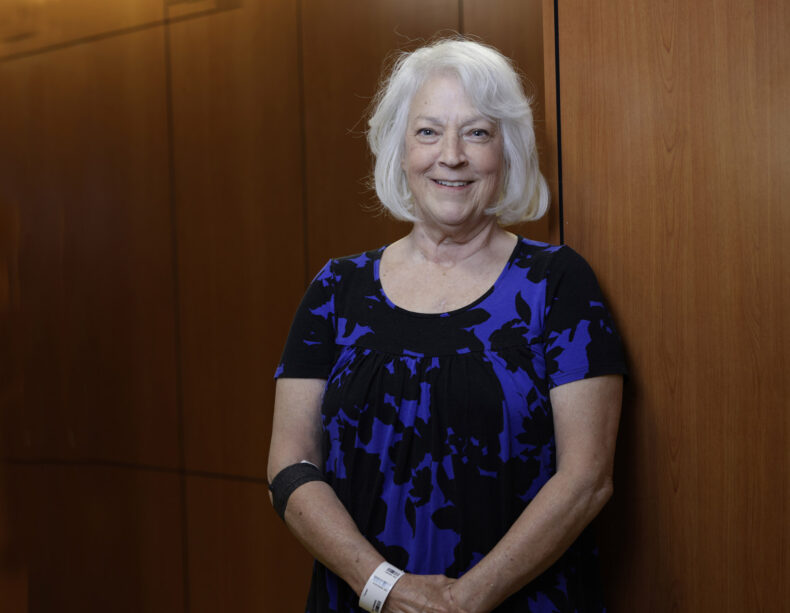
 Patient Theresa Stratman (photo by Donn Jones)

A Vanderbilt Transplant Center patient received an open-heart surgery, a lung transplant and a liver transplant back-to-back in 15 hours of procedures. It is the first time Vanderbilt has performed these three major surgeries sequentially.
The patient, Theresa Stratman of Louisville, Kentucky, is now a walking miracle — able to get to her continuing medical appointments and live without medical oxygen. But in February 2025, she was near death, struggling to breathe and walk across a small room.
Stratman said her recent medical troubles began in the fall of 2020, when she contracted COVID-19. She survived that bout but noticed it was painful to breathe on a vacation to Las Vegas the following year. She saw her doctor afterward and was diagnosed with pulmonary fibrosis, a chronic lung disease characterized by the formation of scar tissue (fibrosis) in the lungs. Her doctor put her on oxygen right away.
“My doctor pretty much told me a number of times, there’s not much more that he can do,” she said. “And he just kept saying, it doesn’t look good, the prognosis is not good. You know, there’s nothing else I can do.”
Those were very difficult times. Stratman said she was turned down as a transplant candidate at a local hospital. She was diagnosed with cirrhosis of the liver in 2021, and was also suffering from heart disease. Her husband died in February 2022, followed by her father in March 2023.
In 2023, Stratman consulted with a friend who is a nurse. That friend consulted the doctors she worked with, and they told her to take Stratman to VUMC. Stratman said she immediately made an appointment. Once there, she said she received new medications, new rehabilitation and continued great care.
“They got me back on my feet,” she said. “They changed all my medications, got me into physical therapy and I went from being in a wheelchair to being able to walk around on my own.”
She maintained her health for a while, but in fall 2024, her pulmonary fibrosis worsened significantly, and she was admitted to a local hospital, then a local rehab, all the while continuing conversations with her providers at VUMC. By early February 2025, she was discharged and returned home. Days later, she drove to VUMC for testing, and her situation was dire. She “halfway collapsed in the hallway” and was admitted to VUMC.
Meanwhile, Stratman urgently needed a coronary bypass grafting of her left anterior descending coronary artery, which was 70% blocked. Because her lungs and liver were in poor condition, the transplant team decided to do the heart surgery, lung transplant and liver transplant together.
Ten days later, on Feb. 16, she entered the operating room for a marathon of surgeries. It started with the coronary artery bypass graft (CABG), a surgical procedure that improves blood flow to the heart by bypassing blocked coronary arteries. The double lung transplant was next, followed by the liver transplant.
“I was up for anything,” Stratman said. “I was extremely grateful. And shocked. And my whole family was shocked, but I knew it had to be done.”
The three procedures required three separate surgical teams — heart, lung and liver surgeons — along with multiple nursing teams, anesthesiology specialists and others. Konrad Hoetzenecker, MD, PhD, surgical director of the Vanderbilt Lung Transplant Program, led Stratman’s operative procedure together with Seth Karp, MD, H. William Scott Jr. Professor of Surgery and chief of the Section of Surgical Sciences; Martin Montenovo, MD, MMHC, surgical director of the Adult Liver Transplant Program; and Tarek Absi, MD, associate professor of Cardiac Surgery.
David Erasmus, MD, the medical director of the Vanderbilt Lung Transplant Program, coordinated the transplant teams and led the medical management of the patient.
Kelly Mishra, MD, associate professor of Anesthesiology, provided general anesthesia.
“Both lung transplantation and liver transplantation are among the most complex surgical procedures, and coronary artery bypass grafting (CABG) is also considered a major operation,” Hoetzenecker said. “The uniqueness of this combined approach lies in the coordination of all these surgeries to minimize risk for the patient.”
Stratman recalls waking up four days after the surgeries. A little over two weeks after the procedures, she was transferred to Vanderbilt Stallworth Rehabilitation Hospital for inpatient rehab, then released for outpatient rehab at the Vanderbilt Dayani Center.
Now she’s back in her home in Louisville, back at the gym, and she returns to Vanderbilt for appointments at least once a month. She expressed appreciation for her Vanderbilt care team, and her sister, Kim Higdon, who took a four-month personal leave to take care of Stratman 24/7 until the end of May.
“I’m proud of what I’ve gone through, and I hope that it can help others in the future,” Stratman said.


