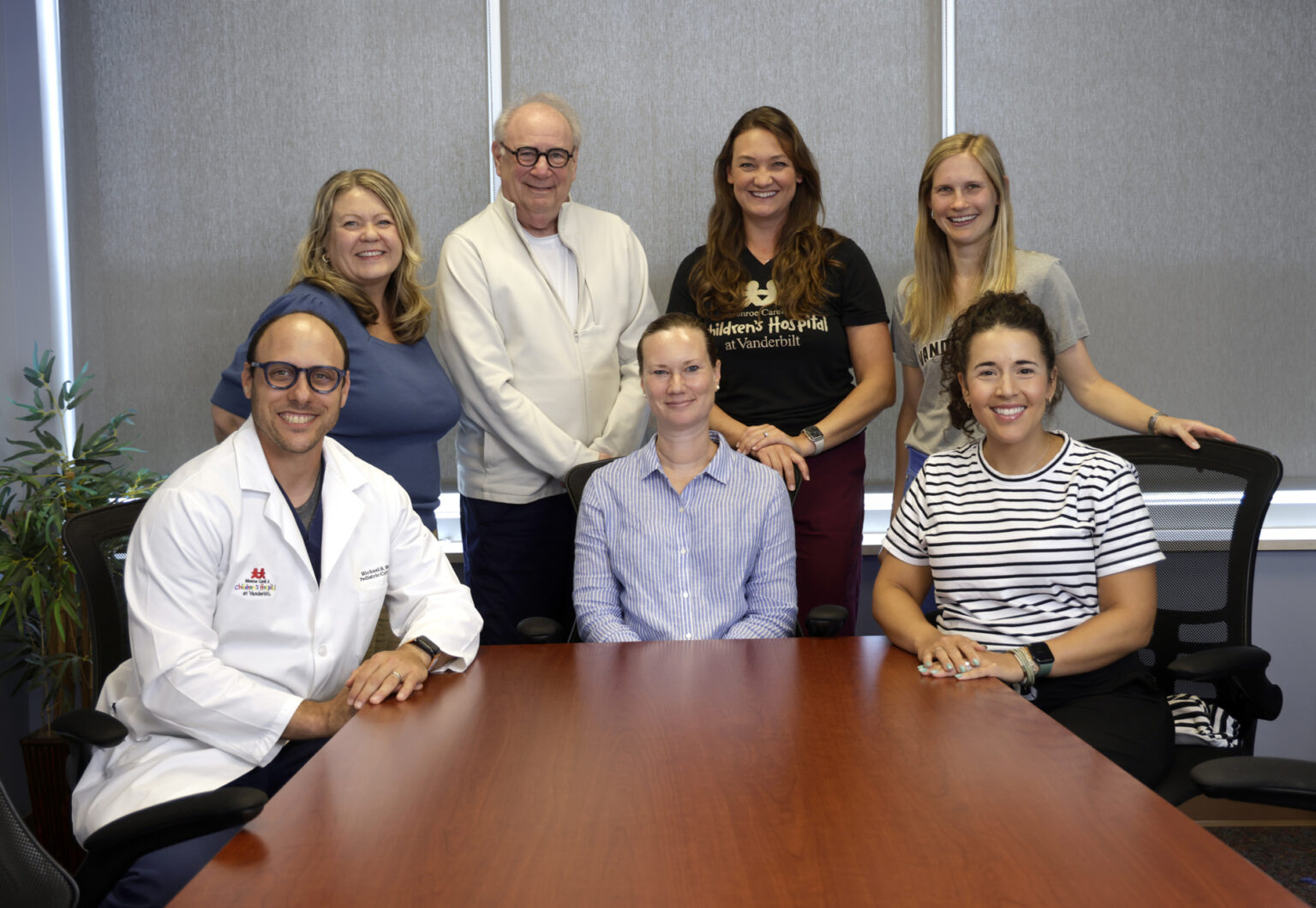
 The multidisciplinary team at the Moderate-to-Severe Acquired Brain Injury Clinic includes, front row from left, Michael Wolf, MD; Elizabeth Martin, MD, MPH, MHS; Jane Owen Robbins, OT. Back row from left, Tisha Coggin Clay; Charles Hausman, SLP; Kat Hedden, PT, DPT; and Mackenzie Phillips, SLP. (Photo by Donn Jones)

Children from Middle Tennessee and surrounding regions who sustain brain injuries are treated with the highest standard of evidence-based medical care at Monroe Carell Jr. Children’s Hospital at Vanderbilt.
But for many families, the fear of recovering from such a scary event is often compounded by the worry of continuing to manage their child’s recovery after they are discharged from the hospital.
That’s where the support of a specialized Physical Medicine and Rehabilitation (PM&R) clinic comes in. Located in the Doctors’ Office Tower at Monroe Carell, the Moderate-to-Severe Acquired Brain Injury Clinic is staffed by a PM&R doctor, a team of therapists and a teacher who helps students get back to school successfully after recovering from their injury.
“Our clinic started when we recognized the need for a multidisciplinary approach for our kids with more severe acquired brain injuries,” said Elizabeth Martin, MD, MPH, MHS, assistant professor of Physical Medicine and Rehabilitation and the medical director of Pediatric Rehabilitation at Monroe Carell. “One of the areas we identified was the need for an outpatient follow-up clinic. There really wasn’t a defined area where these kids were following up; they were scattered across the institution.”
The clinic sees patients who have suffered a moderate to severe traumatic brain injury or a nontraumatic brain injury; the latter can include injuries caused by a stroke, tumor or encephalopathy. The clinic’s focus is on those who have the most significant deficits after their injuries, Martin said.
At the clinic, Martin and her team of therapists equip patients’ families with the information they need to help their child recover and thrive after being discharged from the hospital. Patients rotate through a half-day schedule and visit with an occupational therapist, physical therapist and speech language pathologist. At the beginning of each day, the team discusses the goals and methods for working with each patient, Martin said.
Then, the specialists do their testing, sometimes working together to avoid overwhelming the patient with the same questions repeatedly — a testament to the value of housing many disciplines in the same place.
“It’s very much a multidisciplinary clinic, which I think is one of the things that we all love most about it,” said Mackenzie Phillips, a speech language pathologist at the clinic.
Phillips explained that when treating a patient recovering from a brain injury, it can be hard to get a sense of what a patient’s neurological capability was prior to the incident.
“We don’t know most of these kids prior to their injury,” Phillips said. “So, it’s hard to know what their learning style is. We’re pretty reliant on the data we get from acute care — those that saw them in the hospital. We look at those notes and say, ‘What does it look like this kiddo is capable of doing? What do they need?’”
Various assessments help therapists better understand a child’s neurological status. Cognitive testing, for instance, is important to Phillips as a speech language pathologist, and the information gleaned from a cognitive test such as the BRIEF (Behavior Rating Inventory of Executive Function), which evaluates skills like memory, organization and planning, can benefit the entire care team.
Once each specialist completes testing and works with the patient in their area of expertise, the team conferences again to develop and share a plan with the family and arrange necessary follow-up visits, Martin said.
The clinic’s ultimate goal is to leverage this valuable time with therapists and other specialists to help the patient achieve their best quality of life and their “new normal.” For school-age patients, that often means returning to classroom learning.
Returning to a daily educational environment after a brain injury can present many difficulties, which can be complicated by how schools help students reacclimate. The clinic offers the services of a schoolteacher whose decades of expertise equip her to serve as a liaison between patients and their schools.
Tisha Coggin Clay, assistant manager for Patient- and Family-Centered Care, is the team lead for teachers who are part of the hospital school program at Monroe Carell, and her role includes helping families navigate a return to school.
“These are kids who have been in regular classes, doing fine, and then something happens, and we’re navigating their recovery afterward,” said Coggin Clay. “Helping schools and parents understand what to look for and what to do when those things happen is part of the return-to-school education we provide.”
Support from hospital staff in removing the burdens associated with a child being hospitalized can allow families to focus on their child’s recovery. For instance, Coggin Clay can, with parental consent, contact the child’s school to explain the situation and send an excuse for absences. There might also be the need to coordinate a part-time return to school or visits from a teacher at home.
“Families often struggle … navigating a medical system that has its own jargon and its own complex system,” said Coggin Clay. “And then there’s the education system that’s also complex and has its own jargon. And families are expected to translate both.”
Often, despite the celebration that comes with being discharged from the hospital, families may still feel apprehension about managing their child’s continued recovery without around-the-clock support from clinicians. That, according to Martin and Phillips, is where the clinic helps bridge the gap.
“It depends [on the patient], but we try to give them some practical, immediate things to do,” said Phillips. “The clinic has done really well to put together some standard documents that are shared with families, and I’m constantly messaging families on the portal [My Health at Vanderbilt] just to check in.”
Martin added that it’s important to help families feel equipped to manage their child’s medical needs at home and make them feel “tucked in and taken care of.”
“There’s a lot happening when you’re in the hospital and your child is really sick,” said Martin. “To go home, and suddenly you’re doing all of that on your own … can be incredibly overwhelming.
“We help families understand that while many of the things they may be seeing with their child are scary, it’s also very common after having these types of injuries, and they do get better.”
The clinic providers know their work gives families peace of mind. Phillips, for one, delights in seeing lives change for the better because of their support.
“We say this every week that the brain injury clinic comes up — this is the highlight of our week,” she said. “I feel so happy to be in such a collaborative, wonderful clinic that helps these families.”