



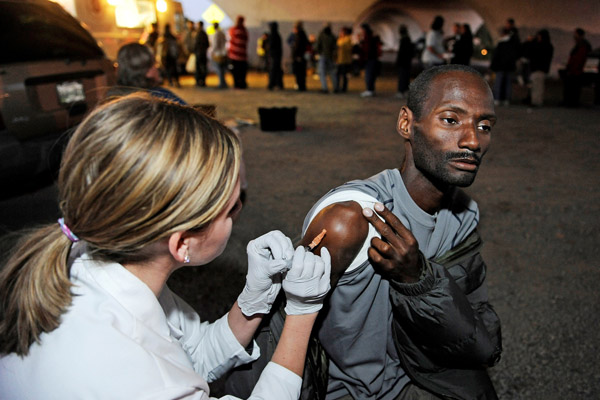
 An early Shade Tree Clinic initiative was providing vaccinations for people without housing in Nashville.

A serendipitous alphabetical seating arrangement in anatomy lab led to a fast friendship between first-year medical students Katie Cox Johnson, MD’07, and Kristina Collins, MD’07. Their connection led to a grassroots, two-year mission to establish a medical student-run, free medical clinic to provide high quality care for uninsured residents of Nashville.
“It’s such a special and fond memory for me in so many ways, and definitely one of the most rewarding times of my whole life was setting Shade Tree Clinic up with Katie,” said Collins, who is now a dermatologist in Central Texas.
Collins remembers showing an article to her classmate about student-run clinics at other medical schools. At the time, around 50 such clinics existed in the United States.
This prompted a deeper conversation about the critical need to provide medical care to those without insurance. Cox Johnson shared that her own family had often struggled to maintain medical insurance coverage and gain access to appropriate health care.
“She had family members with medical problems that were really serious,” Collins remembered. “They had very limited access to health care. We started researching how student-run medical clinics had been done at other places and what we would have to do in order to make such a clinic happen at Vanderbilt.”
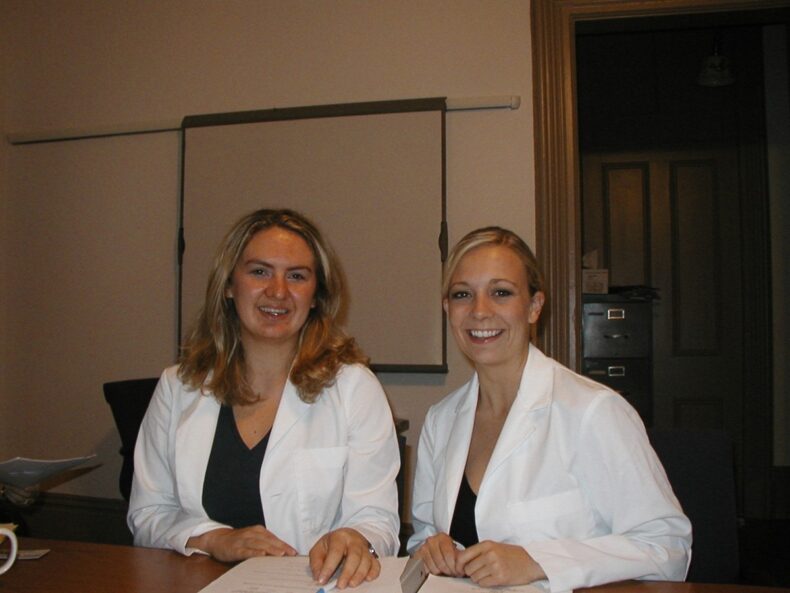
The pair requested a meeting with then Vanderbilt University School of Medicine Associate Dean for Medical Students Bonnie Miller, MD, MMHC.
“They showed me this large binder packed with information and basically said, ‘How come we don’t have one?’,” Miller recalled. “This was 2003, and I hadn’t been in that position long. My background was not in medical education — I was a surgeon — so I was learning on the job. My answer was, ‘I just don’t know.’”
Miller challenged them to dig deeper and thoroughly research local needs and startup requirements for such a clinic. The Community Scholars Program funded medical student summer projects between their first and second years, so with this impetus the pair hit the ground running.
The late Lewis Lefkowitz, MD, professor of Preventive Medicine, served as their mentor for their summer project; he was a staunch supporter and volunteer for the clinic initiative. In fact, in 2008, an educational clinical case series was established, “The Lefkowitz Hour: Clinical Medicine and Patient Advocacy at the Shade Tree Clinic,” during which students present challenging cases to other students, house staff and faculty.
The medical students analyzed Nashville-area statistical health data from the Metro Public Health Department; identified potential clinic locations so services would be near communities with greatest need; formed partnerships with governmental and nonprofit health service and social service organizations; and proposed a framework for the clinic’s operating structure.
In their resulting 20-page report, they laid out the clinic’s threefold purpose:
“First, it will provide access to free health care in a community that has no other such opportunities for residents in need. Second, it will give interested medical students early experience both in the clinic and in underserved communities with which they may not be familiar. Third, it will allow for the establishment of an interdisciplinary team from all interested schools and departments within the larger Vanderbilt University system so as to increase communication between the students of various disciplines.”
A geographic triangle that included the central corner of Bordeaux, East Nashville/Inglewood and Bellshire were areas of Nashville that ranked poorly on health indicators and lacked access to safety net provider clinics. They walked these neighborhoods and had conversations with the people who lived and worked there.
They heard:
“A clinic would be a blessing to this area.” “This clinic needs to be on a bus route.” “I sure need some place where I can get my medicine.” “If there was a free clinic, I would go there instead of the ER.”
The pair, who became the clinic’s first executive co-directors, presented a well-thought-out proposal for the clinic to Miller and then VUSM Dean Steven Gabbe, MD. They included a startup cost estimate of $8,634 and a yearly expense estimate of $7,401, itemized down to bandages and bus passes, with hopes that VUMC could assist with surplus equipment and basic medical supplies.
They got the green light to move forward from Miller, Gabbe and Vice Chancellor for Health Affairs Harry Jacobson, MD, as well as the Vanderbilt legal team, led by Julia Morris, JD, MSN.
Classmates had learned about their effort along the way; they were enthusiastic and all in. Medical students Dana Guyer, MD, and Sara Corr, MD, would go on to take over the mantle as co-executive directors when the clinic opened in 2005. There was also a groundswell of support among faculty members who were eager to volunteer their time and expertise.
A serendipitous connection with actor and philanthropist Paul Newman led to a gift of $37,000 in seed money to cover startup costs and kick-start the clinic’s opening.
“The Paul Newman thing happened because my dad was friends with him and was helping with fundraising for the camps he had been running for kids with serious illnesses,” Corr said. “I think Dad was probably just bragging, saying, ‘Oh, my daughter’s working on this …’ Paul was excited to support our effort.”
For two years, a small cadre of medical students, advised by faculty, chipped away at a lengthy checklist that had to be addressed before the clinic could welcome its first patient. A legal agreement signed between VUSM and the clinic established Shade Tree Clinic as an extension of the medical school. Compliance with medical waste disposal regulations, a Clinical Laboratory Improvement Amendments waiver to allow basic, on-site lab testing, permits for specialized equipment, and insurance for volunteers also had to be secured.
As the students brainstormed the perfect name for the clinic, they recalled how Lefkowitz responded when they expressed frustration over the difficulty in finding a perfect location for the clinic. He told them, “You don’t need a beautiful building to take care of folks. You just need a shade tree under which to see them.”
His comments took root. The concept connected with what Cox Johnson saw in her mind’s eye. A clinic that operated much like a “shade tree mechanic,” where an innovative, skilled individual rolls up to a neighbor’s yard to repair a vehicle under the expansive shelter of a shade tree.
“A shade tree mechanic goes where they’re needed and repairs things without necessarily having a professional repair shop,” said Collins. “Katie thought of it as going to help people where they need it. We were moving away from the physical space of Vanderbilt and taking health care to the people, where they were.
“I also saw it as planting a shade tree for future generations, where you might not ever see the full extent of the importance and significance of that shade tree. But it’s there, and it’s making a difference.”
Shade Tree Clinic began humbly in a double-wide trailer in a historically disadvantaged area of East Nashville. Then CEO of United Neighborhood Health Services (now Neighborhood Health) Mary Bufwak, PhD, allowed the fledgling clinic to share space rent-free with a UNHS clinic along Dickerson Pike. Bufwak had long been a champion of providing primary health care services for Nashville’s medically underserved. The medical students’ enterprise would expand access to care during Shade Tree Clinic’s operating hours, which were after business hours once a week and on Saturday.
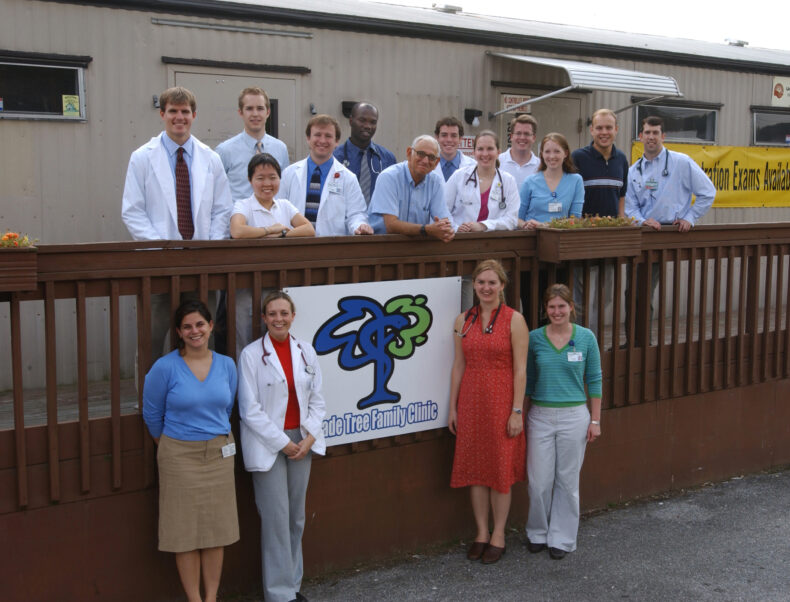
The clinic has moved twice since then, now sharing space with a Vanderbilt Health clinic in the Melrose area of Nashville.
“I was initially worried when we moved to the Melrose location, because we had really wanted to stay in the neighborhood,” said Eleanor Weaver, MD, a faculty co-medical director. “We had always been in East Nashville, and I was worried that we would lose accessibility for our patients. But there’s been a lot of shift in terms of where our patients live, and they were less situated in that zip code than when the clinic began. It turned out that the move geographically was not a big deal. And it is a really wonderful space. It’s on the bus line; we have more storage; and the dispensary is able to function more easily.”
Cox Johnson was diagnosed with multiple sclerosis while still a Vanderbilt medical student, and later she developed cancer. She died in 2019 at just 38. Collins said her friend would be amazed at today’s Shade Tree Clinic and proud of its continued impact on countless lives.
“Katie and I always had these big dreams for Shade Tree Clinic,” she said. “And as proud as I am that we took the initiative to get it going, I’m equally as proud of the students, faculty and school administration who continue to invest themselves in the clinic, carrying that torch and then passing it forward. It took the collective Vanderbilt to make it possible, and that’s what continues to make it possible today.”