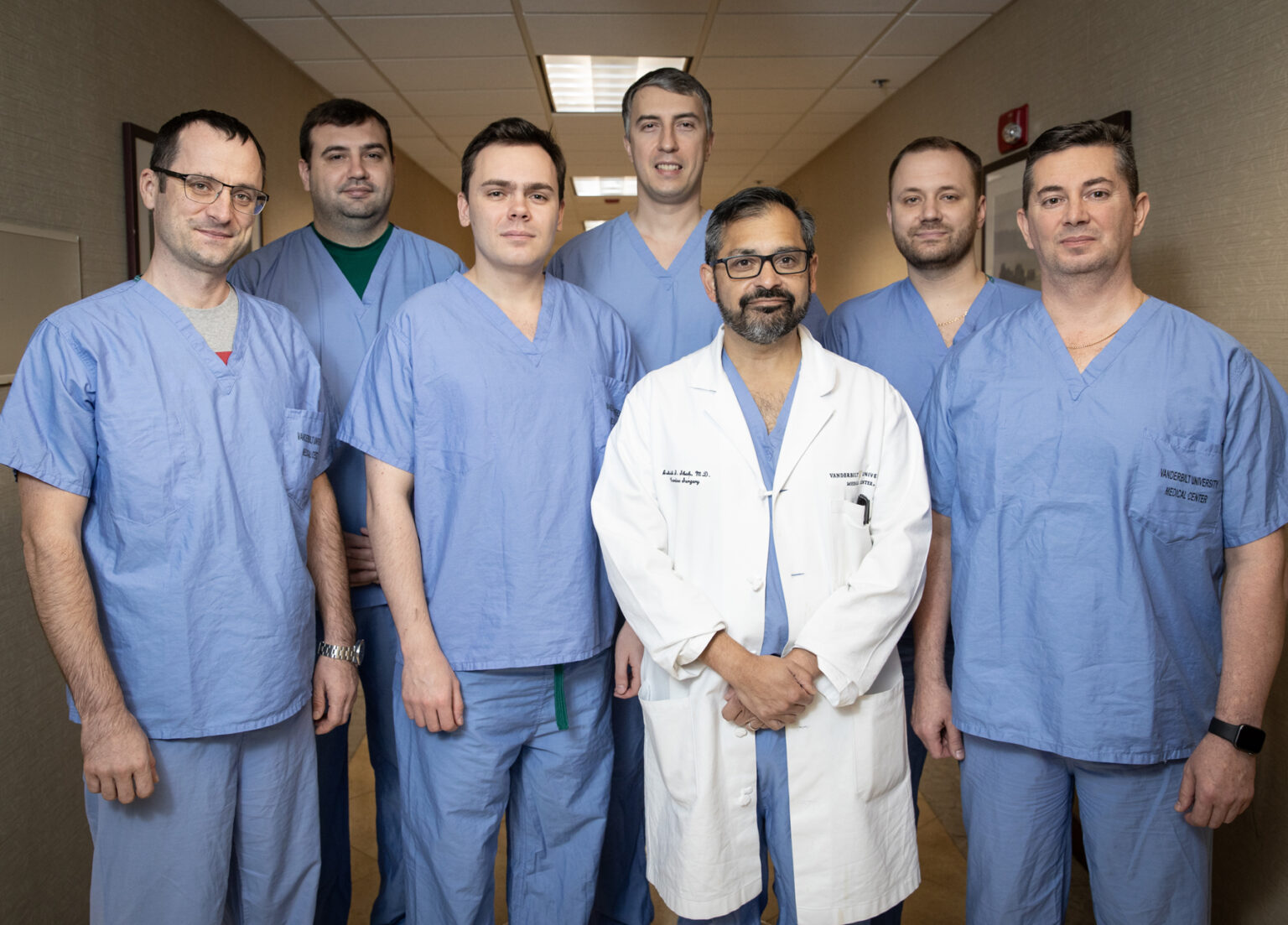
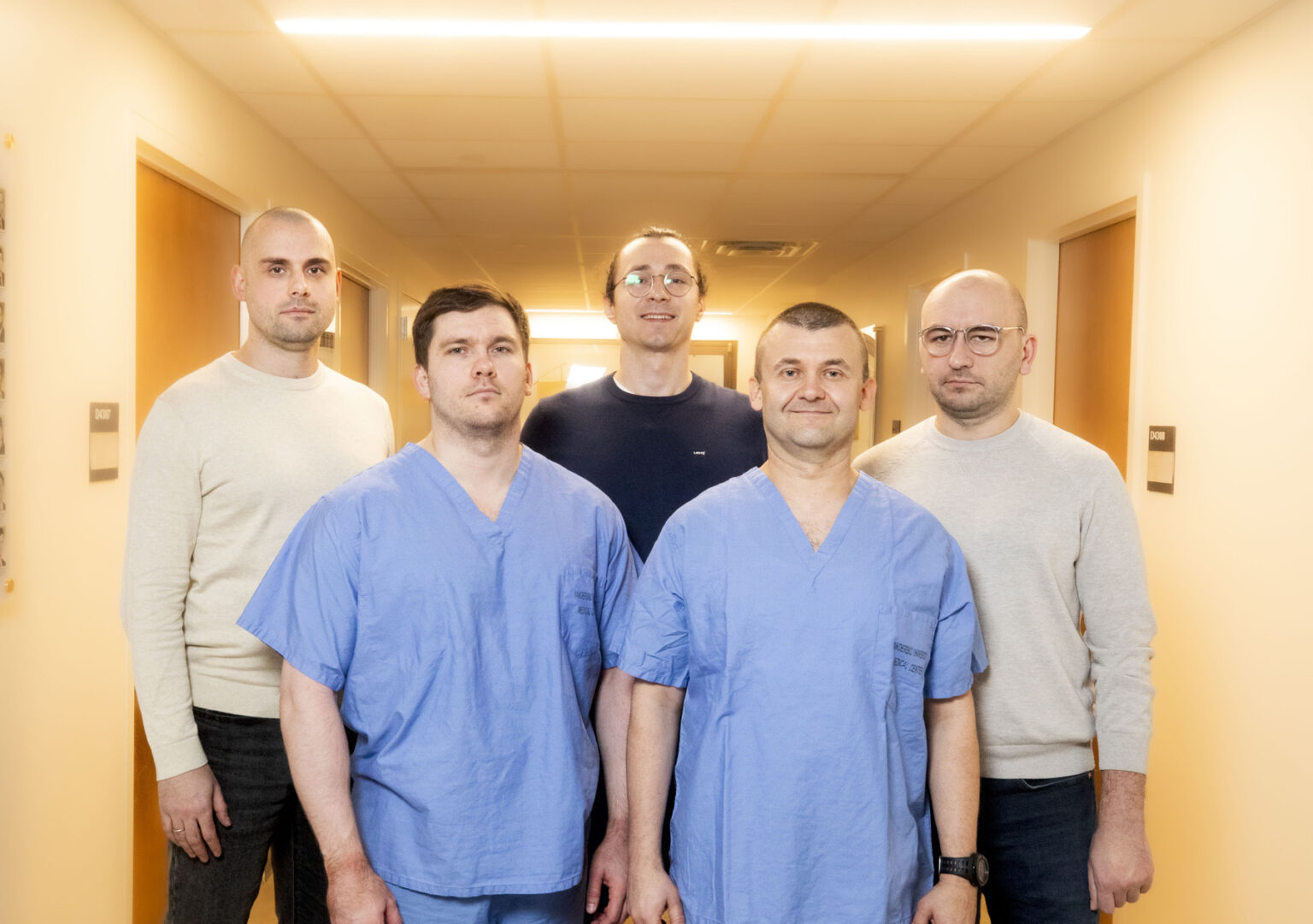
 The team from Ukraine included (front row, from left) Yevhen Haidarzhi, MD, PhD, Andrii Zhylenko, MD, (back row, from left) Oleksandr Dubnevych, MD, Illia Yeremieiev, MD, and Vlad Kropelnytskyi, MD. (photo by Susan Urmy)

For the fourth year, a delegation of doctors from Ukraine recently visited Vanderbilt University Medical Center to observe organ transplants and protocols.
With the help of the Vanderbilt Transplant Center and other centers, Ukraine has developed a growing transplant program in the country in the last five years. Historically, Ukraine’s transplant programs have been underdeveloped, as citizens needing transplants would typically leave the country for places such as India. But having a program in-country has become critical since travel became much more difficult after Russia invaded Ukraine in February 2022.
The five-doctor delegation from Ukraine — two surgeons, two anesthesiologists and a pathologist — observed all aspects of transplant, from procuring donor organs to observing the transplants themselves.
“It’s a lot of cases that I can see during the short period of time,” said Vlad Kropelnytskyi, MD, “and it’s very useful to understanding.”
The Ukrainian delegation, which visited over the course of two weeks, was comprised of Kropelnytskyi; Yevhen Haidarzhi, MD, PhD; Andrii Zhylenko, MD; Oleksandr Dubnevych, MD; and Ilia Yeremieiev, MD.
The doctors came from the Ukrainian capital, Kyiv, as well as Zaporizhzhia in southeast Ukraine, near the war’s front. They spent extensive time with the Vanderbilt Transplant Center’s liver and kidney transplant teams, said Joseph Magliocca, MD, director of the center.
“We have previously hosted Ukrainian thoracic surgery teams at VUMC, so we were thrilled to learn that their abdominal organ transplant teams wished to visit our center as well,” said Magliocca, holder of the Cindy and Dave Baier Directorship. “This has been a two-way educational endeavor. While we are very proud to share our innovative techniques and strategies for successful liver and kidney transplantation, we are humbled and awed by their tremendous determination to continue to build and improve complex transplant care under such difficult circumstances. Both the VUMC transplant teams and our Ukrainian colleagues are excited to continue developing this important academic relationship.”
Observing large transplant centers such as the Vanderbilt Transplant Center is vital for the Ukrainian doctors, because such procedures require a large, multidisciplinary team using complex techniques, from obtaining donor organs to completing transplants. It is important for the team to not only witness the transplant surgeries themselves but understand the protocols that surround them. That includes how to determine who is a good candidate for a transplant, how to keep patients alive during transplants using extracorporeal life support, and how to manage patients posttransplant with frequent laboratory tests and a balance of multiple medications.
Transplant surgeons in Ukraine are working under extraordinary conditions, performing surgeries in dark hospitals as power grids have been shattered by war. They have treated thousands of wounded soldiers and civilians and slept for months in bomb shelters with their children and families and pets, determined to stay in their country and continue to save lives.
This transplant surgery experience exchange program between VUMC and Ukraine was launched in 2022 by former U.S. Sen. Bill Frist, MD, founding director of the Vanderbilt Transplant Center; leadership of the Vanderbilt Transplant Center; Vasyl Strilka, MD, from the Ministry of Health of Ukraine; and Rostyslav Semikov, MD, founder of the Peace and Development Foundation and Audubon Bioscience.