


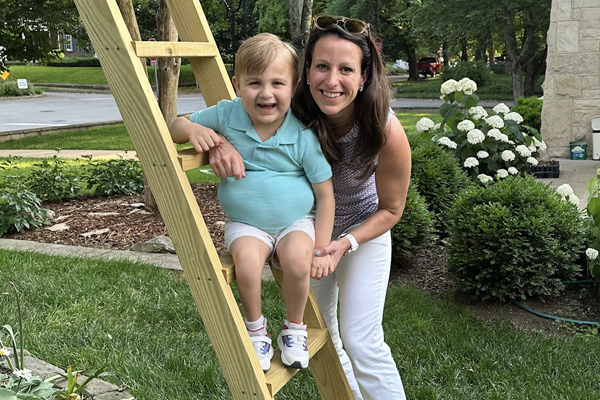
 Everett Drewes enjoys a sunny day with his mother, Margaret, after returning home following a second lifesaving kidney transplant.

Years ago, a running buddy of Matthew Drewes explained what she did for a living — as an associate professor of Surgery, end-stage kidney disease and transplantation were her areas of expertise.
Drewes recalls that at that moment, he knew he needed to check the box on his driver’s license to record his decision to become an organ donor.
On June 19, 2020, Everett Drewes was born with a rare condition called Eagle-Barrett syndrome, characterized by underdeveloped abdominal muscles and abnormalities in the urinary tract system that lead to kidney complications. Before he was born, doctors anticipated that he would need a kidney transplant.
The importance of Matthew Drewes’ check mark on his driver’s license became tangible when Everett, who was 3, received a kidney from his father at Monroe Carell Jr. Children’s Hospital at Vanderbilt. Unfortunately, it failed a few days later. In the process of trying to save the kidney, Everett suffered heart damage, making him ineligible for the kidney transplant waitlist. He was placed on dialysis, and the family waited for his heart to heal.
This time, when Everett joined the kidney transplant list, so did his mom, Margaret Drewes.
While she was not a suitable match for her son, she agreed to participate in what is known as a paired kidney exchange where a series of incompatible living donor-recipient pairs are connected, allowing recipients to receive a compatible kidney from an altruistic donor.
On April 9, Everett received a second lifesaving kidney transplant at Monroe Carell.
Today, the family is looking forward to a future that includes a better quality of life for their only child.
It’s the first time in his life that Everett has a fully functioning kidney.
“We want him to live a long, healthy and happy life,” said Margaret Drewes. “It’s what is foremost for us. We want it to be as normal as possible. It seems like such a simple wish. It’s been absolutely amazing to see him thrive, posttransplant.”
The Dreweses believe their positive outcome is a possibility for thousands more waiting for a kidney, if only more people were aware of the process and the need.
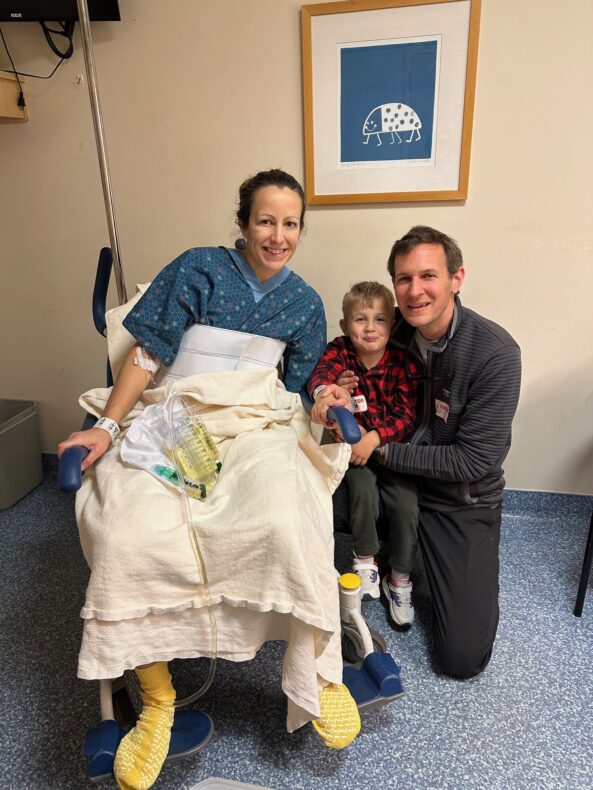
“Unfortunately, there is a large number of people who will die waiting on a transplant,” said Matthew Drewes. “It doesn’t have to be that way. It’s why education and raising awareness are so important. We haven’t figured out how to educate people about the benefits of donating, especially when it comes to living donations. If people understood it more, more people would donate, and more lives would be saved.”
According to the United Network for Organ Sharing, there are 105,792 people in the United States who need a lifesaving organ transplant (as of July 14). In 2024, more than 7,000 living donor transplants were performed in the U.S., with the majority being kidneys. An increasing number of people are also donating a segment of their livers.
According to United Network for Organ Sharing (UNOS) there are 105,792 people needing a lifesaving organ transplant (as of July 14). In 2024, more than 7,000 living donor transplants were performed in the United States, with the majority being kidneys. An increasing number of people are also donating a segment of their livers.
Monroe Carell is among an elite group of pediatric hospitals offering heart, liver, kidney, pancreas, lung and dual organ transplants. The transplant teams offer innovative options to allow more children, including high-risk patients, to be considered for life-saving procedures. The pediatric solid organ program is a part of the Vanderbilt Transplant Center (VTC) one of the nation’s busiest transplant centers by volume.
The VTC performed a record number of solid organ transplants in fiscal year 2025 — 918 lifesaving procedures among its adult and pediatric programs. The adult program performed a record 859 transplants, and the pediatric program completed a record 59 transplants during the fiscal year, which ran from July 2024 until the end of June 2025.
In fiscal year 2025, pediatric transplant teams at Monroe Carell performed a record 22 kidney transplants in addition to 21 liver transplants and 15 heart transplants. Monroe Carell also performed the state’s first-ever pediatric liver-pancreas transplant in 2025.
Monroe Carell firsts for pediatric solid organ transplantation are:
1963: Kidney transplant
1987: Heart transplant
1979: Living donor kidney transplant
1989: Neonatal heart transplant
1991: Single lung transplant
1991: Liver transplant
2000: Triple organ transplant of heart, lung and liver
2016: Dual heart-kidney transplant
2021: Dual kidney-liver transplant
2024: Living donor liver transplant
2025: Dual liver-pancreas transplant
Living donations, which began because of the increasing shortage of deceased donor organs, are another option offered at Monroe Carell. These include directed donation, which allows a living donor to give an organ to a specific person; nondirected donation, which is based on medical compatibility with a patient on the national transplant waiting list; and paired kidney exchange, involving multiple kidney donors and recipients.
Living donation gives the recipient the opportunity to receive an organ sooner. People on the transplant list often wait months to years to receive an organ from a deceased donor.
“The value of living donation is immeasurable,” said Saeed Mohammad, MD, associate professor of Pediatrics and director of the Pediatric Solid Organ Transplant Center at Monroe Carell. “We see better outcomes with longer graft survival rates. We are often able to transplant a patient sooner and get the patient off dialysis sooner, which is always a win.”
At least 13 people die every day waiting for an organ transplant, while every eight minutes another person is added to the national transplant waiting list, according to statistics from the Organ Procurement and Transplantation Network. One donor has the potential to save eight lives.
The breakdown for Monroe Carell waiting lists for each organ, as of July 13:
- Kidney, 17
- Heart, seven with more under evaluation
- Liver, nine, with more under evaluation
- Kidney/liver, one
“Our highly experienced teams will continue to strive to be leaders in organ transplantation, all while broadening the access to care for our region,” said Mohammad. “As a growing program experiencing increased patient volumes, we plan to expand the innovative services we provide to children with end-stage organ disease treated with solid organ transplantation.
“We have a deep bench of expertise, a robust relationship within VTC and work very closely with our adult experts while developing our comprehensive pediatric-focused program,” he added.
It is that expertise in novel therapies that Christina Huff found most comforting as she considered transplantation for her 15-year-old daughter, Jordyn Williams, who was born with cystic fibrosis (CF), a chronic, inherited disease that damages the lungs, other organs and the digestive tract, which includes the pancreas and liver.
Huff was told early on that Jordyn would need a transplant. It became more evident after multiple, two-week hospitalizations for repeated lung infections. Infections and hospitalizations are common for CF patients due to the thick, sticky mucus characteristic of the disease that clogs the airways where bacteria colonize, leading to complications.
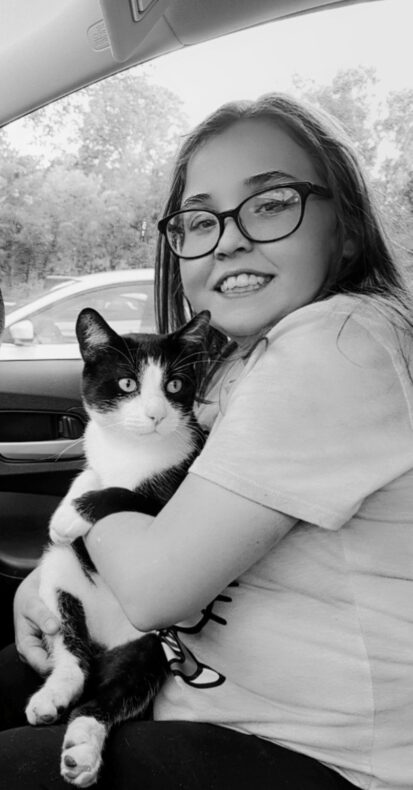
On May 2, Jordyn became the first patient to receive a pancreas and liver transplant at Monroe Carell. The milestone dual organ transplant opens the door for more pediatric patients to receive lifesaving care and bolsters the options for those with complex medical needs to get the best chance of a normal life.
Jordyn is doing well and has returned home to Lebanon, Tennessee, where she will be a 10th grader at Watertown High School.
“That’s a big win,” said Huff. “I can tell that she is feeling better and that there is a difference since the transplant. My biggest clue? She has more energy and wants me to take her out more. Before, she didn’t want to go anywhere and would stay in her room.”
Huff admits the prospect of her daughter having the first such transplant was a bit unnerving, but she found solace in the family’s long-standing relationship with the Monroe Carell team.
“When they first brought it up, I really had to think about whether I wanted her to be ‘the first,’” said Huff. “It was really scary. But we talked about all the benefits and had a good understanding. I was confident in all the doctors on her medical team. We have been with them her entire life, and that makes a huge difference.”
Huff, who is incredibly grateful that her daughter will have a better quality of life, recognizes it came at a heart-wrenching cost to another family.
“It makes me emotional to think about it,” said Huff, choking up. “Probably the biggest thing outside of being grateful for the transplant itself — is that there are people who are organ donors.
“None of this would be possible without those people. It’s hard to compartmentalize that someone’s loss became our great gain.”
The Dreweses did not have that part of the transplant process to ponder and have focused on the incredible experience of helping save another life. In their particular situation, several people were impacted.
Donating a kidney is a major surgery, requiring a four-to-six-week recovery. The success rate of a parent to child donation is very high.
“We didn’t expect anything to go wrong, so when it did it was devastating,” said Margaret Drewes. “Matthew had given this incredible gift, and it didn’t last for very long. We were hesitant at first for the next donation.”
The second time around, the couple didn’t widely share that Margaret Drewes was donating a kidney so that her son could receive a lifesaving organ.
The family recently celebrated Everett’s 5th birthday, and he’s begun kindergarten.
“We are entering a new phase,” said Margaret Drewes. “He’s really enjoying his new kidney. We’ve heard the average for kidneys is 15-20 years. We’re looking forward to that.”