Izumi Kaji Archive — Page 1 of 1

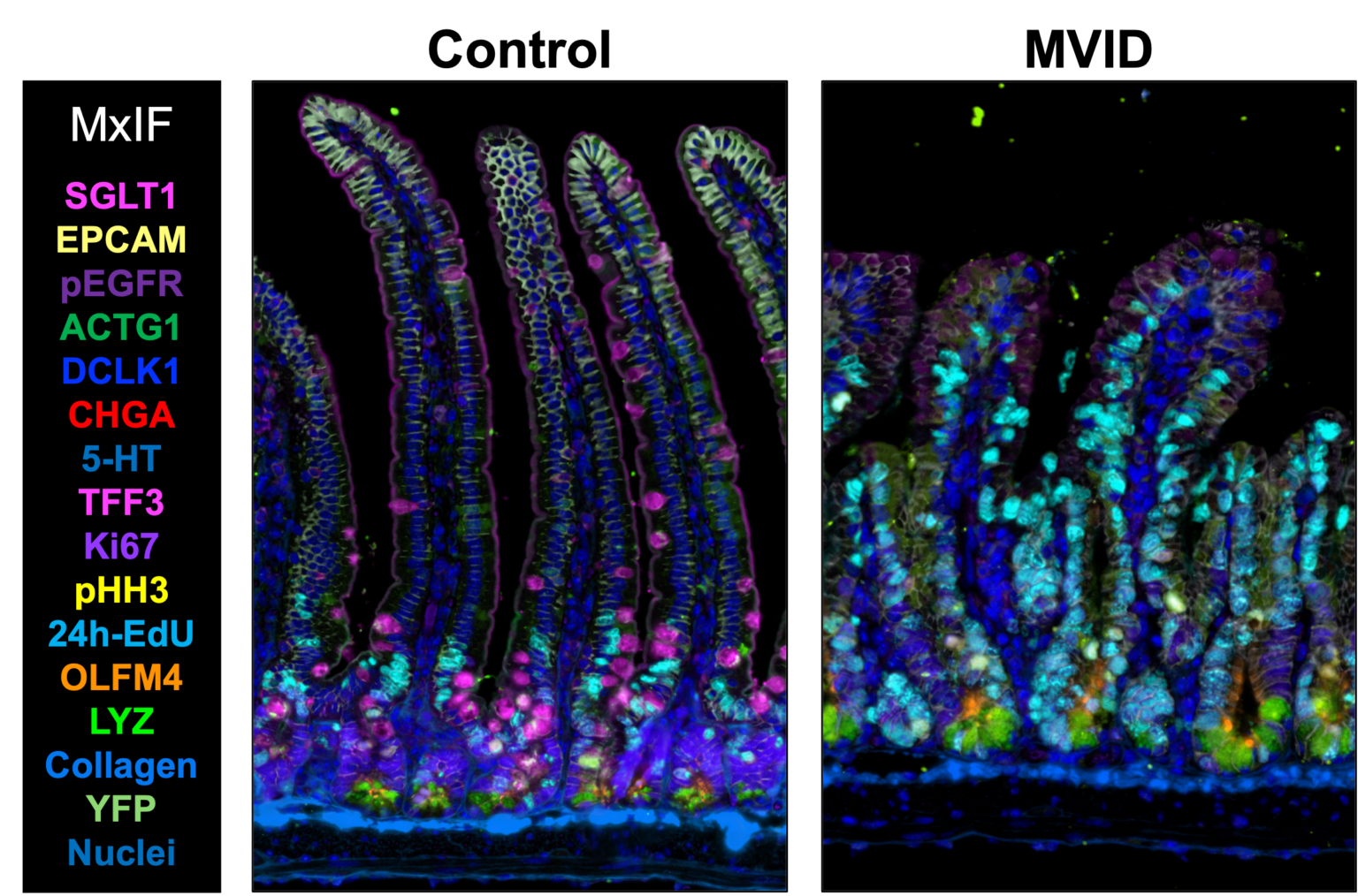
Multiplex immunofluorescence comparison of mouse small-intestinal tissue, showing elongated villi in the left panel and shorter, irregular villi with denser fluorescent labeling in the right panel. A color legend lists markers including SGLT1, EPCAM, PEGFR, ACTG1, DCLK1, CHGA, 5-HT, TFF3, Ki67, pHH3, 24h-EdU, OLFM4, LY Z, Collagen, YFP, and Nuclei.
March 18, 2026

Motor protein plays key role in intestinal stem cell identity, function

Study findings suggest a new therapeutic approach for a rare digestive disorder, microvillus inclusion disease.

Sleeping newborn baby lying on their side on a bed, with one arm bent near the face and soft natural light falling across the scene.
April 4, 2025

Study details genetic architecture of congenital diarrheal disorders in infants

The findings represent a significant advance toward development of more effective, targeted therapies for congenital diarrhea and enteropathies

Izumi Kaji, PhD, and James Goldenring, MD, PhD, were among eight researchers from Vanderbilt University Medical Center honored last week by the American Physiological Society.
April 27, 2023

Researchers honored at American Physiology Summit

Three faculty members and five postdoctoral fellows at Vanderbilt University Medical Center received research honors last week from the American Physiological Society during its 2023 American Physiology Summit.

Close-up 3D rendering of densely packed pink, rounded finger-like biological structures, with larger forms in the foreground and smaller ones receding into the background.
February 2, 2023

Nutrient absorption disease model

Vanderbilt researchers developed a model of a patient-specific mutation to explore the pathology of microvillus inclusion disease, a genetic disorder that causes life-threatening diarrhea.

3D histological illustration of a row of tall columnar epithelial cells, with elongated nuclei and a brush-like apical surface above a purple underlying layer.
August 5, 2021

Motor protein linked to intestinal cell differentiation

The motor protein MYO5B, a cause of the congenital intestinal disorder microvillus inclusion disease, does more than move cellular cargo, Vanderbilt researchers have discovered.