Vanderbilt Institute for Surgery and Engineering (VISE)

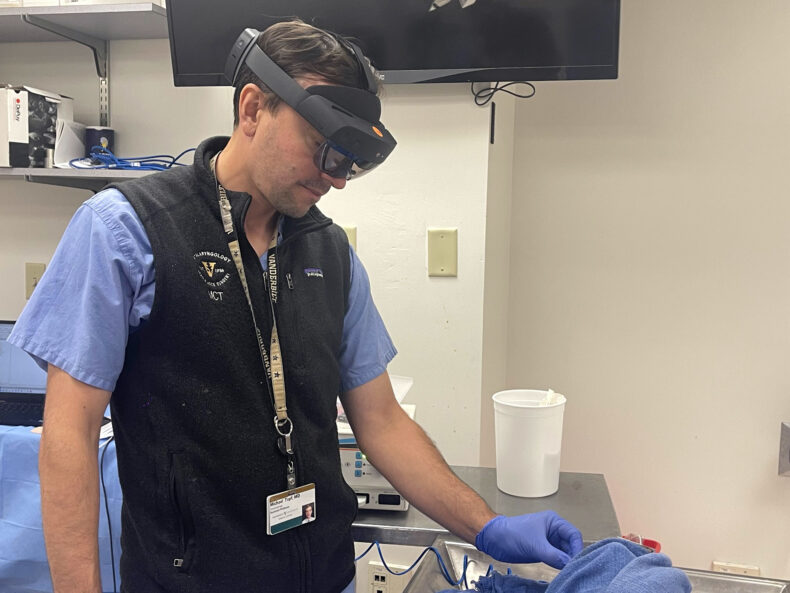
Michael Topf, MD, wears a model of a new head-mounted augmented reality system that can guide surgeons during operations to excise head and neck cancer.

Grant supports development of head-mounted augmented reality system to guide tumor resection 

The technology will allow surgeons to rely less on a fallible mental construction of the resection plane, thereby reducing the risk of human error affecting the procedure. 

New NIH grant funds novel brain network approach to improve epilepsy surgery

Investigators received a $3.2 million grant to develop novel brain network-based measures to guide surgical decisions and improve outcomes in the field of epilepsy surgery. The project builds upon work recently published by VUMC investigators in the journal Brain.

The research team includes, left to right, Bruno Scaglioni, PhD; Keith Obstein MD, MPH; James Martin, PhD; Claire Landewee, BS; Simone Calò, PhD; and Pietro Valdastri, PhD. (hoto by Susan Urmy)

VISE-affiliated researchers conduct phase 1 trial of novel magnetic endoscope for colonoscopies

A Vanderbilt research team is conducting the first phase 1 clinical trial of a magnetic, flexible endoscope that has the potential to provide a safer alternative to standard colonoscopy, particularly for individuals with inflammatory bowel disease.

A Vanderbilt Institute for Surgery and Engineering team working to create a navigational system to decrease stone fragments left behind after surgery includes Nicholas Kavoussi, MD, left, Ipek Oguz, PhD, and Daiwei Lu. (photo by Susan Urmy)

VISE team works to develop 3D navigation system to better treat kidney stones

A multidisciplinary team at Vanderbilt is working to create a real-time navigational system to decrease residual stone fragments left behind after kidney stone surgery. 

Benoit Dawant, PhD, left, Erik Tkaczyk, MD, PhD, and colleagues have developed a new way to measure human monkeypox severity.

Vanderbilt study uses AI to speed mpox drug trials

A machine learning algorithm developed by researchers at Vanderbilt performs as well as humans at identifying skin lesions in clinical photographs of people with monkeypox.

Collaborative project from VU and VUMC improves intubation box safety for COVID-19 caregivers

As hospital and health care staff across the country continue learning more about the transmission and spread of COVID-19, caregivers for coronavirus patients continue adapting to the changing needs and best practices for personal protective equipment (PPE).

1 2