


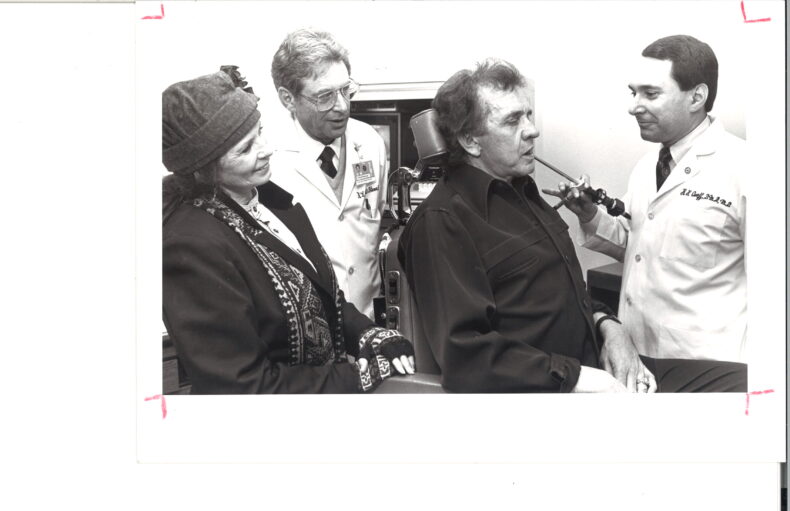




In 1991, Johnny Cash was playing a series of shows at The Mirage in Las Vegas. Every night the crowds would file in and the Man in Black would deliver the hits. “I Walk the Line,” “Folsom Prison Blues,” “Ring of Fire,” “Sunday Mornin’ Comin’ Down,” and many more. Before the show was over, he would be on stage more than two hours and sing about 30 songs — while also telling stories, bantering with the crowd and introducing the band. Every night.
That vocal workload, combined with the desert air, was taking its toll.
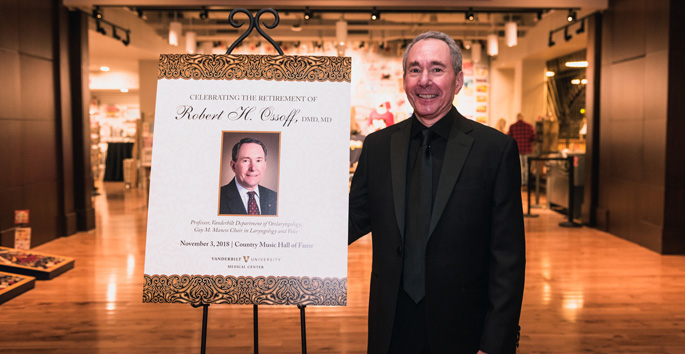
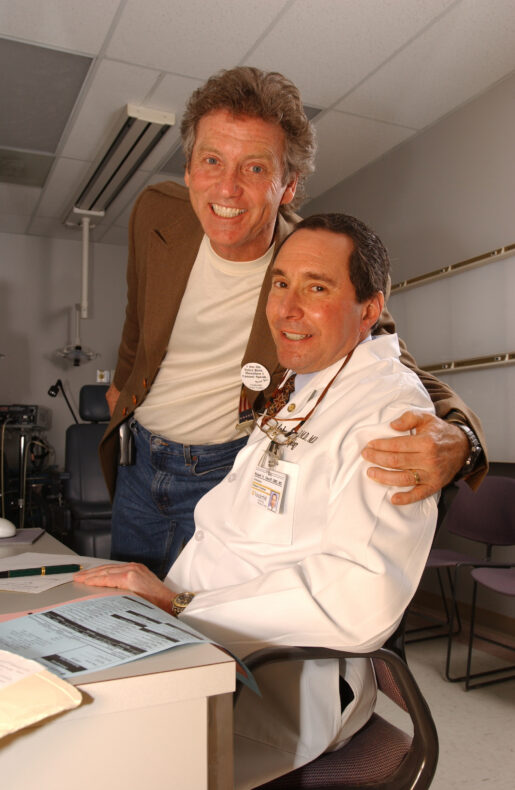
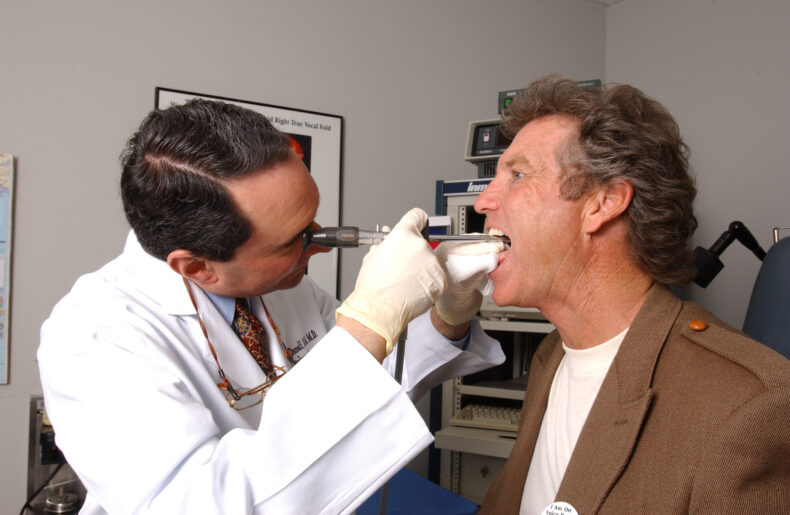
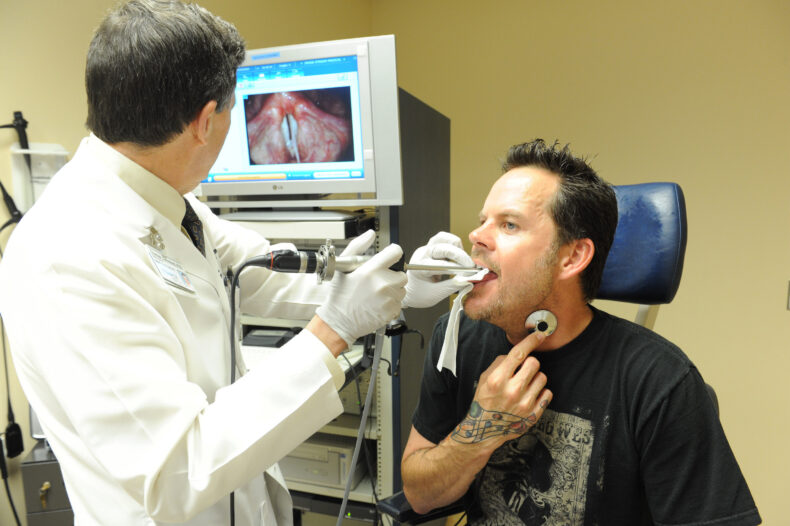
Cash brought the problem to Robert Ossoff, DMD, MD, at that time the chair of the Department of Otolaryngology and director of the Vanderbilt Voice Center.
“Johnny told me how Vegas always killed his voice,” Ossoff, who retired in 2018 after a 32-year career at Vanderbilt, recently recalled. They went over the strategies: a humidifier in the hotel room, drinking plenty of water all day, including on stage.
It didn’t seem to be enough. If only there was a way to raise the humidity on stage, especially in front of Cash as he sang.
That’s how the “mist mic” came about. Using Ossoff’s concept, Cash’s road crew figured out how to set up a humidifier just off stage, and connect tubing to the microphone so that a gentle mist would envelop the onstage air.
“Apparently it worked,” Ossoff said. Soon he was hearing from other performers who wanted to know how they could also get a mist mic.
“I would direct them to Johnny’s road crew,” Ossoff said.
Shortly afterward, in an interview in People magazine, Cash repeated a statement he had made before: “Ossoff is the man I trust with my voice more than anyone in the world.”
This was pretty heady stuff for the (at that time) new Vanderbilt Voice Center, but it exemplified the kind of comprehensive care that the center is about.

The bridge between Vanderbilt University Medical Center and Music Row
“We often speak about medicine and music being Nashville’s two greatest industries. Dr. Ossoff was among the first to recognize this connection, helping VUMC build bridges and forge new relationships with our entertainment industry colleagues through the now legendary Voice Center,” Jeff Balser, MD, PhD, President and Chief Executive Officer for VUMC and Dean of the Vanderbilt University School of Medicine, said in honoring Ossoff upon his retirement.

Since its opening, the Vanderbilt Voice Center has assisted many Nashville musicians and singers, including many well-known names — including Minnie Pearl, Kathy Mattea, Patty Loveless, Emmylou Harris, Trisha Yearwood, Martina McBride, Ronnie Dunn, Pam Tillis, Wynonna Judd, Gary Allan and Gretchen Wilson. But that’s not all.
Other patients have included a former U.S. president, national news broadcasters, opera singers, stars of Broadway musicals, radio and television personalities, and other patients whose voices are their livelihood, including teachers, attorneys and ministers.
The doctor who told Willie Nelson he wasn’t Superman
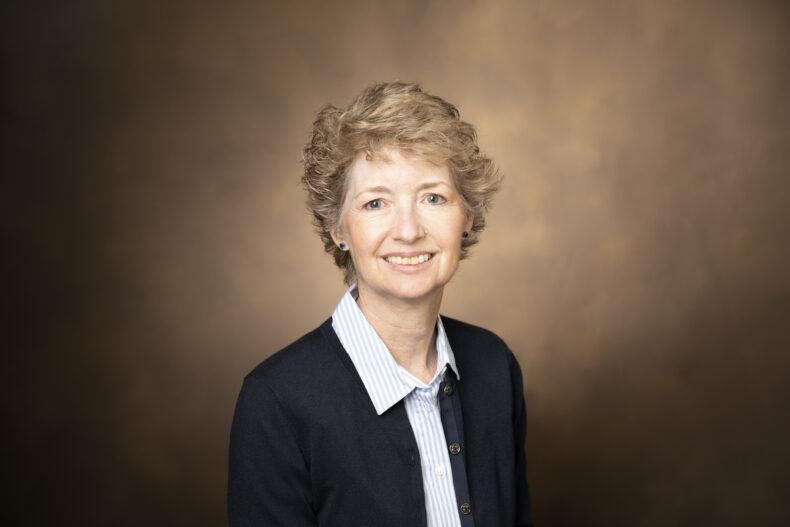
The center’s current director, Gaelyn Garrett MD, MMHC, once examined Willie Nelson and told him he needed to take it easy on his voice because he wasn’t Superman.
Naturally, being Willie Nelson, he wrote the doctor’s advice into a song, called “Superman”:
🎶 Well I blew my throat and I blew my tour I wound up sippin’ on soup d’jour
I wasn’t Superman…Try to do more than I can…I wasn’t Superman
Well the doctor said son it’s a cryin’ shame But you ain’t Clark Kent and I ain’t Lois Lane 🎶
Garrett came to Vanderbilt in 1994 in one of the early cohorts of fellows at the center.
When her fellowship was over she had intended to move back to her native North Carolina, but she found there was nowhere she’s rather be than at the Voice Center.
“Never in my wildest dreams did I think I’d be living in Nashville for 30-plus years,” she said. “But when I saw what we had here, I thought, ‘This is incredible.’
The same fellowship program that brought Garrett to Vanderbilt years ago continues to educate young laryngologists (a surgeon who also deals with non-surgical voice issues), and has seeded programs in that voice specialty all over the U.S. Specialists trained at the Vanderbilt Voice Center are in major music centers such as Los Angeles, New York, Boston and Austin – but also in many smaller cities and communities.
“Every place needs a laryngologist,” she said, noting that, for example, that voice problems are one of the main reasons teachers miss work.
Ever-evolving voice demands across many industries
While state-of-the-art treatments, including laser surgery, and available for treatment of voice problems (singer Larry Gatlin, an early patient of the Voice Center, allowed his vocal surgery to be broadcast as part of a report on ABC’s “Good Morning, America”), training singers and other patients in using their voices without harm is a major focus.
Since its beginning, the Voice Center has focused on voice training and problem prevention.
“We don’t like crisis management,” Garrett noted.

Looking back to early days of the Voice Center, Ossoff gave special credit to two voice specialists, Edward Stone, PhD, a speech pathologist with an uncanny ability to connect with singers, and Thomas F. Cleveland, PhD, professor of Otolaryngology-Head and Neck Surgery, emeritus, who came to Vanderbilt in 1991 to establish and direct a therapeutic program of voice intervention for singing voice problems, the first real program of its kind in the United States.
Cleveland was notable at VUMC as likely the only faculty member with a baby grand piano in his office, the better to work with his patients.
As the Voice Center was getting started, Cleveland and Ossoff would often speak with music industry groups and over time, some record labels would even arrange for young singers to come to the center for coaching about vocal techniques in order to prevent problems.
That focus on training and prevention continues; the current Voice Center lineup includes four full-time laryngologists and eight speech pathologists who are voice specialists.
The bridge between the Vanderbilt Voice Center and Nashvillians of all professions is a solid one at this point. Teachers, preachers, call-center workers and stars of the Grand Ole Opry all make their way to its doors.
“It’s ever-evolving,” Garrett said. “Voice demands are really high across many fields.”

