


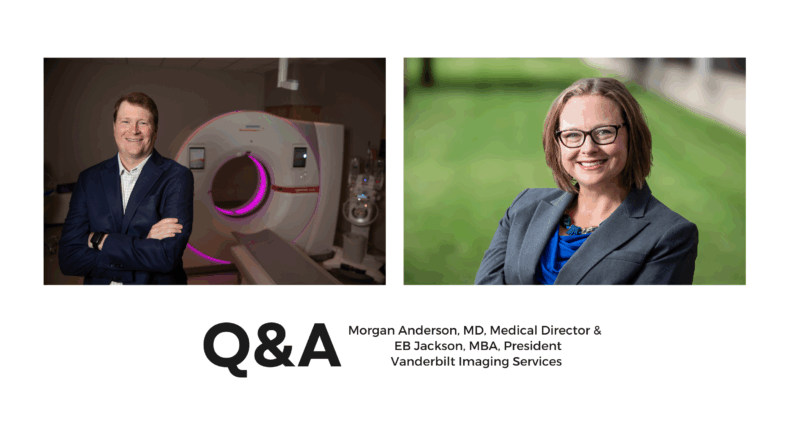
 Morgan Anderson, MD, left, and EB Jackson, MBA (photos by Susan Urmy and Erin O. Smith)




How does Vanderbilt Imaging Services benefit Nashville and the communities you serve?
EB Jackson: Through Vanderbilt Imaging Services, VUMC is making an intentional effort to create imaging capacity outside the hospital setting, which benefits the community in several important ways.
First, Vanderbilt Imaging Services offers freestanding locations with adjacent flat-lot parking, friendly, experienced staff and same-day access with insurance support. As a system, Vanderbilt Health has tremendous hospital demand — we know that the emergency department is overcrowded, but even aside from that, a great deal of outpatient imaging happens within the hospital, because many clinics are located on the physical Main Campus in Nashville. Choosing a Vanderbilt Imaging Services location allows patients to avoid the complex logistics of Main Campus while saving the hospital spaces for hospital patients.
We’re also providing a lower-cost option. With designation as a “nonhospital-based location,” the cost for most patients is significantly lower. As a matter of fact, insurance companies are increasingly directing patients to seek centers like ours because of our billing status.

Morgan Anderson: VUMC, being an academic medical center, essentially serves people within a 200-mile radius around Nashville. We’re receiving patients with very specialized care needs and rare diseases. We’re leading in cancer research and transplants — we’re very subspecialized in our medical center.
Having these outpatient imaging centers along the margins of Greater Nashville, as well as quite close to Main Campus, allows Vanderbilt Health to image many patients away from Main Campus, creating ease for the patient. It’s much more convenient.
A big focus for us is screening. Take mammograms, for example. Historically, the only place to get screened several years ago was on the Vanderbilt University Medical Center campus on 21st Avenue.
Now patients can even self-schedule a mammogram in My Health at Vanderbilt at four VIS locations, as well as VUMC’s Regional Hospitals and other Vanderbilt Health locations in surrounding locations. Vanderbilt Imaging Services has expanded access to diagnostic mammography, breast ultrasound and breast MRI for patients whose screening exams indicate the need for follow-up imaging. Many of our patients don’t reside in Davidson County, so these imaging centers along the outskirts help with their transportation and commute to receive the care they need. This helps with congestion and patient convenience, and boosts access to an important screening tool.
How does VIS fit into the growth of the health system?
EB Jackson: Vanderbilt Health’s growth objectives and the services going into the new Jim Ayers Tower connect to what Morgan was describing about screenings.
Upstream of those really intensive inpatient surgeries and intensive care, there’s imaging at every step. There’s imaging between your primary care physician and a specialist, between the specialist and surgery, and between surgery and your follow-up care. At every step in the care continuum, there’s likely going to be imaging of some kind to help understand the problem and the response to treatment — whether things are working.
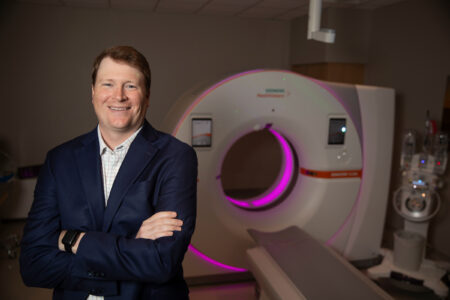
When we consider how we’re going to grow and what equipment we’re investing in, we stay in lockstep alignment with the system’s growth plans and objectives. For example, we’re thinking together about coronary artery CT. We’re planning our next CT machine upgrades to ensure we can accommodate those studies, which would be upstream of a lot of the cardiac growth that the system is anticipating given demographics in the region.
Morgan Anderson: Coronary artery CT is another example of a screening-type study. As EB mentioned, screening will continue to grow, and it’s much more convenient for patients to have these scans done at our outpatient locations rather than having to go to the Main Campus and get caught in the congestion there.
EB Jackson: One final thought around convenience for patients and ordering providers. Vanderbilt Health providers can order studies directly through Epic (the electronic health records system), and community providers can use Vanderbilt Health Connect, which provides free access to Epic including ordering, results and patient charts for appropriate providers and team members. Community providers may also fax orders. One phone call to 615-936-3606 puts you in touch with schedulers and folks who can help with insurance pre-certification, even for same-day needs!


