


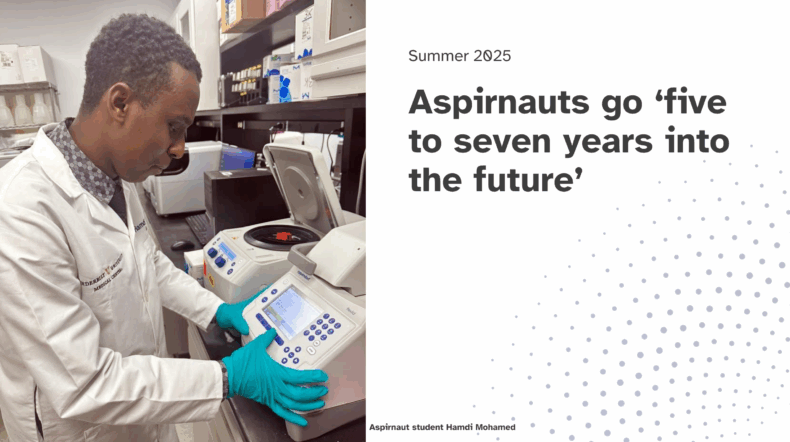
 Aspirnaut student Hamdi Mohamed




For six weeks this summer, high school students from throughout the southern and eastern United States donned white lab coats in Vanderbilt University Medical Center laboratories to discover something new.
They were part of the Aspirnaut program, which prepares high school and college students, primarily from rural areas, for careers in the STEM fields — science, technology, engineering and mathematics.
Established in 2006, Aspirnaut has an impressive track record. Of the 380 students who have tasted its summer offerings of discovery science, professional skills development, and self-discovery, nearly 80% are pursuing an advanced STEM degree program or have joined the STEM workforce.
Part of Aspirnaut’s “secret sauce,” according to Billy Hudson, PhD, who co-founded the program with his wife, Julie Hudson, MD, MA, is that it gives students a “glimpse” into their future.
On July 11, at the conclusion of this summer’s program, 17 high school students presented their research projects during a formal scientific symposium. But while their well-practiced talks adhered to the decorum of the occasion, the mood was celebratory, even joyful.
“This program is life changing!” proclaimed 16-year-old Precious McGee, a rising high school junior from Marks, Mississippi (population fewer than 1,500).
Aspirnaut “solidified my love for the research field,” said the ebullient young woman, who wants to be a pediatric oncologist. “It made me feel my future.”
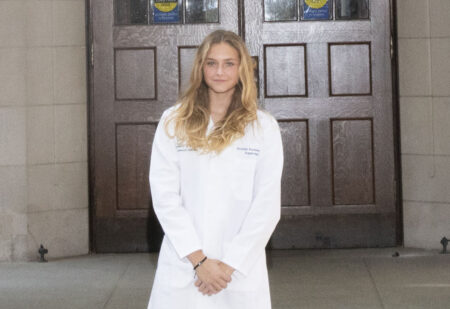
“I really loved the lab work,” agreed 17-year-old Scarlett Hale, a rising junior from Crockett, Virginia (population about 1,000). Hale wants to go to medical school. “My passion is to help people who don’t have the opportunity to help themselves,” she said.
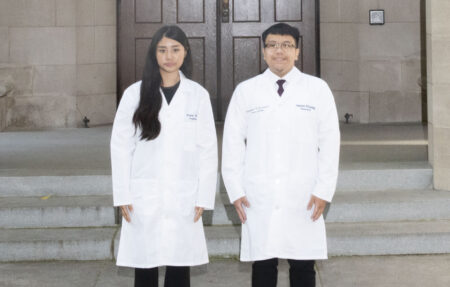
Jason Khang, a native of St. Paul, Minnesota, is a member of the indigenous Hmong community from East and Southeast Asia. His father was among 30,000 Hmong refugees displaced by the Vietnam War who immigrated to the United States.
This summer, Khang, 17, a rising senior who is interested in computer engineering, studied how artificial intelligence can be applied to diagnostic imaging in the kidney. The potential of AI to improve disease detection is “really cool,” he said.
Hamdi Mohamed is a rising senior from Lewiston, Maine. His project, which concerned the genetics of bladder cancer, inspired him to want to open his own lab one day, perhaps focusing on cancer biology.
What was the best part of Aspirnaut?
“Getting your hands dirty in the lab. Seeing the fruits of your labor come true. It was,” Mohamed said, “the most satisfying thing I’ve done in my life.”
Aspirnaut would not exist were it not for the vision and commitment of its founders, Julie Hudson, VUMC’s Vice President for Medical Center Relations and the program’s executive director, and Billy Hudson, the Elliott V. Newman Professor of Medicine at VUMC and the program’s scientific director.
That commitment extends to Aspirnaut’s dedicated administrators and to the dozens of faculty members, research staff and graduate students in several departments of the Vanderbilt University School of Medicine who volunteered their time and mentorship to guide the students through their projects — and along their career paths.
It also extends to the substantial support provided over the years by the National Institutes of Health and by the program’s many academic, philanthropic and industry partners.
In March, Chafen Lu, PhD, and the Springer-Lu Family Foundation of Chestnut Hill, Massachusetts, gifted $5 million to establish an endowment to support the high schoolers, now called the Lu-Springer High School Research Scholars.
In introducing the oral presentations, Billy Hudson reminded the students of his pledge “to take you five to seven years into the future.”
“This was a gift,” he said. “The gift was a set of experiences … For many of you, this is the first time to give a scientific presentation … Give it your best … Know that you’re doing this for yourself.”
By emphasizing self-discovery skills, including wellness coaching, career mapping, and thriving psychologically, Aspirnaut models both the technique of science and its underlying humanity.
“This program was definitely the highlight of my life,” said Arman Sadri, 17, a rising senior from Titusville, Florida, east of Orlando, who aspires to a career in radiation oncology.
“(It) really values that fact that we all come from a different place,” Sadri said, “and we need to make sure that all of us are heard.”
For who knows where the next biomedical science breakthrough will come from?


