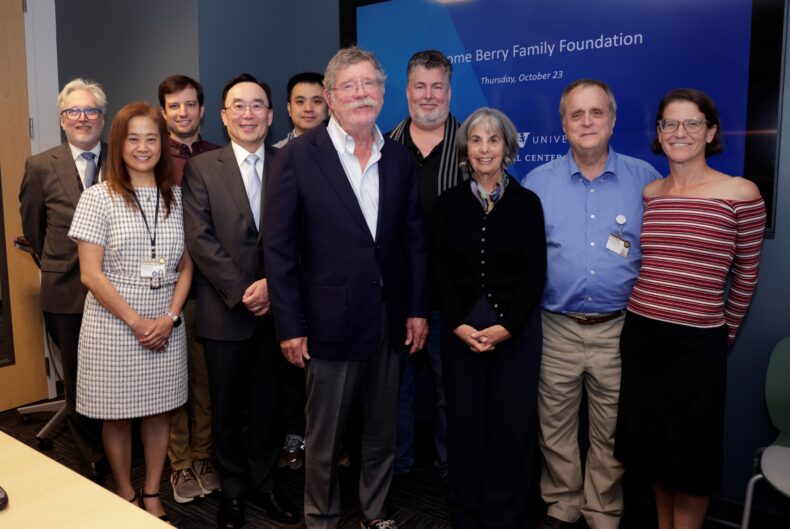
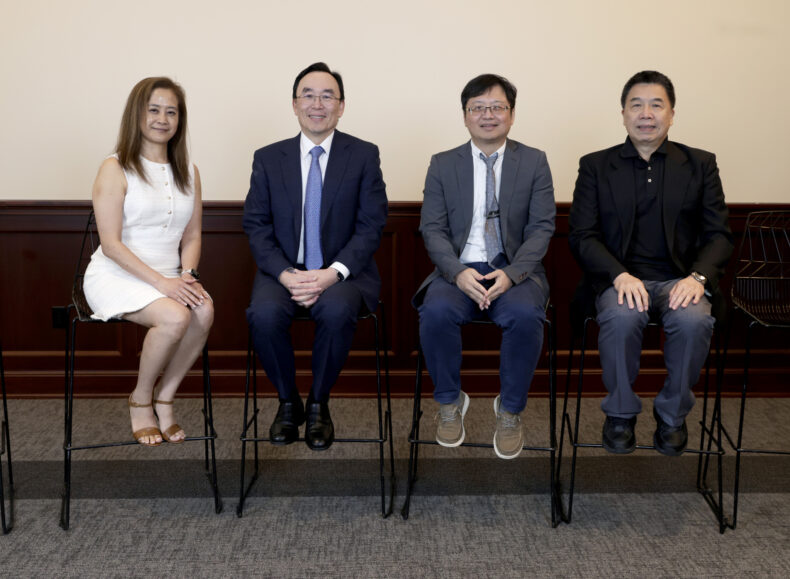
 Among those at the symposium were, from left, Janey Wang, MS, MEng, Yu Shyr, PhD, Hsin-Chou Yang, PhD, and Chun-houh Chen PhD. (photo by Donn Jones)

On Aug. 2, statisticians from Vanderbilt University, Vanderbilt University Medical Center and three major Taiwanese research institutions — Academia Sinica, National Cheng Kung University, and National Tsing Hua University — convened at Vanderbilt’s Carmichael College for “Next-Generation Statistics: From Theory to Practice in a Data-Rich Era,” a half-day symposium.
The event was the first of an international multiyear series co-organized by Vanderbilt’s Department of Biostatistics and Academia Sinica, with plans to conduct the next symposium in Taipei, Taiwan, in 2027.
In a ceremony before the symposium, Department of Biostatistics Chair Yu Shyr, PhD, and Academia Sinica’s Institute of Statistical Science Director Hsin-Chou Wang, PhD, signed a memorandum of understanding to formalize plans for joint initiatives between their institutions.
The Taiwan-based scientists delivered presentations on multiomics modeling to better personalize cancer treatment and introduced new statistical methods to enhance analyses of lifestyle and environmental impacts on health, decrease the cost of diagnosing conditions such as Parkinson’s disease, and improve electron microscopy approaches to mapping proteins. The presenters from Vanderbilt included the following:
- Siyuan Ma, PhD, assistant professor of Biostatistics, looked at how high-quality gene clustering can boost statistical power and assist in addressing major issues in biomedical research, such as unannotated genes.
- Qi Liu, PhD, professor of Biostatistics and Biomedical Informatics, presented a robust new method, MEcell, that offers microenvironment-aware spatial modeling of cell identities.
- Bryan Shepherd, PhD, professor of Biostatistics and Biomedical Informatics, discussed his work to counter “naïve” handling of detection limits by developing cumulative probability methods that have become the gold standard in the field.
- Andrew Spieker, PhD, associate professor of Biostatistics, spoke on addressing variations in AUC (Area Under the Curve) estimates caused by idiosyncratic practices across different labs.
- Simon Vandekar, PhD, associate professor of Biostatistics, presented recommendations for improving neuroimaging study design and replicability.
- Hakmook Kang, PhD, associate professor of Biostatistics, demonstrated how the GPU (Graphics Processing Unit)-enhanced Gaussian Process developed by his team can dramatically speed up computing time (completing processes up to 240 times faster than older methods) for autism research.
The symposium’s three segments each included a lively panel of participants responding to the speakers. Throughout the morning, the speakers took special care to acknowledge the significant contributions of colleagues and trainees, including many Vanderbilt students and alumni. A detailed account of the full symposium can be viewed here.