


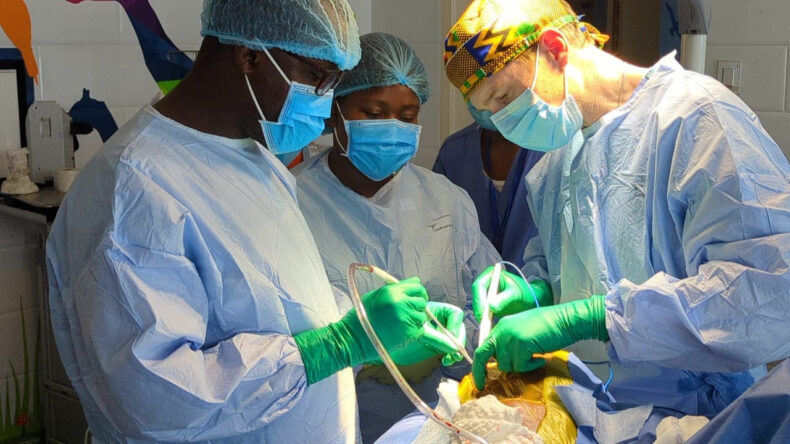
 Michael Dewan, MD, assistant professor of Neurological Surgery, works with surgeons during a procedure in Monrovia, Liberia.




Neurological surgery is among the most complicated, delicate and consequential medical subspecialties: Surgeons have spent decades honing the methodology required to treat conditions such as hydrocephalus, spina bifida and brain and spinal tumors. Still today, many low- and middle-income countries are eager to learn how to treat patients but aren’t equipped to handle a high volume of neurosurgical conditions.
Sharing information can make all the difference. Akin to the “teach someone to fish” analogy, perform an operation and a patient’s life is saved; teach a doctor a new surgical method and that doctor can save the lives of countless others.
That’s not to say that the VUMC doctors who lead the Global Neurosurgery department don’t roll up their sleeves and perform surgeries. Global Neurosurgery program co-directors Michael Dewan, MD, assistant professor of Neurological Surgery, and Christopher Bonfield, MD, associate professor of Neurological Surgery, are among the VUMC faculty who visit under-resourced countries — Tanzania, Peru and Brazil are recent examples. But as Dewan says, hands-on surgery is not the primary role of the program; it’s the education and training piece that provides the highest impact.
“I might go abroad or provide education via telecommunication to another neurosurgeon who is treating a patient in their hospital,” explained Dewan. “And so, in that sense, the education and training we offer helps in the treatment of patients, and the clinical piece is a byproduct of that.”
Much of the education and training VUMC’s program offers begins when surgeons abroad reach out to inquire about partnering to exchange knowledge and surgical techniques. According to Dewan, a hospital in Liberia reached out earlier this year in hopes of learning about the manner in which hydrocephalus is treated at a place like VUMC. A relationship began online, and some months later, the Global Neurosurgery program provided direct training to surgeons from that hospital.
“The Vanderbilt name has certainly been out there,” Dewan said of the appeal of working with VUMC. “I think it speaks to the reputation of Vanderbilt as an institution that provides high caliber health care and medical training. People want to be associated with that and be a part of that legacy.”
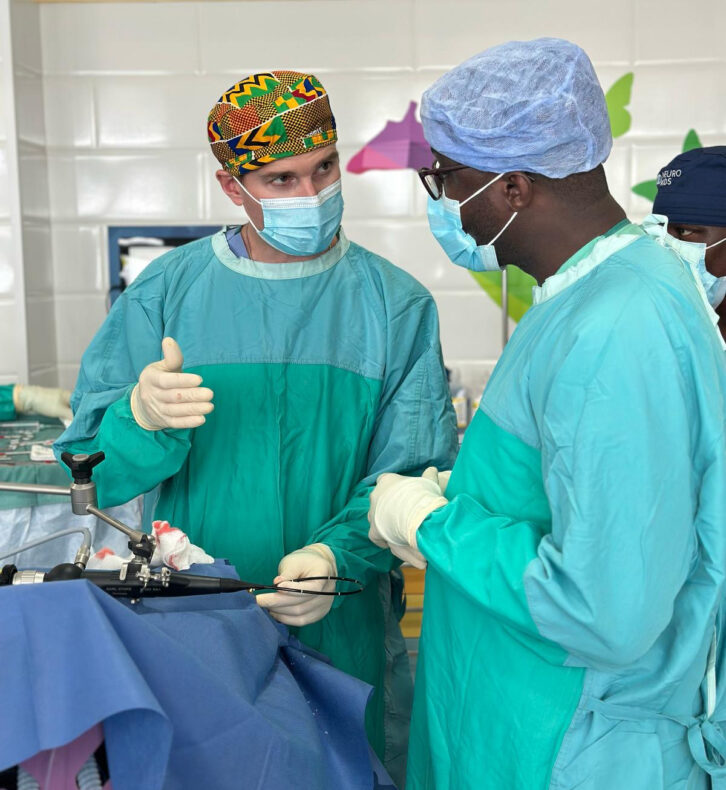
Dewan said VUMC’s partners abroad are perhaps the most integral people in the program even though they’re not VUMC faculty members. Without the partnerships they cultivate together, there wouldn’t be opportunities for research — another critical aspect of the program’s work to promote global health.
Josie Haizel-Cobbina, MBChB, MPH, program manager of Global Neurosurgery, said the history of the program’s research component dates back to the height of the pandemic, when, in light of travel limitations, much of the work was literature-based and done remotely with residents and medical students.
Some of the big-picture topics the program sought to investigate through research includes the global burden of pediatric neurosurgery, treatment of neurotrauma in low- and middle-income countries and barriers to pediatric neurosurgical-oncologic care in sub-Saharan Africa. The team adopted a mixed-method approach for the neurosurgical-oncologic project, offering a chance to get into the “why” of the data.
“When it comes to quantitative research, we all know the numbers, but when you really [ask] … ‘what is really driving these numbers?’ That is what you get from qualitative research,” said Haizel-Cobbina.
Haizel-Cobbina added that there is a great deal of emphasis put on identifying barriers to neurosurgical care and thinking about interventions that can bring that care to more people and communities. That is, at its core, a major tenet of global health, which Dewan says is often confused with international health.
“Global neurosurgery really refers to the effort to provide access to neurosurgical care to anyone and everyone, regardless of borders and backgrounds,” Dewan said.
In describing how global health applies to those around the world — including in Nashville — Haizel-Cobbina said “global is home.”
It’s easy to forget, she said, that “there are also disparities and challenges here that we need to focus on. So personally, I find it very interesting when programs … blend both sides: doing international work but at the same time focusing on what is happening in our own back yard.”
Inevitably, though, there are differences in how neurosurgical care may be handled in the United States versus elsewhere. Dewan described how a neurosurgeon might treat an infant with hydrocephalus via a shunt procedure (a common surgery that drains cerebrospinal fluid from the brain to the abdomen) in a high resourced setting, while a different type of procedure, known as an endoscopic third ventriculostomy and choroid plexus cauterization (ETV-CPC) could be in order in a low resourced setting.
While a shunt, which could get blocked or infected, spurring a neurosurgical emergency, could be easily treated in a place like Nashville — where top-level care is just down the road at VUMC — that neurosurgical emergency could be life-threatening in another setting in which the procedure needed to resolve it is a multi-day journey away.
“In those situations, patients don’t have the luxury of [immediate] treatment for an emergent shunt malfunction,” Dewan said. “An ETV-CPC is an internal diversion that places patients at much lower risk of having a post-operative emergency.”
Dewan’s own non-profit, NeuroKids, co-founded with Benjamin Warf, MD, of Boston Children’s Hospital, seeks to bring the ETV-CPC procedure to more children to improve hydrocephalus outcomes.
“We’re trying to make the ETV-CPC procedure more accessible by training neurosurgeons in the technique,” Dewan said.
VUMC neurosurgeons are also directly involved in capacity-building efforts abroad, which aim to help increase the volume of training programs and neurosurgeons, said Bonfield.
“It’s known that people who train in a country generally tend to stay there,” said Bonfield. “Unfortunately, in some regions, medical students who want to pursue neurosurgery may be required to seek training elsewhere, and in some instances they must learn a new language. This presents a major barrier to developing the neurosurgical community in their home country, but access to more neurosurgical training mentors and programs can help break down that barrier.”
Reid Thompson, MD, the William F. Meacham Professor and chair of Neurological Surgery, said he’s proud to lead a department that places a major emphasis on improving global health.
“It’s part of our mission to extend neurosurgical knowledge beyond Nashville,” said Thompson. “My dad was a scientist who took us abroad when I was kid, developing educational research programs, and that’s where I think I got it.”
Thompson added that in many cases, there are disorders or surgeries that are more common in other parts of the world, so sometimes it’s the neurosurgeons abroad who are teaching him and his colleagues.
“They’re teaching me because they do these kinds of things all the time,” said Thompson. “I’m learning from these young neurosurgeons who handle things we rarely see here.”
That exchange of information benefits everyone, and the long-term partnerships set the stage for continued research and surgical techniques to improve neurosurgical care for people of all ages across the globe.
“It’s amazing to see not only what faculty, residents and medical students are able to teach, but also what they learn,” said Haizel-Cobbina. “We see that transformative growth that we all benefit from as the years go by.”


