


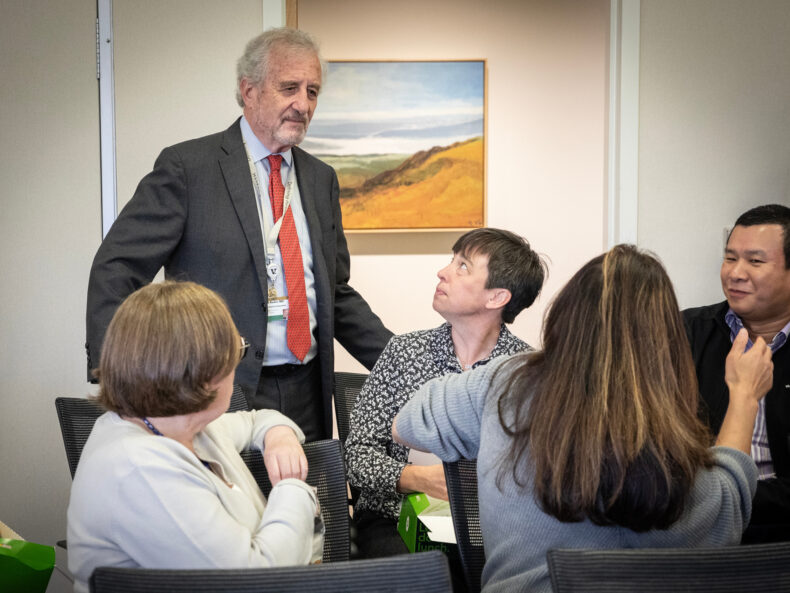
 Dan Roden, MD, chats with colleagues during a break in the symposium. (photo by Erin O. Smith)




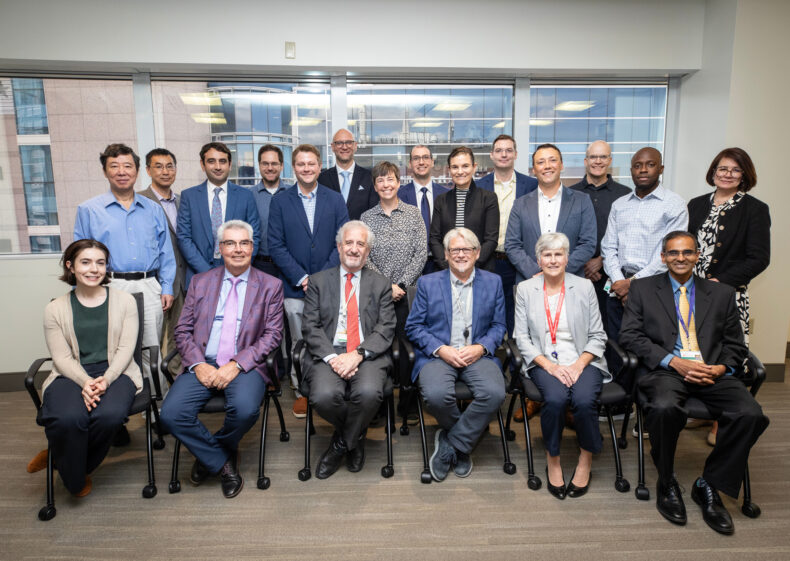
On Friday, Sept. 26, clinicians and scientists from around the world attended a symposium at Vanderbilt University Medical Center to honor the 75th birthday of Dan Roden, MD, a pioneer in personalized medicine and beloved colleague, mentor and friend.
Roden, VUMC’s Senior Vice President for Personalized Medicine, is internationally known for his contributions to understanding arrhythmias (abnormal heart rhythms) and to the field of pharmacogenomics, how genes influence the body’s response to medications.
He also imagined and helped launch a biobank of hundreds of thousands of DNA samples, linked to donors’ electronic health records, which VUMC President and CEO Jeff Balser, MD, PhD, called “a Rosetta Stone for understanding how the DNA sequence relates to health and disease.”
With more than 350,000 DNA samples, BioVU is the world’s largest repository of genetic material linked to de-identified electronic health records based at a single academic center.
A Vanderbilt faculty member since 1981, Roden has authored or co-authored more than 1,000 research papers, received hundreds of millions of dollars in grants, and trained dozens of MDs, graduate students and fellows. “This lifetime of work has not only guided academic research; it has saved countless lives,” Balser said.
Balser, who earned his MD and PhD in Pharmacology in 1990 under Roden’s mentorship, opened the daylong symposium.
Organized and hosted by VUMC’s Alexander Bick, MD, PhD, director of the Division of Genetic Medicine and Clinical Pharmacology, and his staff, the event featured brief research talks and personal reflections by 20 of Roden’s colleagues and former trainees.
“Dan’s compass has always pointed true north … on patients,” said Ellen Clayton, JD, MD, the Craig-Weaver Professor of Pediatrics and professor of Law who co-founded the Vanderbilt Center for Biomedical Ethics and Society. “It’s not just the science. It’s how the science is going to be done, and how it’s going to be used.”
Nancy Cox, PhD, an internationally known geneticist who founded the Vanderbilt Genetics Institute, emphasized Roden’s abilities as an “unbelievable communicator” and “incredible ambassador” for Vanderbilt.
Noting that Roden continues to pursue his science, Cox extended a birthday wish. “May you continue to have audacious and capacious (big tent) ideas,” she said. “May your many (academic) children have those same audacious and capacious ideas and learn to communicate them … for the good of everyone.”
Roden, in concluding the program, said, “I’ve been really, really lucky to be a witness to and an occasional participant in advances that have changed our understanding of variable drug responses … and how a broad vision of personalized medicine can be envisioned and executed.
“I really hope this progress has just begun.”


