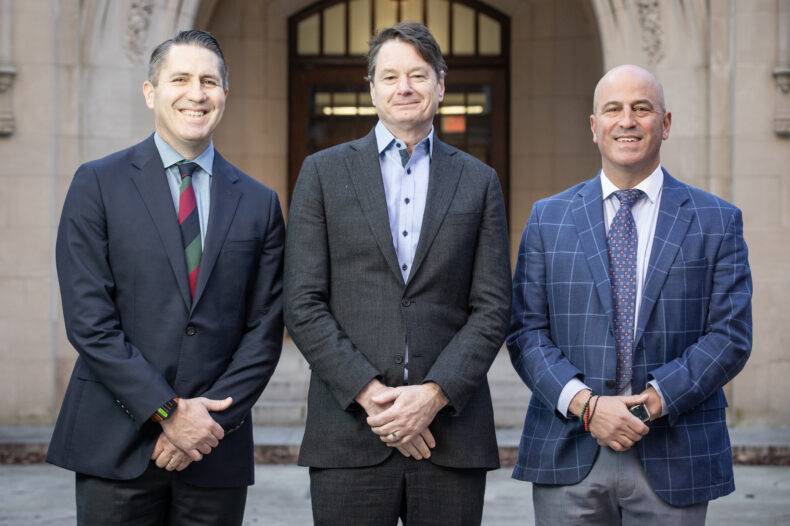
 From left are are Alexander Gelbard, MD, Eben Rosenthal, MD, and Marc L. Bennett, MD, MMHC. (photo by Erin O. Smiteh)




Vanderbilt Health’s Department of Otolaryngology-Head and Neck Surgery is known globally as being one of the best centers for ear, nose and throat, head and neck cancer, as well as for the many subspecialties that fall under its umbrella.
It’s one of three Vanderbilt Health clinical departments to rank first in the nation in National Institutes of Health research funding.
Its residency program was recently recognized by Doximity, an online professional network for U.S. physicians, as No. 1 by reputation for the fifth consecutive year, and the Otolaryngology program is currently ranked in the top 10 by U.S. News & World Report.
Department Chair Eben Rosenthal, MD, the Barry and Amy Baker Professor of Head and Neck Research, believes the department’s continuing medical education (CME) offerings have much to do with its success.
“There’s a reason we call it ‘practicing’ medicine — a doctor doesn’t arrive at a destination; rather, we all seek to continually learn as physicians, both from our patients and from our peers,” said Rosenthal. “CME isn’t just about credits. It’s about building on your knowledge and creating a network of learners who want to improve medicine for everyone.”
As the name suggests, CME is a framework in which physicians attend courses to continue learning within their fields and is required by the Accreditation Council for Continuing Medical Education (ACCME). Those courses count toward the credits physicians accumulate (as decided by their respective certifying boards) that are required to retain their licensure.
Vanderbilt Health’s Department of Otolaryngology-Head and Neck Surgery typically hosts more than 400 physician learners for approximately eight to ten courses per academic year that total roughly 70 credit hours. Some are centered on lectures, but the ideal type of course, said Rosenthal, is a panel-based discussion, which opens up dialogue and encourages question and answer interactions between peers.
In the four years since Rosenthal became chair, he’s invested a great deal of time and energy into the improvement of CME, said Meghan Franklin, program manager for Continuing Education Course Development for the department.
“Many of the topics in our courses are intangible in nature and help spark discussions about leadership, professional development or how to interact with patients,” said Franklin. “If you were going to a symposium on ear surgery, you might not think you’d have a discussion about leadership, but that gets woven in. Dr. Rosenthal really has a vision for Vanderbilt Health to be a leader in peer education. People know that you come to Vanderbilt to go to the courses you want to attend or get additional training in the areas you need.”
The numbers back that up. This summer’s Surgeon Scientist Symposium in Otolaryngology (S3O) welcomed physicians from 21 states to Nashville for lectures, workshops and panels that sought to provide early-career otolaryngologists with the tools needed to achieve success in translational research. This CME event spans institutions, as evidenced by the exchange of knowledge among physicians from all over the country.
The symposium, which is supported by a grant from the National Institute of Deafness and Communication Disorders, is directed by Aaron Moberly, MD, associate professor of Otolaryngology-Head and Neck Surgery.
The Department of Otolaryngology-Head and Neck Surgery also presents the Haynes Innovation Award to a resident from another academic institution who has developed a program or process that has the potential for breakthrough changes in the field. The competitive award is named in honor of David Haynes, MD, MMHC, professor of Otolaryngology-Head and Neck Surgery and is supported by a generous gift from Herbert Christopher, a longtime patient of Haynes.
“CME is about reaching beyond the walls of your institution to share knowledge with others and learn from the collective advancements of our field,” said Rosenthal. “We want to position Vanderbilt Health as a leader in that space. We’re all learners, and we can all be teachers, too.”