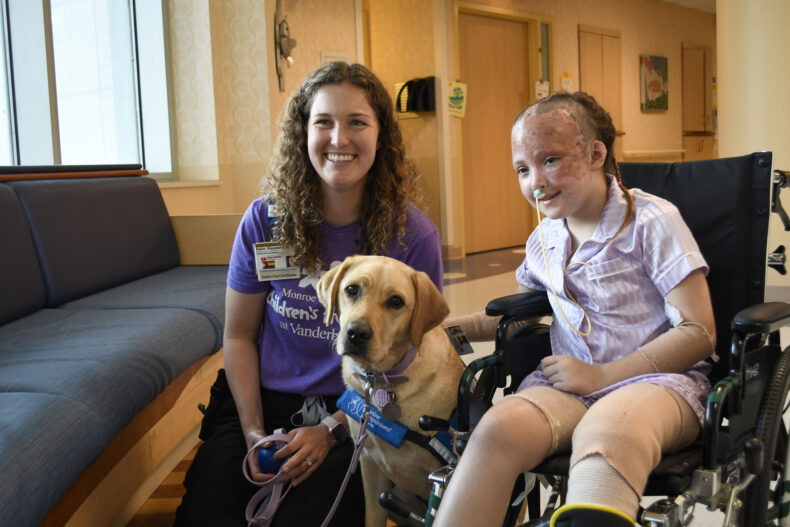
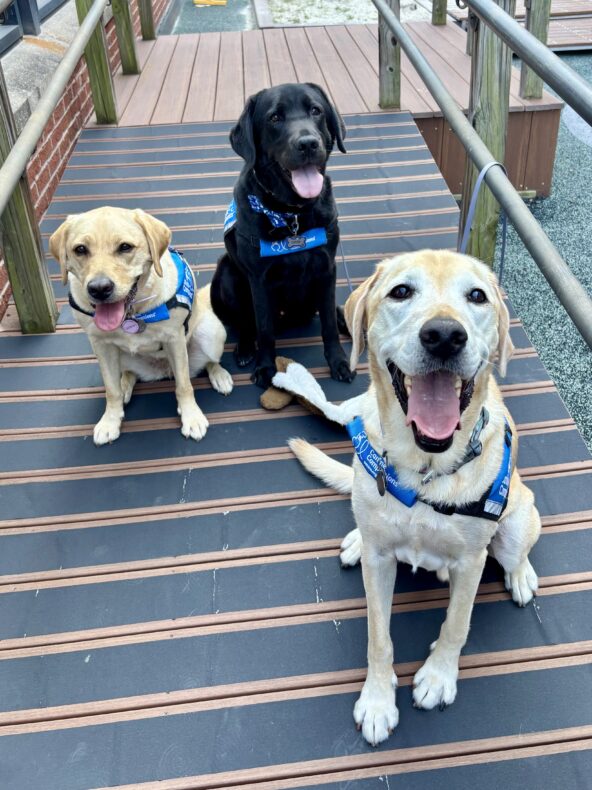
 Velour, left, Squid, back, and Norman, front right, come to work every day tails wagging. They love meeting new friends who are looking for some comfort and dog wiggles. (photo submitted by Chrissy Durrough Lugge)




The patient arrived late and frustrated, having accidentally left his medicine at home before driving across Tennessee to Vanderbilt Bill Wilkerson Center’s Pi Beta Phi Rehabilitation Institute. He has essential tremor, a neurological condition that causes rhythmic shaking, and needed a motor skills evaluation ahead of deep brain stimulation surgery.
“He put on a brave face and worked through all the tasks,” said board-certified neurological clinical specialist and physical therapist Chrissy Durrough Lugge, DPT, NCS. “The most frustrating part of this evaluation for patients is when we ask them to pour water from cup to cup and drink water from a cup and spoon. He was down on himself because he was struggling with issues he’s supposed to be struggling with — the very reasons he might need brain surgery.”
For the final part of the evaluation, Lugge had the patient lie down on a plinth, or height-adjustable mattress, to assess his tremors in a different position. That’s when Norman, the Department of Hearing and Speech Sciences’ facility dog, jumped up and laid his head on the patient’s chest.
“Norman loves when patients lie down on our plinths because he takes full advantage of cuddle opportunities,” said Lugge, who is Norman’s handler. “My part only took 10 seconds, but he and Norman lay there a lot longer. And when the patient got up, his voice cracked when he told me, ‘That’s exactly what I needed.’”
Harnessing healing canine power
There are more heartwarming stories about the three facility dogs of Vanderbilt Health — Norman, Squid and Velour — than bits of kibble in a 40-pound bag of dog food.
Facility dogs are fully trained service dogs who work with many people rather than serving one person to mitigate a disability. They generally work in health care, education and criminal justice settings. Norman, Squid and Velour were provided free of charge by Canine Companions, a nonprofit that trains dogs to handle the sights, sounds and stresses of hospital environments, and are official full-time members of the Vanderbilt Health care team. They even have the same photo ID required of every other employee clipped to their harness (and yes, it’s as adorable as it sounds).
“We keep our fingers on the pulse of what is new and innovative that can be used to engage people in healing,” said Janet Cross, MEd, former administrative director of Patient- and Family-Centered Care at Monroe Carell Jr. Children’s Hospital at Vanderbilt. “Facility dogs fit that bill for our hospital. There has been a lot of evidence around the effectiveness of facility dogs in the medical setting.”
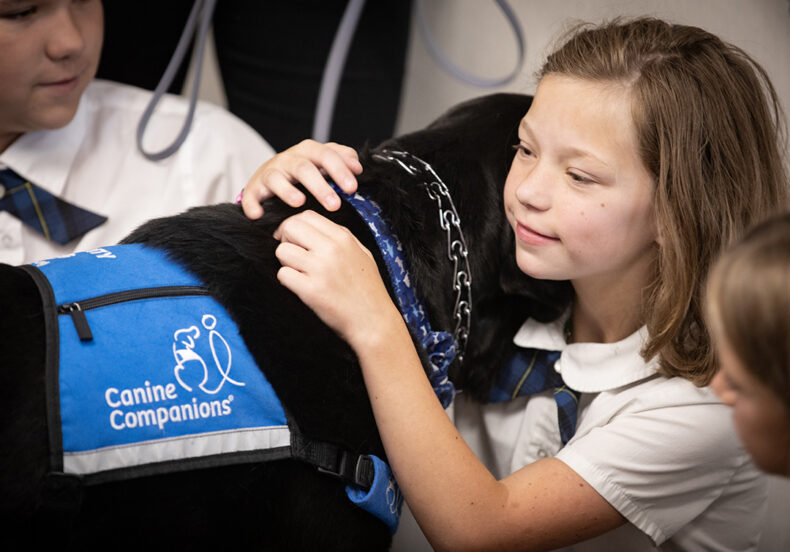
Research backs up what handlers see every day: Patient interactions with facility dogs can lower blood pressure, reduce pain perception, ease loneliness and fear and offer an important form of medicine — connection.
Unlike medical staff, whose job it is to ask questions and address issues, dogs aren’t there to fix. They simply show up, offer support and absorb the love patients give them. In a place where people often feel most vulnerable, that unconditional presence is powerful.
Norman is Employee of the Month every month
Norman, a 9-year-old golden Labrador, became Vanderbilt Health’s first facility dog when he was matched with Lugge in 2019.
“In January 2019 I got the call that there was a spot for me at Canine Companions team training in Santa Rosa, California,” she said. “There’s a class of people and a class of dogs, and they bring them together to see who clicks. On the first day, I texted the Pi Beta Phi Rehab team and said, ‘I know the dog I want.’ Norman was the one, and I was very strategic about making sure I was close to him.
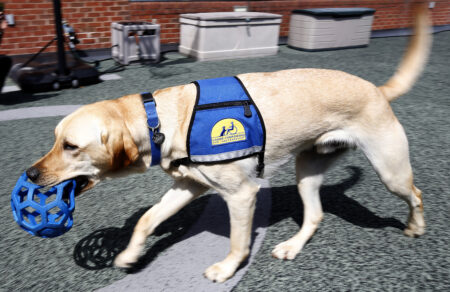
“I didn’t have a special vision: Everyone could see Norman is incredible. But I hit the jackpot when I got Norman, and he’s been our Employee of the Month for more than 80 months.”
Norman knows 70 different commands. He can operate automatic doors, open drawers and be the eyes, ears, arms and legs for anyone in need. With Lugge, he leverages those skills to help neurological patients recovering from stroke, traumatic brain injury, spinal cord injury, brain cancer, facial paralysis and more, but his greatest gift — one that can’t be taught — is his emotional IQ.
“When we arrive at work, I let him take the lead so he can find whoever needs him,” Lugge said. “At least once a week, a therapist will tell me about a patient who had a breakthrough or broke down in tears because of Norman. Our patients are often going through the hardest times in their lives health-wise, and it’s hard for them to come to grips with what’s going on. Norman has a way of breaking down those walls.”
There are some patients who are scared of dogs. Norman can sense that, too.
“Anytime a patient says they’re scared of dogs, Norman will hang out on his bed in my office, or I’ll put him in a treatment room with another therapist,” Lugge said. “Most of the time, after a few visits, those people will say, ‘I’m afraid of dogs, but not this dog.’”
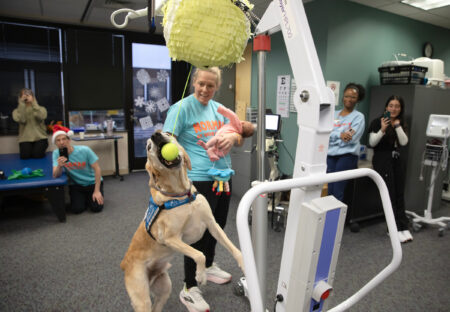
Norman recently added “author” to his resumé. In September, Lugge and her husband, Simon, self-published “Norman, At Your Service: My First Day,” a children’s book about his job. Each book includes a custom Norman “pawtograph” on the title page. At readings, Norman “reads” to kids by acting out certain words.
Norman is a good boy, but he’s not perfect. As dogs do, Norman leaves his toys here and there around the office. That helps patients, too.
“He drops his Lamb Chop toy and his ball, and generally gets in the way, which is great for our patients who fall down,” Lugge said, “If they can avoid Norman and his stuff here, they’re better equipped to avoid their dog stuff, kid stuff and throw rugs at home.”
Squid senses stress before it is spoken
Squid, a 7-year-old black Labrador/golden retriever mix, became the first facility dog in Monroe Carell’s Canine Clinicians program in February 2020.
His path to Monroe Carell began with Canine Companions, who enrolled him at the Gadsden Correctional Facility in Florida, where he spent a year under the care of a female inmate as part of the Canine Companions prison puppy raising program. From there he went to a finisher puppy raiser, where he spent six months socializing and building his skill set of commands. At 18 months, he was paired with a professional trainer to round out his training, which included exposure to the health care setting and an evaluation for placement.
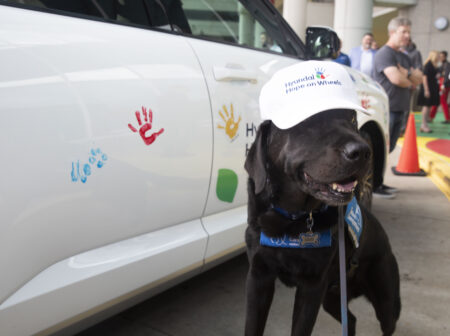
“Squid stood out,” said Leslie Grissim, MA, CCLS, facility dog coordinator and Squid’s primary handler, who includes Squid’s name and a paw graphic on her emails. “There was something grounding and gentle in his presence. He moved with purpose, connected with quiet confidence, and seemed to understand the emotional tone of each moment. I felt it, even before I knew it.”
With Grissim, Squid begins his day with breakfast, followed by a 30-minute dog jog about half an hour later with Sasha, his pet dog sibling.
“This daily exercise is essential: Squid gets a minimum of 60 minutes of movement each day to stay physically and emotionally healthy,” Grissim said.
After the jog, Grissim brushes Squid’s coat and teeth, wipes his paws and inspects his nails, ears and skin to make sure he’s clean, comfortable and ready for work.
At the hospital, Grissim reviews the consult list and prioritizes visits based on what’s most acute. Squid typically sees four to six patients per day, with each interaction tailored to the patient’s emotional and clinical needs. Some days include staff support — both scheduled and spontaneous.
When a 10-year-old girl was admitted to pediatric intensive care with severe pneumonia requiring intubation, her anxiety grew as hours in the hospital became days. Grissim and Squid were called in to help.
“When Squid entered the room, the patient smiled for the first time in days,” Grissim said. “She invited Squid onto the bed, choosing to have him lie between her legs with his head gently resting on her belly. For over an hour, Squid remained still, offering quiet companionship and a sense of safety. Later that day, the medical team discussed plans for extubation. They asked the patient if she wanted Squid to be with her during the procedure. She nodded yes.
“The next morning, Squid returned and settled into the same comforting position. The patient held her mother’s hand in one palm and Squid’s paw in the other. Within seconds, her breathing tube was removed. Squid stayed perfectly still throughout the procedure and remained by her side during the short recovery period that followed.
“He didn’t just help the patient through a medical procedure — he helped her reclaim a sense of control, comfort and trust in a space that had felt overwhelming.”
From idea to inception, the process to bring Squid to Monroe Carell, started by the Patient- and Family-Centered Care team and established through collaboration with Mars Petcare’s BETTER CITIES FOR PETS program, took three years. The benefits continue: Squid and Grissim recently completed a research study in Monroe Carell’s cardiology clinic focused on facility dog intervention and children’s anxiety during outpatient echocardiography.
“There were many examples of patient stories that share the success of facility dog support,” Grissim said.
Beyond all the belly rubs, Squid is calm and thoughtful. Grissim says his superpower is “sensing stress before it is spoken.”
Velour softens hard days
In August 2024, Velour Vanderbilt, MD (medical “dogtor”), joined Squid on the Canine Clinicians team at Monroe Carell. Born in July 2022 in Santa Rosa, California, the 3-year-old yellow Labrador retriever nicknamed V.V. learned the ropes at Canine Companions’ Orlando, Florida, training center with Kaylor Glassman, MS, facility dog coordinator and Velour’s primary handler, and second handler Meredith George, MEd, a certified child life specialist on the hematology-oncology floor. Velour is supported by Dunkin’ Joy in Childhood Foundation, Kacey Musgraves and Amazon.
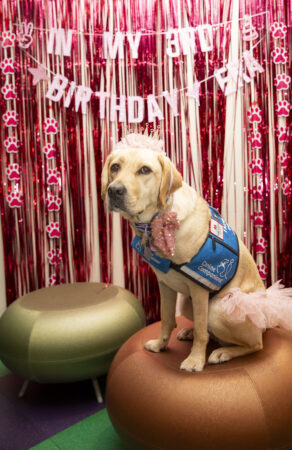
“Velour has a special ability to match the energy of each person she meets,” Glassman said. “If someone greets her with enthusiasm, she wags her tail enthusiastically, and her playful, high-energy personality comes forward. If someone is hesitant, feeling ill or is experiencing pain, Velour has a calm, gentle and patient spirit that is very comforting.”
At Monroe Carell, Glassman and Velour partner with providers to help patients reach their treatment goals. They receive an order from a provider that details the need, and Glassman assesses the situation and comes up with an intervention plan that she and Velour execute.
“This might be as simple as a child taking Velour on a walk one time, or it could be a long-term relationship where goals are being expanded upon throughout the child’s admission,” says Glassman who, along with Velour, frequently works alongside other providers such as physical therapists, child life specialists, social workers and music therapists.
What one child might be hesitant to do for or with a clinician becomes more fun with Velour.
“We recently worked with a young child who had an important mobility goal of moving from a bed into a nearby chair,” Glassman said. “All day long a variety of well-intentioned humans kept relaying to this child the importance of moving to the chair, but the child continually refused to do so. By the end of the day, the team was out of ideas, and they called me and Velour to come give it a try.
“Velour jumped right up on the bed, connecting with the child right away. Within minutes Velour and the child were successfully in the chair, playing a card game together, with loud giggles erupting from the child every time Velour handed over a card.
“The beautiful thing about Velour is that she instinctually meets people where they are. She doesn’t pressure or judge, but she does motivate and inspire children to do things they have been hesitant to do.”