


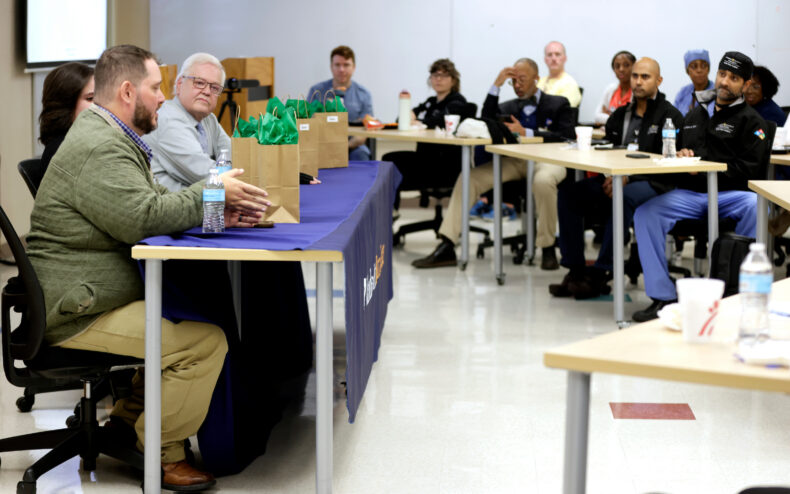
 Burn survivors, Nick Kimbro, left, speaks with Kenneth Howe looking on as a crowd of burn doctors, nurses and care partners learn from their amazing stories of recovery at the Vanderbilt Burn Center’s first Burn Survivor Event. (photo by Donn Jones)




The Vanderbilt Burn Center’s first Burn Survivor Event took place in Light Hall just before Thanksgiving, with four survivors speaking on a panel and interacting with burn doctors, nurses and care partners to share their amazing stories of recovery.
It was also the third “burnaversary” celebrating the Burn Center’s opening in November 1983, which was prompted by a tragedy that occurred in Waverly, Tennessee, on Feb. 24, 1978, when a railroad tank car containing 30,161 gallons of gasoline exploded following a train derailment two days earlier, resulting in 16 deaths and 43 people injured to various degrees.
The 25-bed Level 1 burn unit now averages over 600 admissions a year, and the adjacent burn clinic sees 3,000 outpatient visits a year. The center is staffed by physicians, advanced practice providers, nurses, therapists, psychiatrists and a chaplain. In 2024 there were 567 adult patients and 74 children admitted to the burn unit.
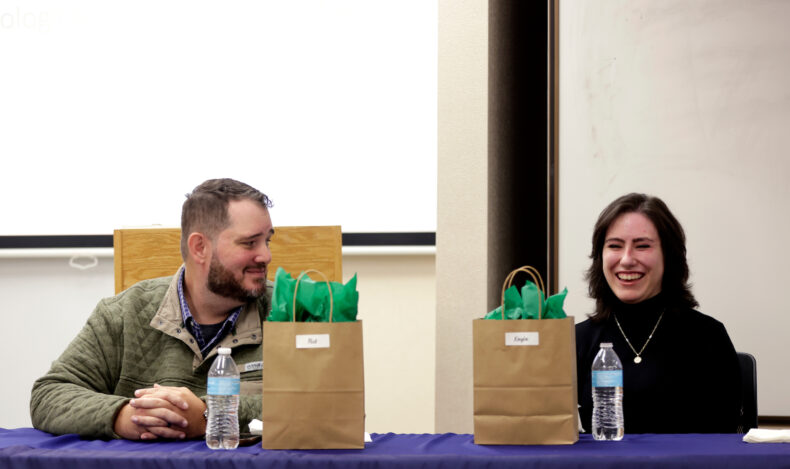
Nick Kimbro, a fire marshal in Tullahoma, Tennessee, who was burned when he fell into a hole of burning embers while responding to a fire, said it felt like every member of the staff truly cared about him and created personal relationships with him.
“I can’t thank the burn unit staff enough for what they have done for my family,” Kimbro said. “For me, the hardest part was realizing that my life had changed and that I’m not going to be doing the things I was doing before. My days of being on an engine company are behind me, and that was a hard pill to swallow — as was realizing I wouldn’t be doing the small things around our farm.
“I take pride in my service as a first responder in caring for people, and I’m not used to being the one who is being cared for. The staff here was really good at instructing my wife specifically how to care for my injuries in the interim before I came back for my follow-up visits. Watching her every day change my dressings and take care of my wounds was incredibly difficult for me. I have never been used to being on that side of it.”
Panelist Deekan Wilson was driving to the lake to hang out with friends when his truck hit some black ice and ran into a tree, exploding on impact.
He was transported by LifeFlight to Vanderbilt Health and underwent many surgeries and some necessary amputations during his 161 days in the hospital.
“I got my prosthetic and have been working on just keeping my body in shape for when I get my leg and start walking again,” Wilson said. “My nurses were awesome. They constantly checked on me. They are the reason why I am a little spoiled now. But they took care of me.
“And then my surgery team, surgeons like Dr. Wagner, were awesome as well,” he said. “If I didn’t have the surgeons I had, I probably wouldn’t be alive. It is as simple as that. The same with my nurses and support team.”
Panelist Kayla Valdivia, who was burned in a house fire caused by a lithium battery explosion, said she didn’t recognize herself when she first looked in the mirror after her accident, but the staff helped her through it.
“My face was completely burned, and they had to shave me, and I understand why, but it was just a lot, especially after losing everything too,” she said.
“But they made me feel like I was human. They created relationships. They even laughed at my terrible jokes. … I will never forget the people who took care of me.”
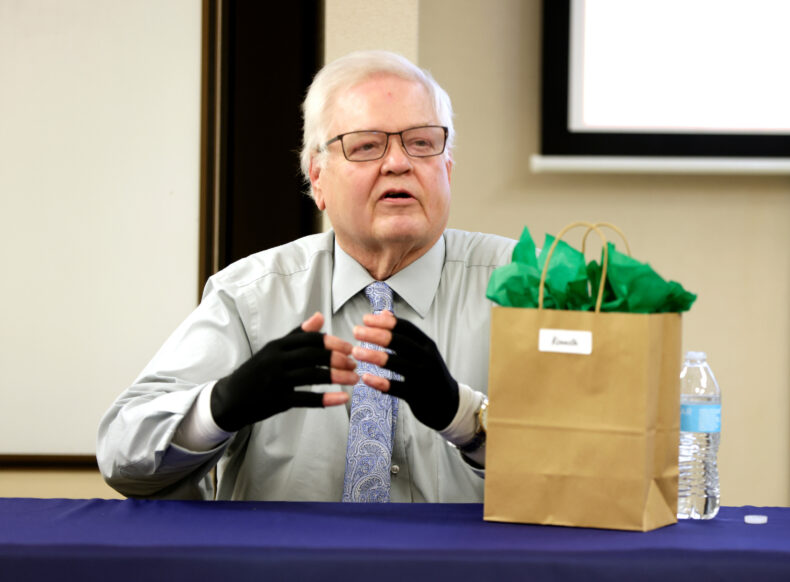
Panelist Kenneth Howe, who lost his wife in the house fire that burned him, said one big part of recovery was having people he could talk to about the accident.
“I found with my recovery, just talking it out with your friends and family really helped,” he said. “I also feel that the staff here is family. They treated me with the utmost respect. … When my wife passed the staff here were saying, ‘We are so sorry, Kenny.’ It wasn’t Mr. Howe, it was Kenny.”
The patients all mentioned that the Vanderbilt Health staff were like family to them, and Vanderbilt Burn Center Director Anne Wagner, MD, echoed that sentiment to the group.
“I want to thank the families of our patients; you guys are the silent warriors,” she said. “I think it goes underappreciated sometimes how hard it is to be the family, so we as a team are grateful to you. And I am very heartened that you patients called us family because I tell all of you when I get to know you that you are now a part of my family. And that’s how I want you to feel, so for you to say it without any prompting means the world to me. That’s what we as a burn team try to do; that’s why we do what we do.”


