


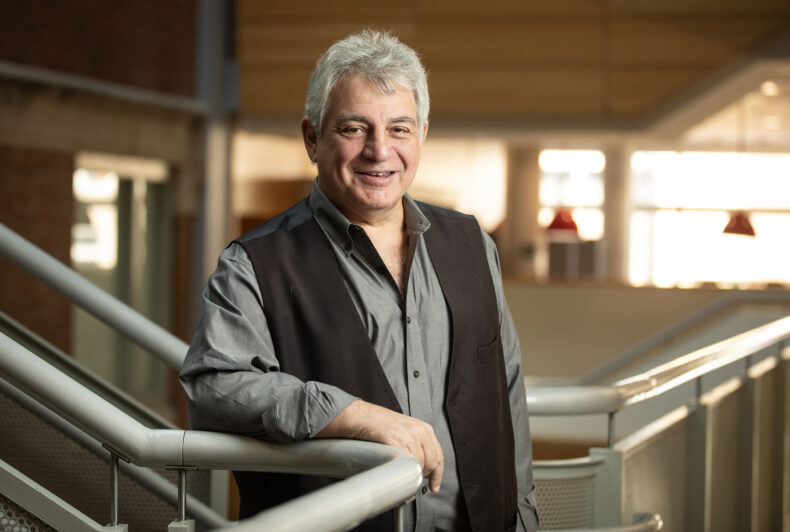
 Ron Emeson, PhD, joined the Vanderbilt faculty in 1991 and was awarded the Joel G. Hardman and Mary K. Parr Endowed Chair in Pharmacology in 1998. (photo by Erin O. Smith)




Ronald Emeson, PhD, the Joel G. Hardman and Mary K. Parr Professor of Pharmacology and longtime chair of the Institutional Animal Care and Use Committee (IACUC), will retire at the end of December after nearly 35 years on the Vanderbilt University faculty. He will continue to serve as IACUC chair through the next animal care and use accreditation site visit, expected by the end of April 2026.
Reflecting on his career, Emeson said the best parts have been “the science, the students, the opportunity to work with talented colleagues, and the IACUC.”
The IACUC (pronounced as a word: eye-uh-cook) helps to ensure that all research, teaching and testing activities involving vertebrate animals are conducted responsibly and humanely. As a federally mandated oversight group, it works to make sure these activities meet the highest ethical, legal and scientific standards for animal care and use. The committee meets monthly; its members include scientists representing all areas of research at Vanderbilt Health, Vanderbilt and the Nashville VA Medical Center, nonscientists, veterinarians and community members.
Emeson began serving as IACUC vice chair in 2007 and became chair the following year. He inherited a meeting gavel engraved with the words: IACUC Chairman — What were you thinking?
“Despite the fact that the committee largely deals with regulatory compliance, I think I’ve propagated an environment that (the members) both enjoy and recognize the importance of the committee’s work,” Emeson said.
The IACUC follows the “3R” policy, a foundational ethical framework for the humane use of animals in research, “to use the fewest number of animals necessary to achieve scientifically valid results, to modify procedures to minimize pain, distress and suffering, and improve overall animal well-being, and to use alternatives to animals whenever possible,” Emeson said. “Animals don’t get a choice about participating in scientific research, so it’s our responsibility to treat them in the most humane way that we possibly can.”
“Ron has been the ideal IACUC chair — respected, principled and knowledgeable,” said Jeanne Wallace, DVM, Vice President for Animal Care, professor of Pathology, Microbiology and Immunology, and attending veterinarian. “His decades of experience as an NIH-funded investigator and Vanderbilt faculty member give him a unique perspective on the complexities of biomedical research. He balances a strong commitment to compliance and animal welfare with unwavering support for scientific progress.
“Ron welcomes diverse viewpoints, fosters constructive dialogue, and guides the committee toward consensus — even on challenging issues. His leadership during a time of growth and change has left a lasting impact on Vanderbilt’s Animal Care and Use Program,” Wallace said.
After Emeson sees the IACUC through the next three-year accreditation site visit, he’ll pursue another passion. A lifelong cook, Emeson said he started baking “fancy stuff” during the pandemic and then started teaching small group baking classes in his home, which he plans to continue during retirement.


