


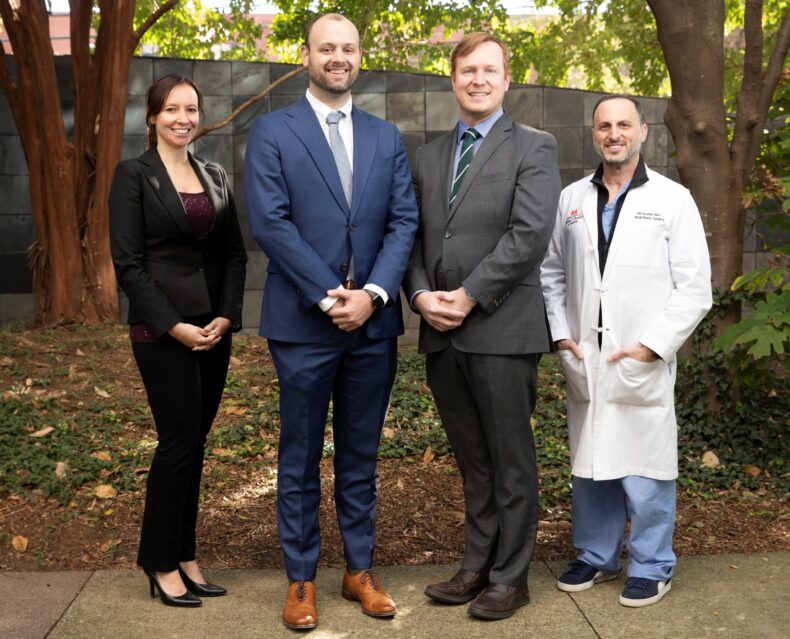
 Vanderbilt Health clinicians reporting on the success of a multidisciplinary approach to cleft lip/palate care are, from left, Izabela Galdyn, MD; Ryan Belcher, MD; James Phillips, MD; and Michael Golinko, MD. Contributors not pictured are Matthew Pontell, MD, and Stephane Braun, MD. (photo by Erin O. Smith)




Uniting cleft lip/palate (CLP) care under one roof leads to better overall outcomes for CLP patients, a Vanderbilt Health team led by Ryan Belcher, MD, MPH, associate professor of Otolaryngology-Head and Neck Surgery, reported in the International Journal of Pediatric Otorhinolaryngology. The research focused on improvements made following the implementation of a full-scale in-person clinical approach in 2019 and detailed the care gaps that were filled at Monroe Carell Jr. Children’s Hospital at Vanderbilt.
Headlining the improvements made to patient experience with CLP treatment at Vanderbilt Health is the addition of a patient care coordinator, Jennifer Tilton, who has worked to ensure that families receive a comprehensive care plan rather than needing to coordinate multiple disparate parts of their child’s treatment on their own.
“By going through the journey alongside them, we support families throughout their child’s care by creating a meaningful, connective pathway for a condition that can be confusing and complex for families to navigate alone,” said Tilton.
Belcher said that in addition to seeing their otolaryngologists or pediatric plastic surgeons for CLP care, many patients were seeing speech therapists, dietitians, geneticists, audiologists, orthodontists and dentists in different places, and the team wanted to create a space to meet all their needs for cleft lip and palate care in one place.
“Vanderbilt has always been a very collaborative place for cleft lip and palate surgeries, between otolaryngology and pediatric plastic surgery,” said Belcher. “That’s not a common relationship around the United States … We feel like this is a unique situation for CLP care.”
While Vanderbilt Health already met the criteria to be designated as an official CLP care team as outlined by the American Cleft Palate Craniofacial Association (ACPA), it was important to centralize a clinical operation in the form of a multidisciplinary clinic. Michael Golinko, MD, chief of Pediatric Plastic Surgery, and James Phillips, MD, associate professor of Clinical Otolaryngology-Head and Neck Surgery, were named program co-directors.
“Our program’s motto is ‘helping kids face the world through a team approach,’” said Golinko, who holds the Delta Dental of Tennessee’s Smile180 Foundation Directorship. “We are extremely passionate about not only providing state-of-the-art medical care but also a top-notch patient and family experience. Through team clinic days and annual community events, families connect organically, which cultivates bonds that allow children to build incredible resilience.”
Following the creation of the Pediatric Cleft and Craniofacial Care program at Monroe Carell, the team had anecdotally observed better overall outcomes resulting from improving turnaround times for surgeries and supporting patients as they worked with other disciplines to round out their CLP care. The study sought to prove those anecdotal observations and demonstrate the value of appropriate surgery timing.
“The ACPA recommends cleft palate surgery be done before the age of 18 months, though there is some data showing that if you do it before 12 months of age, kids can have better speech outcomes … We wanted to make that a goal and show that timing for surgery could be improved,” said Belcher.
The data showed that after the creation of the clinic, cleft palate surgeries happened at an earlier age, and when patients needed ear tube surgery in conjunction with their CLP care, such procedures happened more commonly.
Coordinating care has gone beyond scheduling appointments and combining disciplines, Belcher said. The program also aims to keep patients on track with their care through coordinated outreach, including guidance on financial support. Before Tilton’s position was established, a number of patients had “fallen through the complicated health care gaps” and gone through CLP treatment without insurance, said Belcher.
“Making sure that these patients would follow up was key,” he added. “If they missed appointments, we had social work and care coordinators who would follow up with these families instead of letting them fall by the wayside.”
Tilton emphasized the importance of the multidisciplinary team’s consistent support of families through each step of their child’s medical journey. “Providing coordinated care works because our entire team comes together with one shared goal, using a true team approach,” said Tilton.


