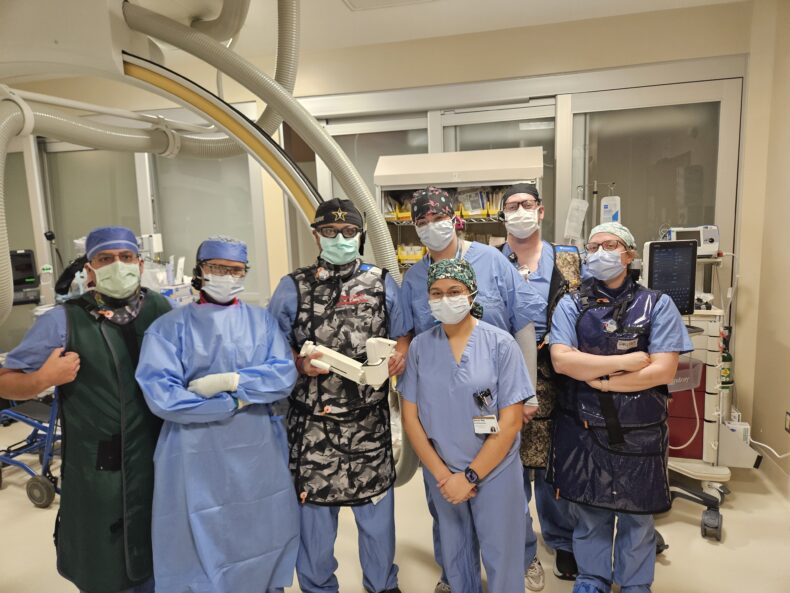
 The Vanderbilt Heart and Vascular Institute team members involved in the robotic central line device trial are, from left to right, Vineet Agrawal, MD, PhD; Ida Oudomsouk, RN; Aniket Rali, MD; Jessenia Mejia (back), Blake Yoder, RN (back), Celia Nunez (front) and Carly Foley, RN (front). (photo courtesy/Aniket Rali)

The Vanderbilt Heart and Vascular Institute (VHVI) recently performed a groundbreaking procedure using a novel robotic device that places central lines.
Vanderbilt Health was selected by the Food and Drug Administration as one of five centers in the country to conduct a clinical trial of the Obvius Robotics device. Its first case, completed in January, was a procedure on Charlotte Jones of Chattanooga, Tennessee.
Jones, who has been receiving care for heart failure at the VHVI outreach clinic in Chattanooga, had her procedure at VHVI in Nashville. The central line was placed robotically as part of her minimally invasive procedure to receive a pulmonary artery pressure monitoring device.
The procedure uses a catheter to place the paper clip-sized CardioMEMS device, which allows medical teams to monitor the pressure inside a patient’s heart in real time, allowing them to make better decisions about Jones’ medications and improving outcomes.
Jones’ procedure lasted about an hour. She stayed another hour afterward to recover, then was able to return to her home in Chattanooga the same day.
Since her procedure, Jones said she has a lot more energy. “Everything feels great,” she said. “My breathing is great. My walking is great.”
Vanderbilt Health is deploying the novel robotic central lines device in the Cardiac Catheterization Lab and the Medical Cardiovascular Intensive Care Unit (CVICU), bringing more innovation into the critical care space, said Aniket Rali, MD, co-director of the medical CVICU, who performed Jones’ procedure.
“Vanderbilt Health was approached as one of the five sites for this trial because of our long track record of innovation, patient safety and the procedural skill we have amongst our ranks to be able to take on something like this,” said Rali, associate professor of Medicine and Anesthesiology.
Co-investigators on the trial are Jeffrey Schmeckpeper, MD, PhD, instructor in Medicine, and Vineet Agrawal, MD, PhD, assistant professor of Medicine.
A central line is a long, thin tube inserted into a large vein in the neck, chest, arm or groin, extending to a major vein near the heart, used for long-term or difficult IV placement. Procedural training and proficiency are required for a clinician to place one safely. But Rali said the robotic device does much of that work, in a standardized and safe manner.
“It basically does the job of what may take a human experience over 100 cases to perform with that level of precision and safety,” he said. “It makes the entire process of getting the needle into the blood vessel much more precise.”
Jones credited Rali for the quality of her care.
“He is really like a doctor that’s on my side,” she said. “He’s been on my side since the beginning.”