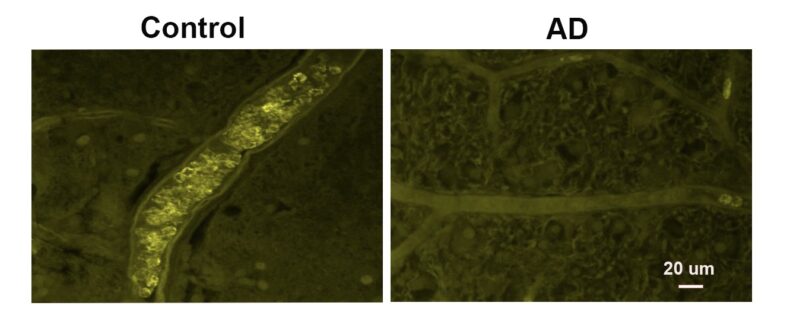
 Retinal image shows normal flow of amyloid protein oligomers, as detected by a fluorophore-labeled nanobody, through retinal vessels in a control eye (left), compared to impaired flow in the donor eye of an individual with Alzheimer’s disease (right). (image courtesy of Wellington Pham, PhD)

Researchers at Vanderbilt Health have received a five-year, $3.1 million grant from the National Institute on Aging, part of the National Institutes of Health, to develop a new method for detecting early signs of Alzheimer’s disease — in the eye.
The grant supports optimization of a light-emitting nanobody that can detect changes in the flow dynamics — or clearance — of complex molecules of amyloid-beta proteins, called oligomers, through tiny retinal vessels at the back of the eye.
The research, based on findings by the grant’s principal investigator Wellington Pham, PhD, and colleagues at Vanderbilt University and the University of British Columbia in Vancouver, could lead to the development of a noninvasive retinal screening test for Alzheimer’s disease that could be conducted routinely in the ophthalmologist’s office.
Pham, professor of Radiology & Radiological Sciences and of Biomedical Engineering, and his colleagues acknowledged in the grant’s project summary that “at present, no disease-modifying therapy is effective against Alzheimer’s disease, nor is it possible to diagnose the disease’s early onset or progress.”
Yet because soluble amyloid-beta oligomers and amyloid plaques that damage brain cells can form years before symptoms of dementia occur, “a window of opportunity exists for early intervention,” they wrote. “Successful detection of the onset of this disease via routine screening will improve therapeutic outcomes and save lives.”
An estimated 7.2 million Americans ages 65 and older are living with Alzheimer’s disease, which is also a leading cause of death in this age group. The burden of the disease, which topped $384 billion in health care and long-term care expenditures in 2025, is expected to continue to grow as the population ages.
The potential for a retinal screening test was bolstered by a recent discovery that clearance of amyloid-beta oligomers by immune cells in retinal blood vessels was disrupted in donor eyes from individuals with Alzheimer’s disease, compared to age-matched, healthy control eyes.
The research, conducted with Joanne Matsubara, PhD, and colleagues at the University of British Columbia, and Yuankai (Kenny) Tao, PhD, associate professor of Biomedical Engineering at Vanderbilt, used an alpaca-derived nanobody developed by Pham, Ben Spiller, PhD, and Brian Wadzinski, PhD.
Nanobodies are potent antibody fragments derived from unique antibodies found in hooved animals including camels, llamas and alpacas. Wadzinski and Spiller, associate professors of Pharmacology at Vanderbilt, operate an alpaca farm west of Nashville. Antibodies from one of the animals were engineered into the nanobody used in the study.
At about one-tenth the size of antibodies, nanobodies can cross the blood-brain barrier where antibodies cannot go. Nanobodies labeled with fluorophores, fluorescent chemicals that light up when excited by another light source, can be used to track the molecules they bind to — in this case, amyloid-beta oligomers in the retina.
Directly targeting amyloid beta has so far been unsuccessful in interrupting the progression of Alzheimer’s disease. Focusing instead on vascular “flow dynamics,” or removal of soluble oligomers, may provide an alternate and more effective means of preventing their toxic accumulation, the researchers noted.
Pham, a medicinal chemist and investigator in the Vanderbilt University Institute of Imaging Science (VUIIS), began investigating the use of nanobodies in Alzheimer’s disease with Wadzinski and Spiller in 2019.
Initial funding for the project was provided by the Vanderbilt Institute for Clinical and Translational Research, Vanderbilt Brain Institute, and VUIIS Director John Gore, PhD.
Receiving NIH support (grant number R01AG098771) “means a lot,” Pham said. The project, which has required a tremendous amount of work and interdisciplinary coordination, could not have been done without the team’s strong collaborative spirit, he added.
The nanobody technology developed at Vanderbilt Health has been licensed for further development to Biosensis, a global leader in neuroscience research tools.