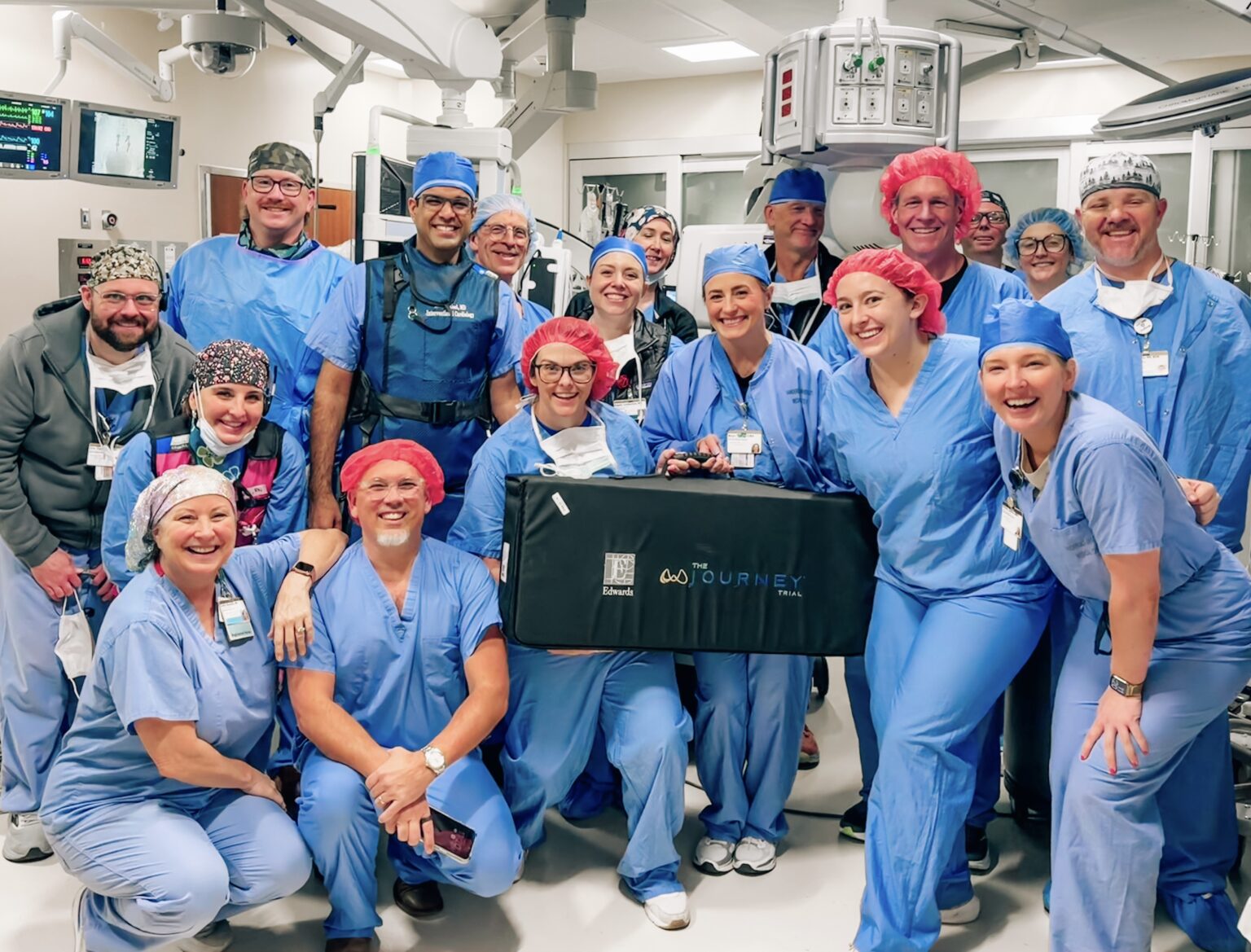
 The Vanderbilt Heart and Vascular Institute team implanted its first J-Valve to treat aortic regurgitation in a patient. (submitted photo)

The Vanderbilt Heart and Vascular Institute (VHVI) has performed its first procedure to implant a novel transcatheter device for treating aortic regurgitation (AR) in patients who are high-risk for conventional open-heart surgery and would otherwise have limited or no options for treatment.
AR occurs when the aortic valve does not close properly, causing blood to flow backward from the aorta into the left ventricle. Symptoms include fatigue, shortness of breath, chest pain and palpitations.
The Structural Heart and Valve Center at VHVI implanted the J-Valve transfemoral system in a patient as part of a multicenter clinical trial. The patient, who had severe AR and was considered high-risk for traditional open-heart surgery, is doing well after the procedure, said Kashish Goel, MBBS, associate professor of Medicine and director of Transcatheter Heart Valve Interventions at Vanderbilt Health.
With the addition of the J-Valve device, VHVI now offers minimally invasive procedures to implant devices treating every valve disease, eliminating the final gap, Goel said. He noted that the trial is still enrolling new patients, so other high-risk patients with aortic regurgitation could qualify.
“This represents a true paradigm shift in how we approach aortic regurgitation,” Goel said. “Transcatheter options for native AR are limited, and this technology and trial open the door for treating high-risk surgical patients. The case was a success and reflects the strength of our multidisciplinary heart team, valve clinical and research teams, cath lab teams, procedural expertise and commitment to advancing structural heart therapies in the region.”
The minimally invasive procedure to implant the J-Valve, which takes less than an hour, uses a catheter to place a small device in the valves to reduce the opening and prevent backflow of blood. The procedure is quick and painless compared to surgical alternatives, and patients typically require a significantly shorter stay in the hospital to recover — usually returning home only a night or two after a procedure.
Minimally invasive, catheter-based devices are now available to treat aortic, mitral and tricuspid heart valve disorders. Transformative innovation over the last couple of decades has changed the landscape and treatment options for patients with heart valve disease with numerous devices now approved and many others in development and testing. Left untreated, these heart valve diseases can lead to heart failure and death.
“In the past, many of these patients couldn’t get surgery because they were considered too high-risk, and we couldn’t really offer them anything except palliative or comfort care,” said Colin Barker, MD, director of the Section of Interventional Cardiology and associate professor of Medicine. “But now we have, I think, a very predictable, durable and effective option. Only a few centers nationally can offer this, and we’re one of them.”
The Structural Heart and Valve Center at VHVI has many options for artificial valve devices, both Food and Drug Administration-approved devices and clinical trials for new ones. VHVI is a destination center of excellence for artificial valve devices and treats patients from across Tennessee and surrounding states. It earns that reputation by the number of clinical trials underway, the high volume of procedures and excellent outcomes.
Patients or referring providers who would like to learn more can contact the lead research coordinator, Megan Jacobs, at 615-421-1348 or megan.jacobs@vumc.org; or the research manager, Natalie Jackson, at natalie.jackson@vumc.org.