 "Eat Your Ice Cream: A Conversation with Dr. Ezekiel Emanuel About Evidence-Based Wellness" was held at the Vanderbilt University Owen Graduate School of Management on April 23, 2026. (photo by Erin O. Smith)

Obsessing over complex health regimens, chasing the latest social media hype, or focusing solely on diet, exercise and sleep aren’t the best paths to wellness, according to bestselling author and physician Ezekiel Emanuel, MD, PhD, the Diane v.S. Levy and Robert M. Levy University Professor at the University of Pennsylvania. He believes achieving real wellness comes down to following six basic rules.
Thomas Steenburgh, Ralph Owen Dean of the Vanderbilt University Owen Graduate School of Management, welcomed Jeff Balser, MD, PhD, President and CEO of Vanderbilt Health and Dean of Vanderbilt University School of Medicine, and Emanuel for a broad-reaching discussion on wellness and how we can all live healthier lives. In tune with Emanuel’s advice, the audience ate pizza and spooned up ice cream. (He’s from Chicago, so he gave the Nashville pizza a pass, but he’s a big advocate of dairy.)
Emanuel, who is also vice provost for Global Initiatives at the University of Pennsylvania, is widely known for his work at the intersection of medicine, ethics and public policy. A physician, oncologist and bioethicist, he was one of the principal architects of the Affordable Care Act (ACA) and remains a prominent voice in national health policy conversations.

Drawing on decades of clinical research and historical evidence, Emanuel’s latest book offers six simple principles to support longer, healthier and more meaningful lives.
They are:
- Don’t be a schmuck! Or in other words, avoid high-risk behavior. Emanuel offered climbing Mt. Everest as one life-threatening activity to avoid, but he admitted serving as president of the United States is statistically riskier.
- Talk to people. Cultivate family, friends and other social relations. He advocated striking up conversations with strangers, using his father, Benjamin, as an example. Emanuel wrote that his father was “incorrigibly social — the quintessential ‘people person.’”
- Expand your mind. Emanuel said the worst thing a person could do to hasten cognitive decline is to retire. Balser, who recently announced his upcoming retirement, laughed and ducked his head. The author recommended taking up challenges that are proven to use many parts of your brain, such as playing a musical instrument or performing stand-up comedy.
- Eat your ice cream. During the discussion, Emanuel blasted sugar-filled sodas and ultraprocessed foods, and he encouraged eating fruit, vegetables, nuts, fermented foods (like kimchi or yogurt), sensible amounts of protein, full-fat dairy (He admits in his book that this is controversial, but he believes nutrient-dense, minimally processed dairy products rich in protein, calcium and vitamin B are quite beneficial.) and maximizing fiber intake.
- Move it! Routine exercise should include aerobic exercise, strength training, and movement to improve flexibility and balance (such as yoga). Many groaned when Emanuel shared he’d likely ride his bicycle 55 miles that weekend. He offered that studies have shown a plateau of benefit when it comes to how much to exercise. About 150 minutes of vigorous exercise weekly and 300 minutes of moderate exercise is enough. “After that, you don’t get more longevity benefit or more cardiovascular benefit, and you increase the risk that you’re going to have an injury,” he said. “So, don’t be a schmuck. Don’t do too much.”
- Sleep like a baby. Emanuel noted that about 1% of the population are “short sleepers” who only require four or five hours of sleep. Most everyone else needs between seven and nine hours of sleep. “You can will yourself to exercise; you can will yourself to eat right, but you can’t will yourself to sleep,” he cautioned. “All you can do is make your bed … and try to make it work. And all of the medications? Throw them out now … They don’t work.” He cited the American Academy of Sleep Medicine and its recommendation of cognitive behavioral therapy to treat chronic insomnia.
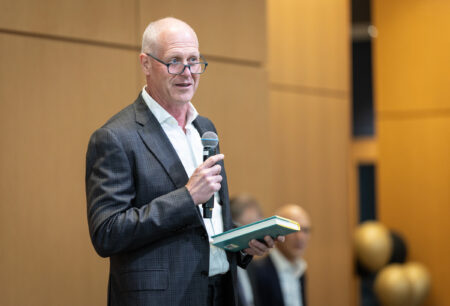
Balser put Emanuel on the spot about health care topics many Americans are concerned about, such as affordability, quality and access.
“Sixteen years after the Affordable Care Act was passed, and 25 million additional Americans have coverage — thank you for the role you played in making that happen,” Balser said. “And yet, we are clearly not where any of us, and certainly not where you would want us to be. As one of the architects and with the benefit of 16 years of hindsight, what did we get right, and what would you do a little differently?”
While Emanuel said he would now advise “comprehensive, full-blown reform … even bigger than the Affordable Care Act” to significantly improve health care in the U.S., he praised the legislation for fiscal achievements that are rarely discussed.
“We not only got the 25 million people coverage, but what’s less touted is the fact that we actually kept health care costs flat for 15 years,” he said. “Is that all the Affordable Care Act? No. Is it a majority of the Affordable Care Act? It’s hard to believe, but it hadn’t happened before that, and then the ACA came in. In fact, we saved $4 trillion just on Medicare spending. So, in that regard, it was successful.”
Emanuel pointed to health goals for any health care system: universal coverage at a reasonable cost with consistent, high quality and improving quality, reducing gaps in health care outcomes, and satisfaction. He told the audience the United States health care system fails every goal.
His recommendations:
- Auto-enroll all uninsured individuals in a health care plan.
- Have multiyear health care contracts so insurers are more invested in preventive medicine and wellness for enrollees.
- Set a health care spending budget that doesn’t increase faster than the gross domestic product, and stick to it.
- Improve health care quality and outcomes by documenting what works and implementing evidence-based interventions. As an example, Emanuel pointed to the need to do this systemically to address the poor maternal-fetal mortality rates in the U.S.
During the discussion, Emanuel often referred to Benjamin Franklin, one of his heroes, who he believes is a great model of a well-lived life.
“One of the problems of the wellness industrial complex and the influencers is that they’re really narcissists — it’s all about me,” he said. “Franklin was the exact opposite of a narcissist. He was all about, ‘How do I do things for other people?’ And it seems to me that’s where we get meaning, that’s where we get purpose, and that really ought to be the guiding principle of a well-lived life.”