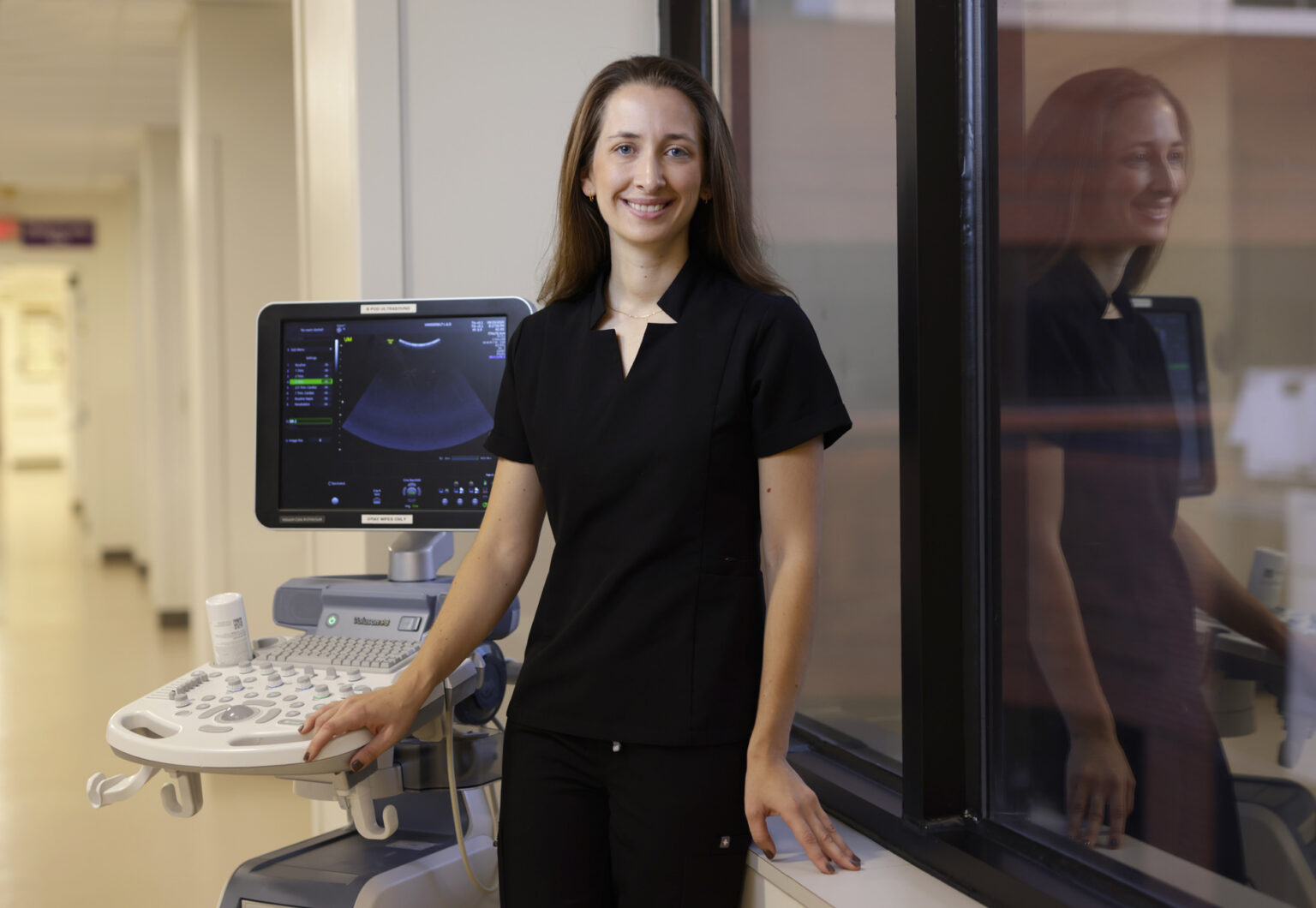
 Alexandra Sundermann, MD, PhD. (photo by Donn Jones)

Researchers at Vanderbilt University Medical Center have developed a more precise way of determining the risk of miscarriage for healthy women who are early in their pregnancies.
In a first-of-its-kind study conducted in a cohort of women with normal reproductive potential, the investigators measured whether — and how much — gestational dating determined by a standardized research ultrasound lagged, or fell behind, what the last menstrual period (LMP) predicted, and assessed how this discrepancy associated with risk of pregnancy loss.
Reporting online Aug. 14 in the journal Obstetrics & Gynecology, the researchers found that “the bigger that lag is, the higher the risk of that pregnancy ending in a loss,” said Alexandra Sundermann, MD, PhD, the paper’s first and corresponding author.
Ultrasound is an important tool for understanding the health of early pregnancy, and this method provides an earlier predictor of risk to women who are concerned about their pregnancies. It will be most useful for patients with regular periods and certain LMP dates.
“These estimates either can provide reassurance: ‘There’s no lag; the pregnancy is measuring on track.’ Or if there is a significant lag, it may prompt the clinician to say, ‘Maybe we should have closer follow-up to see how this pregnancy is progressing,’” said Sundermann, assistant professor of Obstetrics and Gynecology.
Pregnancy loss occurs in approximately 1 in every 6 recognized pregnancies, or 16%. For the past several years, Sundermann and her colleagues have been studying various factors for their potential to increase miscarriage risk, including the presence of uterine fibroids (not associated with increased risk), and alcohol consumption during pregnancy (increased risk linked to timing of exposure).
Their next paper will examine the association between the timing of first trimester bleeding and miscarriage risk.
The current study included nearly 5,000 women from Tennessee, North Carolina and Texas who participate in Right from the Start, a community-based, prospective pregnancy cohort. Research ultrasound exams were obtained around the sixth week of pregnancy. In the clinical setting, first-trimester ultrasounds ordinarily are obtained between seven and 10 weeks.
The researchers found that the risk of pregnancy loss in women with no lag between the ultrasound measurement and their LMP was 6%. However, the risk for women with a five-day discrepancy was 18%, and for women with a 10-day discrepancy, it was 34%.
Context is important in determining risk, however.
“There are other reasons why ultrasound-based gestational dating might lag behind LMP dating,” Sundermann said, “including ovulation dysfunction, uncertain LMP from irregular periods or recent contraceptive use, or vaginal bleeding in the first trimester. While these numbers can be helpful for patient counseling, they need to be appropriately integrated into the clinical context.
Sundermann’s co-authors were Elizabeth Jasper, PhD, assistant professor of Obstetrics and Gynecology, medical student Suchita Kumar, Katherine Hartmann, MD, PhD, now at the University of Kentucky, and Digna Velez Edwards, PhD, MS, professor and director of the Division of Quantitative and Clinical Sciences in the Department of Obstetrics and Gynecology.
The study was supported in part by National Institutes of Health grants K12AR084232, R01HD043883 and R01HD049675, and by the American Water Works Association Research Foundation.