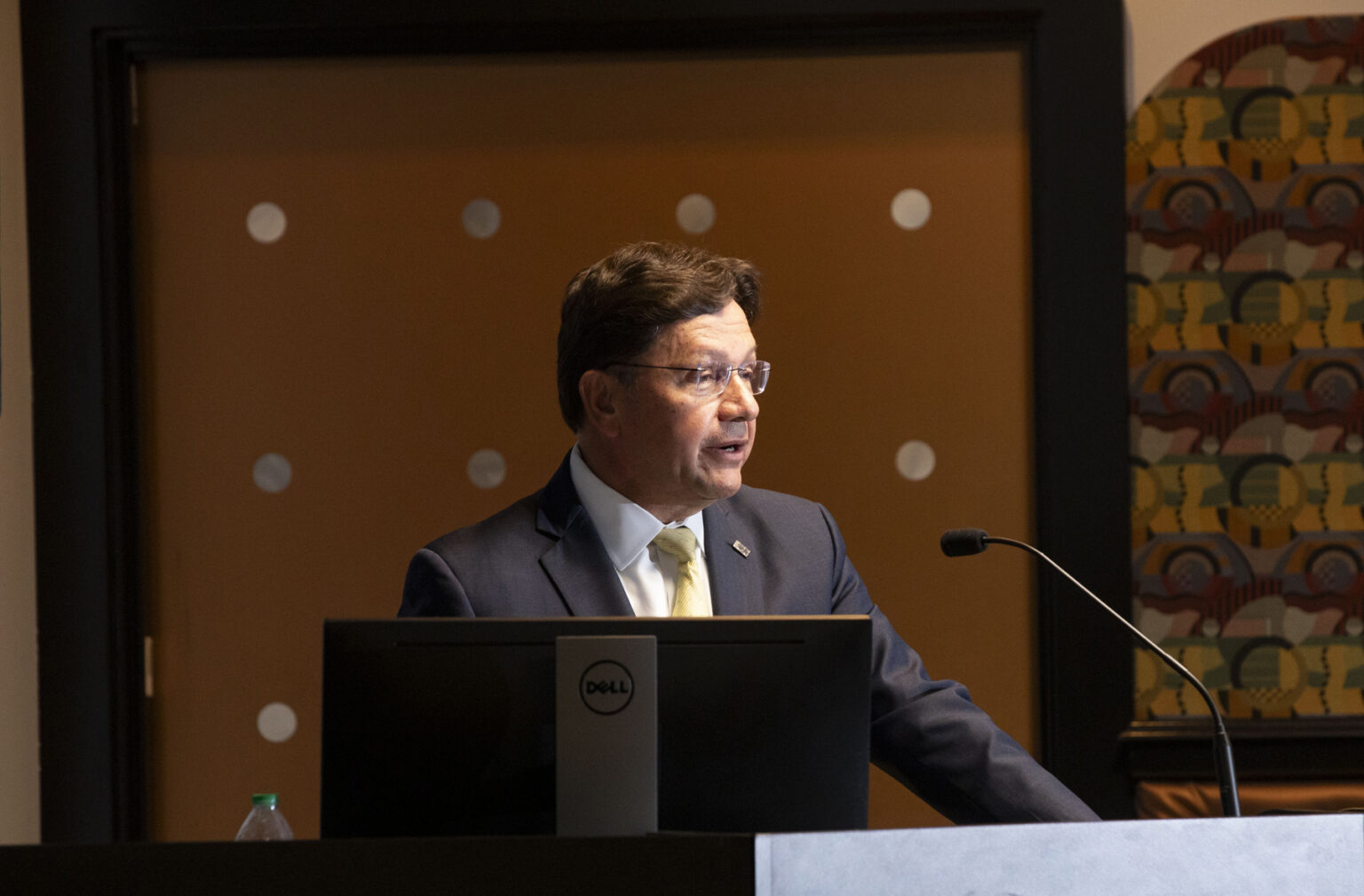
 Juan C. Salazar, MD, MPH, delivers his inaugural State of the Department of Pediatrics address. (photo by Susan Urmy)

Less than a month into his tenure as chair of Vanderbilt’s Department of Pediatrics, Juan C. Salazar, MD, MPH, delivered his inaugural State of the Department address Sept. 9, celebrating the remarkable success of his colleagues’ collective work, while also laying out his vision for the future.
“This isn’t about my tenure,” said Salazar, system pediatrician-in-chief for Monroe Carell Jr. Children’s Hospital at Vanderbilt. “It’s about all of you who have worked tirelessly over the past year. You should be incredibly proud of what you’ve achieved.”
Salazar joined Vanderbilt on Aug. 15, arriving from Connecticut Children’s and the UConn School of Medicine. A renowned pediatric infectious diseases expert, Salazar brings over three decades of experience in academic leadership, medical education and National Institutes of Health-funded research.
Drawing from his experience, Salazar threaded throughout his address the themes that have become synonymous with the Department of Pediatrics’ mission: clinical care, research, education and advocacy.
Salazar highlighted the continued growth and accomplishments of the department, which is now 787 strong, including faculty and staff clinicians.
The department was ranked as the No. 1 NIH-funded pediatric department in the nation, securing $144.5 million in total external research funding, including direct and indirect.
“This is a testament to the groundbreaking research happening here,” Salazar noted, “and it represents the work of everyone in this room.”
He stressed the need for the continued expansion of research and the strategic development of the Vanderbilt Children’s Health Research Institute.
The clinical milestones were equally impressive. The department and Monroe Carell served nearly 400,000 pediatric patients across Tennessee and surrounding states, a testament to its commitment to regional care. That care included more than 310,000 ambulatory visits in fiscal year 2025.
He also celebrated the department’s focus on quality and safety that impact clinical care. Programs like the Quality Academy, which trains faculty and fellows in quality improvement initiatives, have already yielded measurable results, such as improved screening for depression and suicide risk in pediatric patients. “Quality care is not just a goal; it’s our standard,” he said.
Salazar took time to honor the department’s educators, who are shaping the next generation of pediatricians. With over 470 trainees, including residents and fellows, the department remains a leading institution for pediatric education. He highlighted the exceptional match results for residency programs and the numerous awards faculty and trainees received for their teaching and mentorship. He also applauded the 385 academic presentations given by the trainees.
As he leans into his role as chair and system pediatrician in chief, Salazar offered his guiding principles: premier leadership development; fostering, developing and acknowledging outstanding pediatric faculty and staff; promoting children’s health research; being an effective voice for children; fostering partnerships; and financial stability. “And I’ll ask that you hold me accountable to these principles,” he said.
As he closed, Salazar encouraged the department to aim high.
“I am about connecting with you as we move this place forward. The opportunities are enormous. There is no reason why in the next five to ten years we can’t be a top five children’s hospital. We must strive for that,” Salazar said.