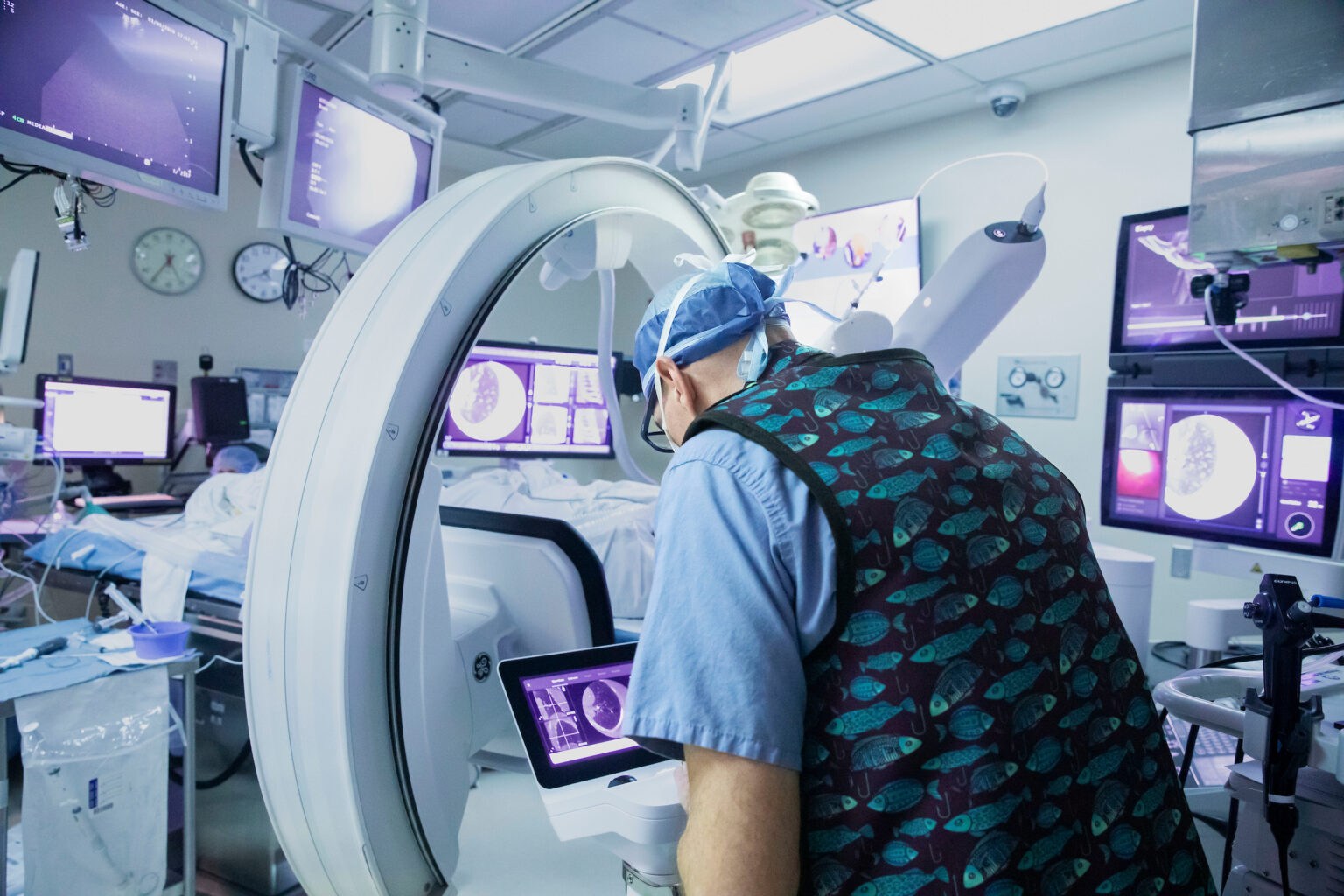
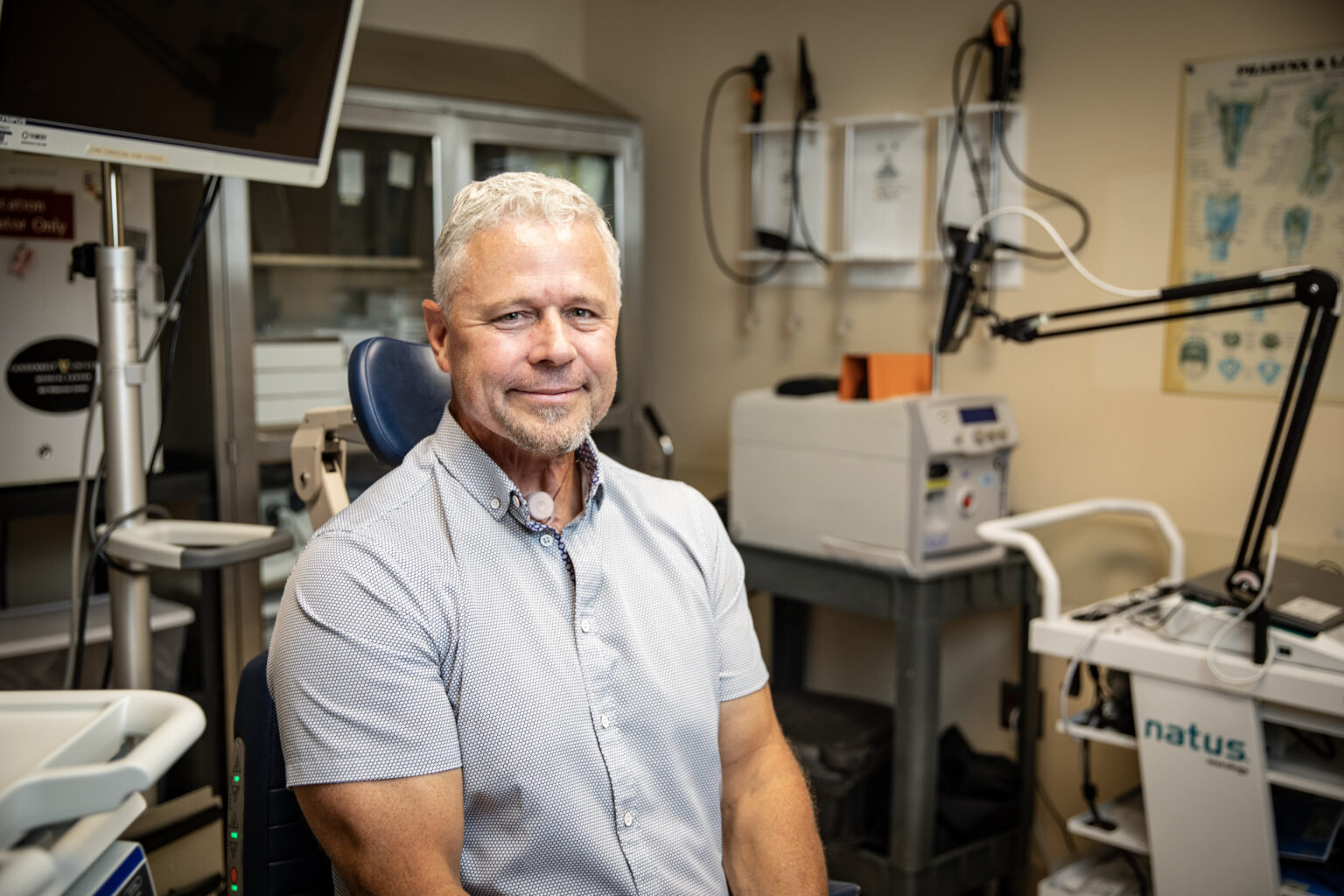
 Dan Hannon (photo by Erin O. Smith)

Dan Hannon never thought he would have cancer.
He was never a smoker, never a heavy drinker and led a pretty healthy lifestyle. And yet, in 2016, the hoarseness in his voice that he initially chalked up to coaching baseball turned out to be vocal cord cancer.
He had noticed gaps in his voice when he would sing (his falsetto range notably took a hit), and for someone who has spent decades in the music industry — first as a musician and now as a producer — it was a hard symptom to ignore.
At the urging of a friend who is a vocal coach, Hannon saw an ear, nose and throat (ENT) doctor. In fact, before he came to Vanderbilt Health, he saw several. He was told his problems stemmed from acid reflux and prescribed over-the-counter medication.
Still, the symptoms persisted. Finally, his fourth ENT physician ordered a biopsy. When he received his diagnosis, the doctor got straight to the point: “It’s cancer.”
Hannon underwent radiation therapy, but the cancer came back in a little over a year, setting in motion a cycle of follow-ups and surgeries as the disease persisted. It became clear that the next step would be a more significant surgery. A friend recommended he see a doctor at Vanderbilt Health for another opinion on a partial versus total laryngectomy, the complete removal of the larynx or voice box.
Partial, then total
“I loved Alex right out of the gate,” Hannon said of Alexander Langerman, MD, SM, FACS, professor of Otolaryngology-Head & Neck Surgery. “He was the first guy who made me feel like he was listening and competent, and had done some of these surgeries.”
Langerman’s recommendation was more or less in line with the opinions Hannon had received from doctors elsewhere, but the key difference was that Langerman left the final call to Hannon. If he wanted to try a partial laryngectomy first — which was his preference as he hoped to preserve some vocal function — he would support him in that approach.
“Sometimes, there’s no option,” said Langerman. “But when there’s multiple options, you really have to go into the pros and cons of those options and help patients understand what the impact of their choices would be.”
Hannon underwent a partial laryngectomy in February 2019. But by October, the cancer was back, and he needed a total laryngectomy after all. It seemed like the worst-case scenario: He had gone through the recovery process for the partial laryngectomy, which he called “the most difficult recovery [he’s] ever experienced,” only to end up needing a total laryngectomy less than a year later.
Yet in 2025, his surgeon said Hannon had one of the better outcomes possible following a laryngectomy.
“Dan ended up having a really good voice, which you notice when you talk to him,” said Langerman. “And for a guy in the recording industry, that matters. … He saw this as an opportunity to turn around his health in general. He’s as healthy as he’s ever been in his whole life.”
A fluent, smooth voice
After surgery, Hannon was given a tracheoesophageal voice prosthesis (TEP), a mechanism that allows the patient to speak by shunting air from the lungs into the esophagus through a fistula, or hole, created between the trachea and esophagus. The patient must block their stoma (the hole in their throat) to speak, either with their finger or by pressing a heat moisture exchange (HME) filter. An HME is a device with a button placed over the stoma that helps with heat and moisture exchange and filtering contaminants.
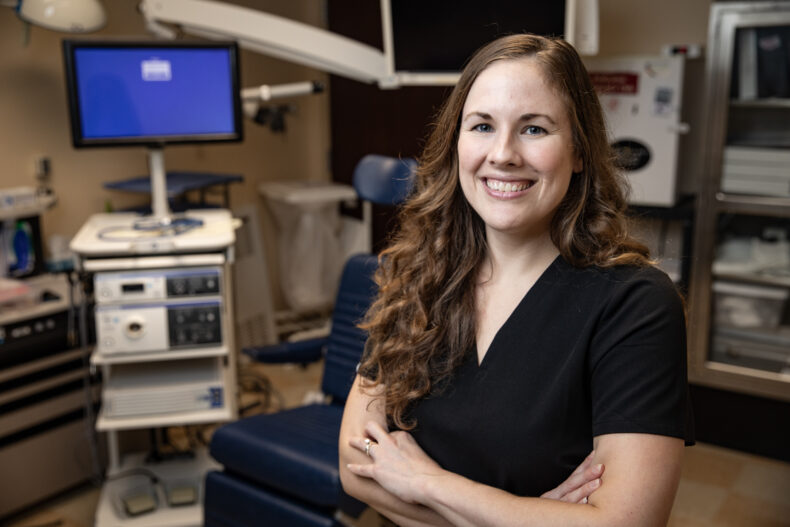
“His voice is the Cadillac of TEP voices,” said Rachel Crews, MS, CCC-SLP, speech pathologist III at the Vanderbilt Voice Center. “When you hear him, he has the most fluent, smooth voice. He’s a great example of an optimal TEP speaker.”
The alternative for some patients is to use an electrolarynx, a device that is held against the throat and produces vibrations that create sound without the help of vocal cords. But in Hannon’s case, it’s his esophagus that produces sound.
“Before, the vocal cords were vibrating when air moved through them, but we don’t have those anymore, so we have to vibrate other tissue,” said Crews, who is one of a number of speech therapists who has assisted Hannon in his recovery and TEP upkeep. “Patients often prefer TEP speech because the vibrating esophageal tissue tends to sound the most like their ‘old’ voice. It’s kind of like a guitar string: the thicker a guitar string is, the lower the pitch; the thinner it is, the higher the pitch.”
Hannon’s voice is indeed very low, but it’s also smooth enough that if you heard him speak over the phone, you would never know he lacked vocal cords.
“Had I known, even when I first got diagnosed with cancer, that this would be the outcome, and that this would be as manageable as it is … I would’ve opted for a total laryngectomy all the way back in 2016,” Hannon said.
Professionally, he switched from playing in a band to producing music, and his accolades include over a billion streams, more than 4 million albums sold and multiple No. 1 albums and songs.
He also continues to enjoy life with his wife and two sons, and he has switched to a plant-based diet, citing the unexpected cancer diagnosis as the motivating factor to control everything he possibly can about his health.
He visits the Vanderbilt Voice Center every three to six months to have the prosthesis changed out and check in with the speech therapists.
“The credit goes to the best speech pathology program in the country,” Langerman said of the center. “They have tons of experience with laryngectomy patients.”
Speaking for the first time
Hannon’s experience speaking for the first time after surgery represented a major victory.
“The relief in that moment was hugely encouraging, and it’s what informs my desire to encourage people who might be going through the same thing,” he said. “Cancer is hard enough in any context, but when it can alter your identity so greatly … the anxiety that goes with that can be pretty depressive.”
“Speech is how we express ourselves,” Crews noted. “Dan is in the business of voice with his job, so for having had to go through something so radical with his own voice, we’re so pleased with how amazingly he communicates. He is such a testament to living life well after this diagnosis.”

Having a stoma and a TEP has resulted in some life changes for Hannon. Fortunately, he said it’s not as difficult to get used to them as one might imagine, and they even make for some occasional hilarity.
“My kids will joke, ‘If you want Dad to shut up, just grab his hands,’” said Hannon, who can still talk with his hands, provided he only uses one at a time. Things get trickier, however, when he has to press multiple buttons at once.
“In the studio environment, when you have an artist on the microphone, you have to push a button called a talkback button to communicate with them from the other room. And there are plenty of times when I don’t push both buttons at the same time. I’ll push my button to start talking and realize they’re not hearing me because I didn’t press both simultaneously.”
Perhaps the most comic relief from having a TEP button is what happens when something is unexpectedly funny and the individual can’t reach their button before laughter strikes.
“Sometimes, I’ll naturally belt out air because I’m laughing spontaneously, and a burst of air will just blow my button out on the floor, which makes it even funnier,” he said.
Hannon lauded the willingness of his care team to be available whenever he needs help and to provide lifelong support.
“That’s the nature of this whole institution,” said Hannon. “Everybody I’ve ever encountered here has been phenomenal, even down to the first-day interns. They’re engaging, curious and helpful. It’s been an amazing experience.”