


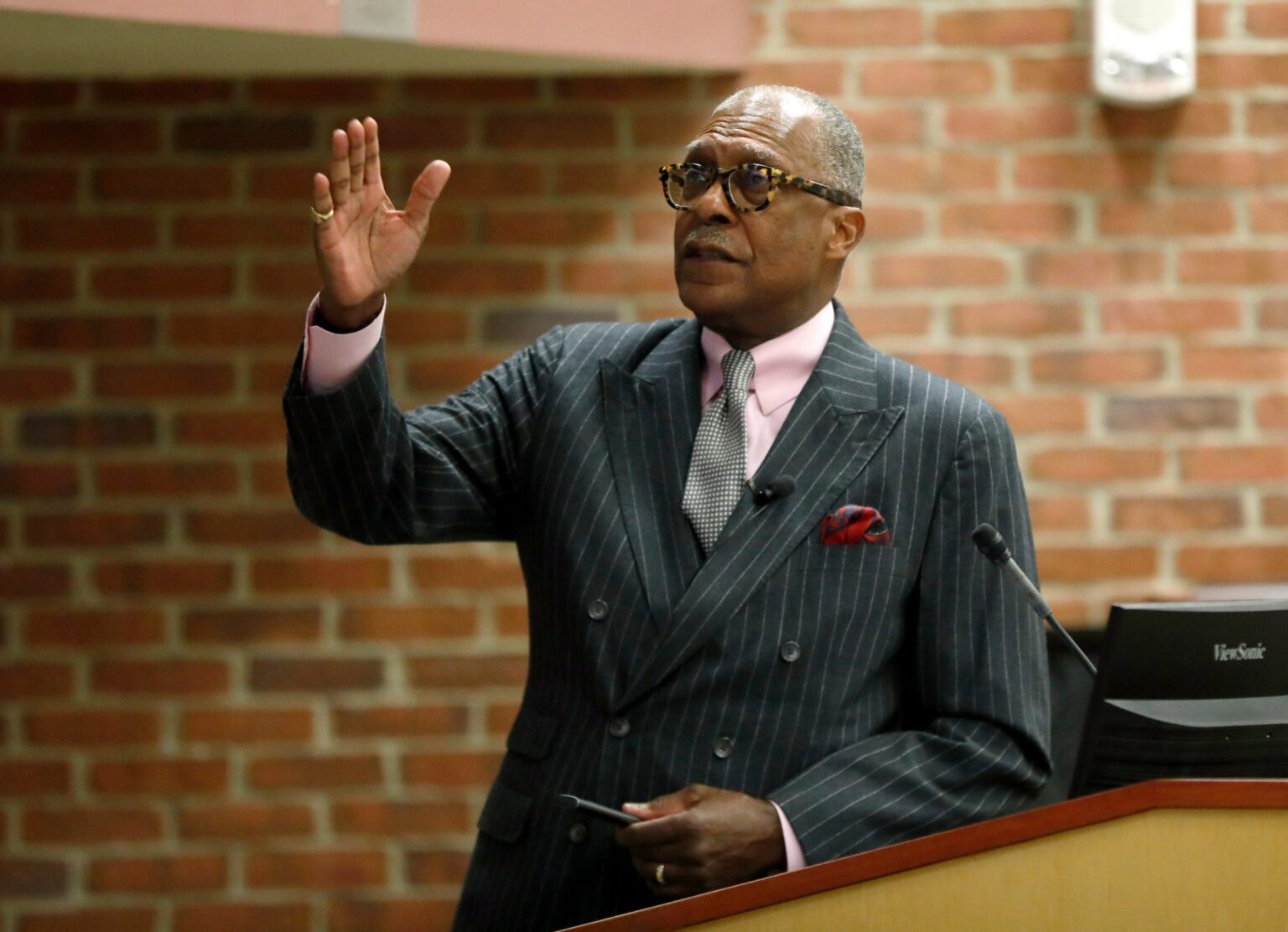
 André Churchwell, MD, called his friend Levi Watkins Jr., MD, a "blazing supernova." (photo by Donn Jones)

One decade after the passing of distinguished surgeon and researcher Levi Watkins Jr., MD, his friend and former colleague André Churchwell, MD, reminded a lecture hall of listeners that it is crucial to speak often of our heroes and share lessons from their examples.
Churchwell, the Levi Watkins Jr., MD, Professor of Medicine and professor of Biomedical Engineering and Radiology and Radiologic Sciences at Vanderbilt University Medical Center, and senior adviser to the chancellor in Outreach and Community Engagement at Vanderbilt University, talked about his personal memories of the distinguished surgeon and researcher during the recent 24th annual Levi Watkins Jr., MD Lecture. The event is part of the Deans’ Lecture Series.
“We are 10 years out from the death of one of my great heroes, Levi Watkins, in April of 2015,” said Churchwell. “When I was asked to do this presentation, it made me realize that we need to keep talking about him, so his life lessons are not forgotten. … He is one of those figures who will have importance and resonance for all of us for eternity.”
Churchwell recognized a group attending the lecture — undergraduate scholars from the Dr. Levi Watkins Jr. Institute at Tennessee State University, as well as the institute’s chair, Barbara Murrell. This program, named in honor of Watkins, who is a TSU alumnus, offers qualifying students an accelerated three-year track to a Bachelor of Science degree in biology or chemistry. Completion of the program also guarantees consideration and support for students who meet the criteria to enter medical or dental school.
In 1966, Watkins became the first African American student admitted to Vanderbilt University School of Medicine and was the only African American student at Vanderbilt until he graduated in 1970. Watkins continued his career at Johns Hopkins and Harvard University, becoming a leading physician-scientist, mentor and role model for countless students, trainees and faculty members.
He is noted for performing the first surgical implantation of an automated heart defibrillator in a human patient in 1980, a procedure that is still a first-line treatment for those at risk for sudden death due to cardiac arrhythmia. His research in the use of angiotensin blockers for patients with congestive heart failure who cannot tolerate the side effects of ACE (angiotensin-converting enzyme) inhibitors contributed to the safety and efficiency of the treatment.
As a young man, Watkins was a volunteer driver for Martin Luther King Jr., and he soon became active in the Civil Rights Movement. Throughout his career, he was especially passionate about increasing opportunities and advocating for those from historically marginalized groups in medicine and the biomedical sciences.
Churchwell, a Nashville native, became aware of Watkins — whom he called a “blazing supernova” — when his mother brought home a 1966 TSU yearbook. She pointed out a handsome, well-dressed young man, a senior premed student from Montgomery, Alabama. Watkins’ photo was beneath the superlative “Mr. Brains.” He was also student council president, among other achievements.
Churchwell decided Watkins would be someone good to emulate, and they should be friends, as well. The pair quickly formed a lifelong bond, bolstered by the fact they pursued careers in cardiology and had shared experiences at both Vanderbilt and Harvard.
Churchwell shared that Watkins was a gifted orator, almost ministerial in his delivery of his views, and he never hesitated to stand up for what he knew was right. And his friend was committed to excellence in every endeavor and would never rest until he reached the “best.”
“Once we were chatting, and he paused and said, ‘We will have eternity to rest. Right now, we’ve got to be busy!’” Churchwell said.
Churchwell shared wisdom from Watkins he called “Levi’s Lessons.” They are:
- Always reach for excellence.
- Keep your own data.
- You are no better than the staff or the people you serve, so acknowledge everyone and treat them with respect.
- Find great mentors, and you must mentor others.
- Commit your life to serving others.
- Preach whenever possible.
- Look good in public.
- Drive a nice car. (Churchwell recalled Watkins’ sleek, white 1980 Buick Riveria with white leather interior.)
Ashish Shah, MD, professor and chair of Cardiac Surgery at VUMC, was just beginning his career at Johns Hopkins at the time Watkins was an esteemed professor in the Division of Cardiac Surgery and a vice dean of the Johns Hopkins University School of Medicine.
Shah remembered that as a junior faculty member among a roster of renowned cardiac surgeons, he was not initially being referred patients. Watkins, who was nearing retirement, noticed and began sending patients his way.
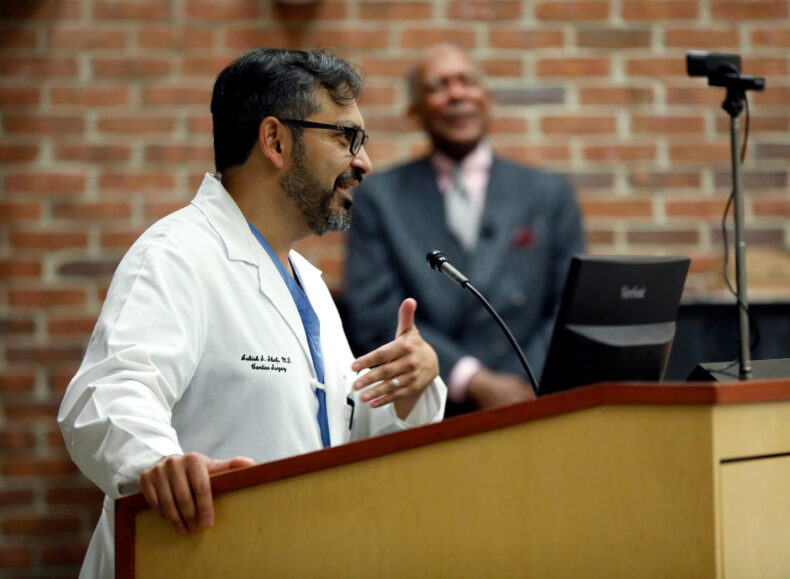
“He’d stop by my office and say, ‘I have a patient for you.’ And I would look around and say, ‘Me? The world-famous guys are down the hallway. … And they weren’t easy cases. He wasn’t going to try to lowball me and give me something easy or something difficult that I couldn’t do.
“They were hard, because he was still getting these very complex referrals. … Dr. Watkins did difficult things. His work on social justice was difficult. His work in the community of Baltimore was difficult. And from a cardiac surgery standpoint, his work was really difficult. He did work in arrhythmia surgery. These are people now who we’d take into the lab and ablate a few things, and they’re going to be OK. Dr. Watkins was doing operations that were very high risk, very lethal, very complex, and he was very successful at it.”
Shah was with Watkins on the day in April 2015 when he had the heart attack and subsequent stroke that would cause his death. He was by his hospital bedside, knowing that the extraordinary man he had orbited for a decade was dying.
“He took great personal pride in all of our accomplishments, and I think if he looked at that list of people (whose lives he impacted) and the things they’ve done — that’s what made him immensely happy,” said Shah, who holds the Alfred Blalock Directorship in Cardiac Surgery at VUMC. “If you come away with one thing, recognize that in the midst of pain, he imparted joy. He made other people around him better and happier. … Not a day goes by that I don’t think about that man.”

