



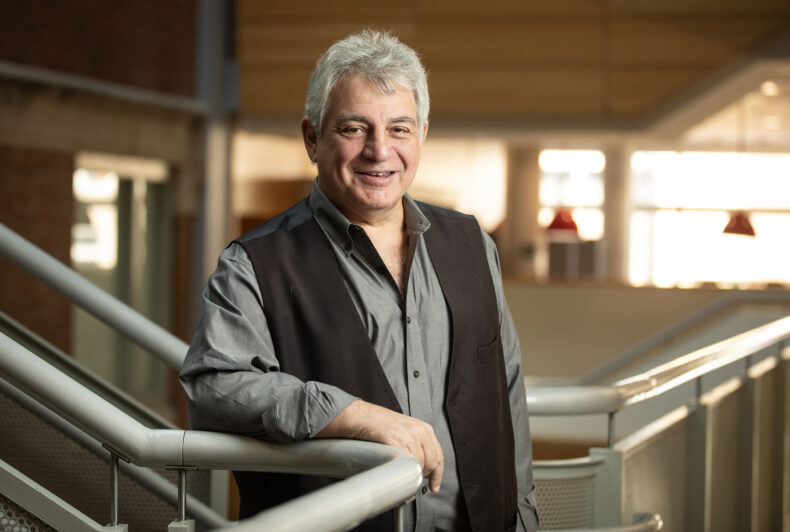




Ronald Emeson, PhD, the Joel G. Hardman and Mary K. Parr Professor of Pharmacology and longtime chair of the Institutional Animal Care and Use Committee (IACUC), will retire at the end of December after nearly 35 years on the Vanderbilt University faculty. He will continue to serve as IACUC chair through the next animal care and use accreditation site visit, expected by the end of April 2026.
In the early 1990s, Emeson was one of the first scientists in the world to explore a newly discovered biological process called RNA editing, a mechanism by which cells can subtly change the function of proteins and noncoding RNAs to fine-tune their activities. His team’s pioneering research made seminal contributions to the field and laid the foundation for understanding how RNA editing contributes to the regulation of neuronal function.
He has been dedicated to graduate student training — in his laboratory, on doctoral dissertation committees, and as a course director and instructor — and has spent countless hours serving the university on committees, councils and task forces.
Reflecting on his career, Emeson said the best parts have been “the science, the students, the opportunity to work with talented colleagues, and the IACUC.”
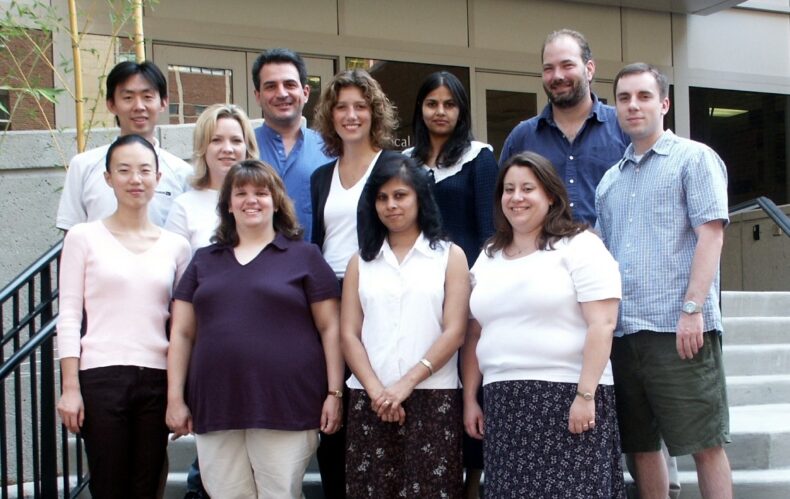
The IACUC (pronounced as a word: eye-uh-cook) helps to ensure that all research, teaching and testing activities involving vertebrate animals are conducted responsibly and humanely. As a federally mandated oversight group, it works to make sure these activities meet the highest ethical, legal and scientific standards for animal care and use. The committee meets monthly; its members include scientists representing all areas of research at Vanderbilt Health, Vanderbilt and the Nashville VA Medical Center, nonscientists, veterinarians and community members.
Emeson began serving as IACUC vice chair in 2007 and became chair the following year. He inherited a meeting gavel engraved with the words: IACUC Chairman — What were you thinking?
“Despite the fact that the committee largely deals with regulatory compliance, I think I’ve propagated an environment that (the members) both enjoy and recognize the importance of the committee’s work,” Emeson said.
The IACUC follows the “3R” policy, a foundational ethical framework for the humane use of animals in research, “to use the fewest number of animals necessary to achieve scientifically valid results, to modify procedures to minimize pain, distress and suffering, and improve overall animal well-being, and to use alternatives to animals whenever possible,” Emeson said. “Animals don’t get a choice about participating in scientific research, so it’s our responsibility to treat them in the most humane way that we possibly can.”
“Ron has been the ideal IACUC chair — respected, principled and knowledgeable,” said Jeanne Wallace, DVM, Vice President for Animal Care, professor of Pathology, Microbiology and Immunology, and attending veterinarian. “His decades of experience as an NIH-funded investigator and Vanderbilt faculty member give him a unique perspective on the complexities of biomedical research. He balances a strong commitment to compliance and animal welfare with unwavering support for scientific progress.
“Ron welcomes diverse viewpoints, fosters constructive dialogue, and guides the committee toward consensus — even on challenging issues. His leadership during a time of growth and change has left a lasting impact on Vanderbilt’s Animal Care and Use Program,” Wallace said.
Eric Delpire, PhD, professor of Anesthesiology, has served as IACUC vice chair with three different chairs.
“Ron and I have had the longest run together, and I am sad that it is coming to an end,” said Delpire, who holds the B.H. Robbins Directorship in Anesthesiology Research. “Ron has filled the role of chair with excellence for so many years. He is recognized for his dedication to the IACUC mission, his time commitment, and his sense of humor. The time he has committed to the IACUC is incalculable, even setting his vacation time around full committee meetings to make sure he didn’t miss any.”
Delpire also noted that Emeson has been a valued scientific colleague.
“He’s always happy to talk about science and collaborate,” Delpire said. “While his expertise is in RNA editing, he has touched so many areas of neuroscience that it is difficult to describe his many contributions — the evidence is in the many high-profile papers he has published over the course of his prestigious career.”
Emeson has trained 23 doctoral degree candidates, seven master’s students, and five postdoctoral fellows in his laboratory, and he has served on 90 doctoral dissertation committees — the panels of scientists who evaluate and guide each graduate student’s doctoral progress and trajectory. Emeson has been an active instructor for 19 different courses and a director and instructor for many years of the courses: Scientific Communication Skills, Pharmacological Targets and Mechanisms, and The RNA World. He is a three-time winner of the Teacher of the Year Award presented by graduate students in the Department of Pharmacology.
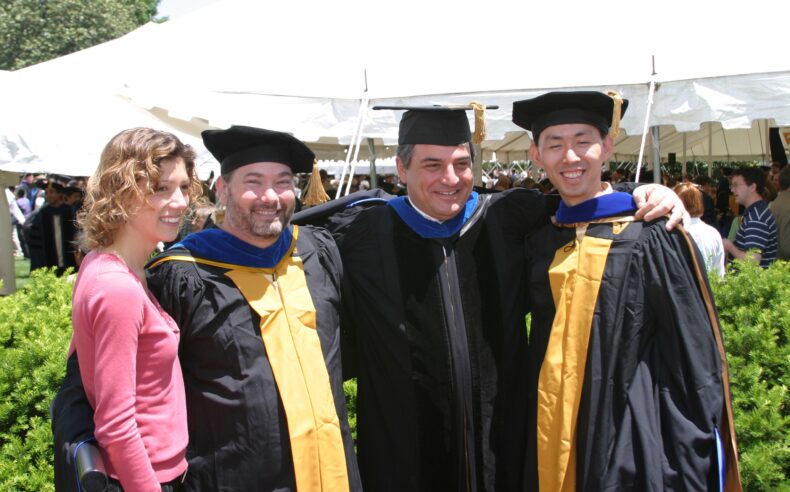
Emeson’s first graduate student, Colleen Niswender, PhD, ultimately joined the Vanderbilt faculty.
“Ron was an excellent thesis mentor,” said Niswender, associate professor of Pharmacology. “He has a gift for explaining complicated material in a simple-to-understand way, and he excels at public speaking. He passed this on to all his trainees, which has served me extremely well over time.”
Niswender said her training with Emeson has guided her role as a mentor.
“I learned valuable information about how much latitude to give to grad students to help them balance their independence with the necessary support for success,” she said. “Each student is different, and Ron’s style helped me hone my own to enable supporting students in an individual way.”
In Niswender’s doctoral research with Emeson, the team discovered that a serotonin receptor was regulated by RNA editing, which changed its signaling activity. For many years after her studies, there were no other receptors in the same superfamily (G protein-coupled receptors) that were found to be edited.
“Imagine my surprise (a few years ago) when Ron called me and said one of the receptors I was currently working on was regulated by RNA editing,” Niswender said. “And so, long after my graduation from his lab, we began a new collaboration that has led us to this point, where Ron is now transitioning one of his projects to my group. Full circle!”
The project is testing RNA editing as a therapeutic strategy to treat genetic disorders.
“We have some really great results using RNA editing to treat the neurodevelopmental disorder Rett syndrome,” Emeson said. “The Rett syndrome studies are a proof of principle that RNA editing could be used as a therapeutic strategy for any genetic disorder that results from a guanosine (G) to adenosine (A) mutation in the genome.”
Emeson gets philosophical about stepping away from his decades of research.
“In science you’re never really done with anything,” he said. “There’s a famous (Sir Isaac) Newton quote: ‘If I have seen further, it is by standing on the shoulders of giants.’ Everything we do builds upon the discoveries of the people who came before us. We make advances on their work, and the next generation will make advances on our work.
“I’m satisfied with the contributions my lab has made, that we worked hard, that we always tried to excel, and that we had some fun along the way.”

Emeson may be putting down the pipettes, but he’s picking up other tools in their place.
After he sees the IACUC through the next three-year accreditation site visit, he’ll pursue another passion. A lifelong cook, Emeson said he started baking “fancy stuff” during the pandemic and then started teaching small group baking classes in his home.

“Baking can be very scientific in its precision; following a recipe is like following an experimental protocol. And I like to teach,” he said.
But he felt like he needed “street cred” to teach baking classes. So, he and his wife will be off to Paris, where he will enroll in a one-year program at the Le Cordon Bleu School of Culinary Arts to earn his Diplôme de Pâtisserie et de Boulangerie (pastry and bread).
Emeson completed his bachelor’s degree in biology at The Johns Hopkins University and earned his PhD in physiology from the University of Colorado Health Sciences Center. He completed postdoctoral training and was a research associate of the Howard Hughes Medical Institute at the University of California, San Diego.
He joined the Vanderbilt faculty as an assistant professor of Pharmacology in 1991 and was awarded the Joel G. Hardman and Mary K. Parr Endowed Chair in Pharmacology in 1998. He also holds secondary faculty appointments in the Departments of Biochemistry, Molecular Physiology and Biophysics, and Psychiatry and Behavioral Sciences.
He has been an associate editor of Frontiers in Pharmacology since 2022; was on the editorial board of the Journal of Biological Chemistry from 2016 to 2022; and has been an ad hoc reviewer for 46 journals.
Among his many university service contributions, Emeson served as director of Graduate Studies for Pharmacology, deputy director of the Center for Molecular Neuroscience, associate director of the Vanderbilt Brain Institute for 13 years and interim director from 2016 to 2018, and chair of the Scientific Advisory Committee for the Vanderbilt Genome Editing Resource. Emeson received the Thomas Jefferson Award in 2015 “for distinguished service to Vanderbilt through extraordinary contributions as a member of the faculty in the councils and government of the university.”


