


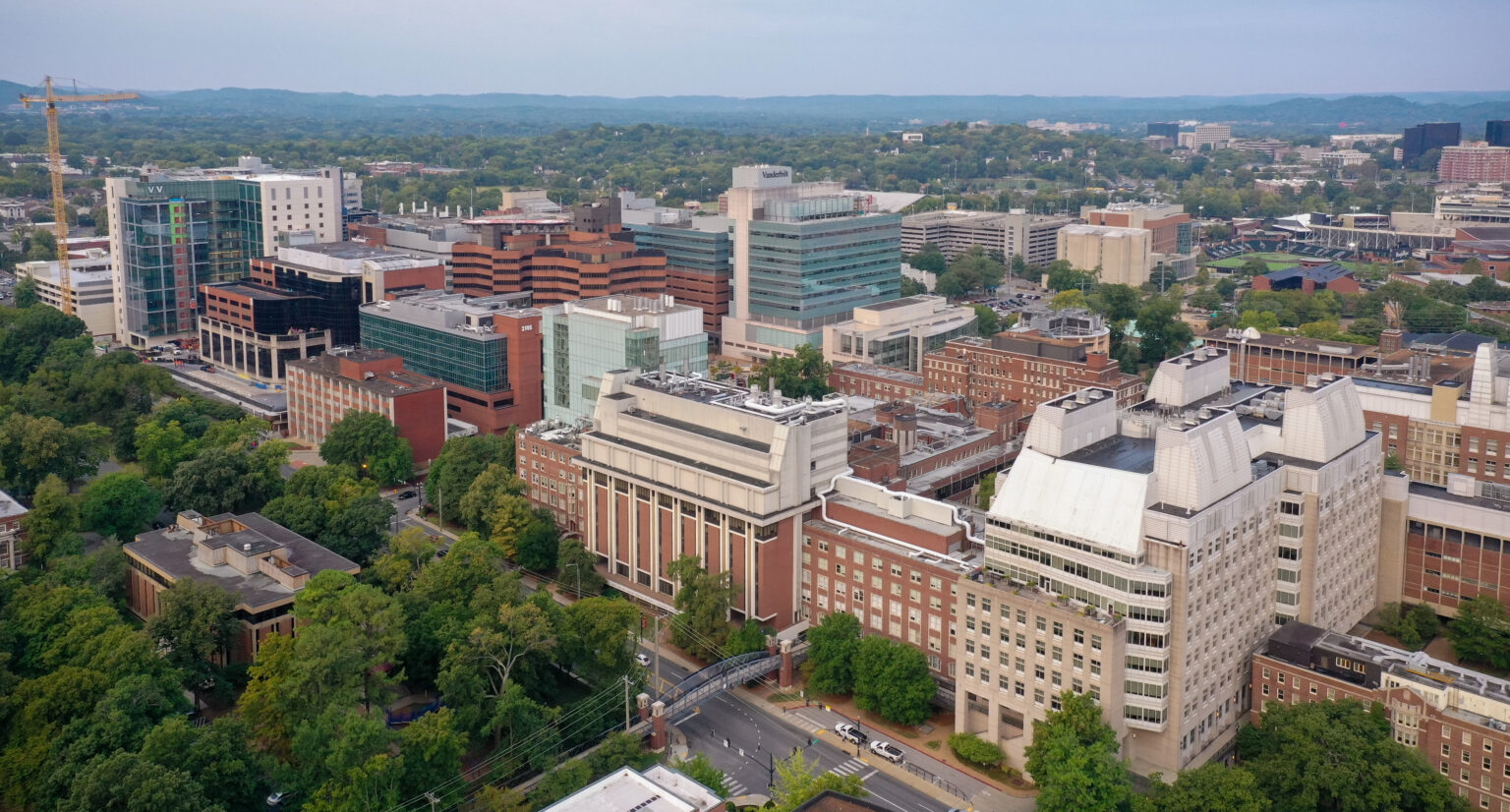
 The Main Campus of Vanderbilt Health in Nashville, Tennessee in 2025 (photo by Brian Hallett)

How can health care organizations implement impactful and long-lasting culture change that will meet patients’ expectations and improve their experience?
Five Vanderbilt Health leaders addressed that question April 15 in NEJM Catalyst, peer-reviewed research and commentary published by the New England of Journal of Medicine.
Their contribution, “How to Transform a Health System’s Organization Structure and Hardwire It for the Future,” was a case study in how to create, and maintain, a strategic cultural renewal.
“Cultural frameworks alone are insufficient without consistent reinforcement and adaptation to changing organizational demands,” they wrote. “Engaging, relevant content, combined with visible support from leadership, can drive voluntary participation and generate measurable outcomes.”
Contributors were first author Brian Carlson, MHSA, MBA, vice president of Patient Experience, Nancy Lorenzi, PhD, MA, MS, emerita professor of Biomedical Informatics, Paul Sternberg, Jr., MD, former chief medical officer, Cassandra Hennessy, MS, senior biostatistician, and Dandan Liu, PhD, associate professor of Biostatistics.
Vanderbilt Health began reexamining its culture in 2017 after a period of rapid growth that included the adoption of electronic health records, increasing patient care complexity, and expanding patient volumes, workforce, and facilities beyond the central campus in Nashville.
Twelve years earlier, the organization had adopted a Credo statement, and Patient and Family Promise to guide employee behavior and patient interactions.
Based on this framework, and with the help of a working group, seven e-learning modules were developed under a new initiative entitled, “Defining Personalized Care.” Topics including “Listen to Understand” and “Power Up Positivity” were designed to reinforce core values and improve interpersonal behaviors across the workforce.
With the encouragement of their leaders, more than 39,000 employees voluntarily participated in the four-year-long road map, achieving an 80% completion rate. A single-center, pre-post study confirmed statistically significant improvements in patient experience scores, particularly in the communication and courtesy domains.
A second phase of the initiative, “Making Health Care Personal,” continued the culture change momentum. Despite the challenges of the COVID-19 pandemic, telehealth expansion, rising patient volumes, and increased operational demands, staff feedback and leader assessments reflected ongoing support for cultural reinforcement efforts.
“The outcomes described here reflect the work and ownership of our people, from the teams who developed ‘Defining Personalized Care’ and ‘Making Health Care Personal’ to all colleagues across the organization who live our Credo and Patient and Family Promise each and every day,” Carlson said.
“Our culture continues to be built through collective effort,” he said. “It is a privilege to be part of an organization so deeply committed to caring for patients and families and for one another.”
Lessons learned:
- Begin by establishing a clear, shared understanding of the need for a cultural change based on patient feedback, workforce insights, and values, rather than mandates from above.
- Assembling a multidisciplinary team is essential to ensure that content resonates with employees across roles and settings.
- Reinforce existing values frameworks rather than replacing them. The Credo and Patient and Family Promise provided a strong backbone for the cultural road map, while concise, emotionally resonant learning modules translated those values into actionable behaviors.
- Flexibility is critical. Adapting the timing, tone, and content of the modules during major disruptions such as the COVID-19 pandemic provided more uplifting content when needed and avoided overwhelming staff.
- Effective communication, through multichannel messaging, leadership assemblies, newsletters, and targeted reminders, combined with peer influence and leader endorsement, drove voluntary participation more strongly than formal requirements.
- Finally, treating culture building as a long-term investment, not a one-time fix, is essential for embedding values into the fabric of an organization, and achieving meaningful improvements in patient experience.