


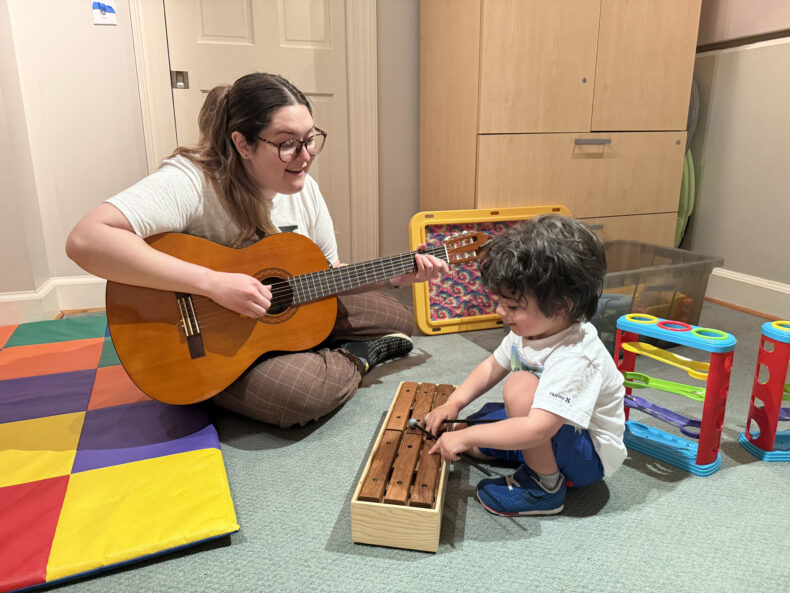
 Patient Kai Chan works with Jess Knoble, MT-BC, at the Vanderbilt Music Cognition Lab.




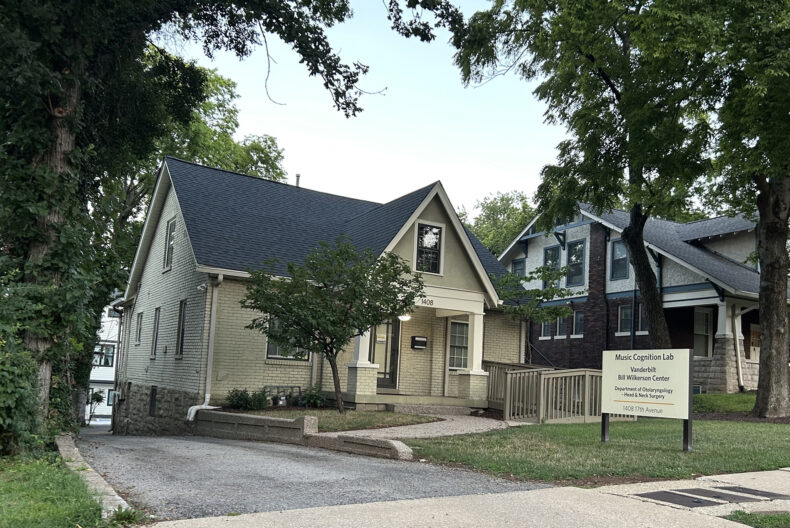
To celebrate its 10th anniversary, the Vanderbilt Music Cognition Lab will host its fourth annual open house from 5 to 7 p.m. Thursday, Aug. 28, at its “lab house” at 1408 17th Ave. S., located along Music Row.

Researchers at Vanderbilt University Medical Center are on their way to finding out what science has to say about why music is important for health. The latest edition of the annual open house invites the community to meet the scientists, engage in research demos, learn about how scientists measure “musicality,” and — appropriately — enjoy live music. This year’s featured performers and speakers include songwriter Tony Arata, electric violinist Tracy Silverman, singer Sara Beck and music journalist Jewly Hight.
“It’s neat to be a little spark of something different on this street,” said Jamee Berg, PhD, a staff scientist at the lab, whose office is situated in the lab’s second, newer space, also on 17th Avenue. “We’re looking for more creative ways to be a part of the community. Almost being a bridge between VUMC and Music Row, not only by proximity but by nature of what we’re studying.”
Open house attendees can chat with the research team about the many questions they’re exploring, including: How can music support parenting? What kinds of connections exist between music and language? How is musicality related to biology, mental health and human development? How are music, science and medicine related?
Miriam Lense, PhD, associate professor of Otolaryngology-Head and Neck Surgery and one of the co-directors of the Music Cognition Lab, reflected on ringing in its 10th anniversary.
“What we’ve seen over the years is a lot more collaboration, a lot more people coming together and a lot more institutional awareness, both at Vanderbilt and more broadly, of the importance of this type of work and how we can use music science to understand basic facets of the human condition, as well as leverage it for therapeutic purposes. I think it’s very powerful in that way,” said Lense.
Lense’s fellow co-directors are Reyna Gordon, PhD, associate professor of Otolaryngology-Head and Neck Surgery, and Srishti Nayak, PhD, research assistant professor of Otolaryngology-Head and Neck Surgery. The wide-ranging expertise of the lab’s faculty and staff supports a vibrant research enterprise that also provides interventions to people of all ages and abilities who may be positively impacted by the health benefits of music.
Since the lab’s founding 10 years ago, the team has made key discoveries in areas including the genetics of human musicality, connections between musical rhythm and language and harnessing music to support social-emotional well-being in families. The lab’s work has been featured in events hosted by the National Institutes of Health and the National Endowment for the Arts.
“Across our research, we seek to integrate different types of data about both individuals and groups, drawing on methods from fields that don’t traditionally talk to each other,” said Nayak. “Music is both a powerful tool for implementation in a therapeutic setting and a lens through which we can understand important differences among populations.”
The lab offers personalized interventions that serve children both with and without developmental differences, and the greater scientific community benefits from the lab’s constant stream of research initiatives.
“[Families] are coming because they want to have their child be part of research and also get the benefit that we’re able to provide as part of that research,” said Amy Smith, PhD, MT-BC, a music therapist and research fellow who also works as a facilitator in the lab.
Among the current research programs offered in the lab, parents can bring their children in for semester-length intervention courses that aim to enhance social communication skills, and children can also receive an autism evaluation if they haven’t received one previously.
“Developmental research is designed to be fun activities for children,” said Nayak, whose background includes extensive work with the early childhood age range.
The methodology for intervention-based research varies based on the child’s interests. Some children might be drawn to toys such as planes, trains and automobiles, while others might be more eager to engage with art or music.
“You are literally personalizing medicine,” Nayak added. “Because you’re saying the intervention is not one-size-fits-all, which is both the scientific goal and also the value that the families are getting out of it.”
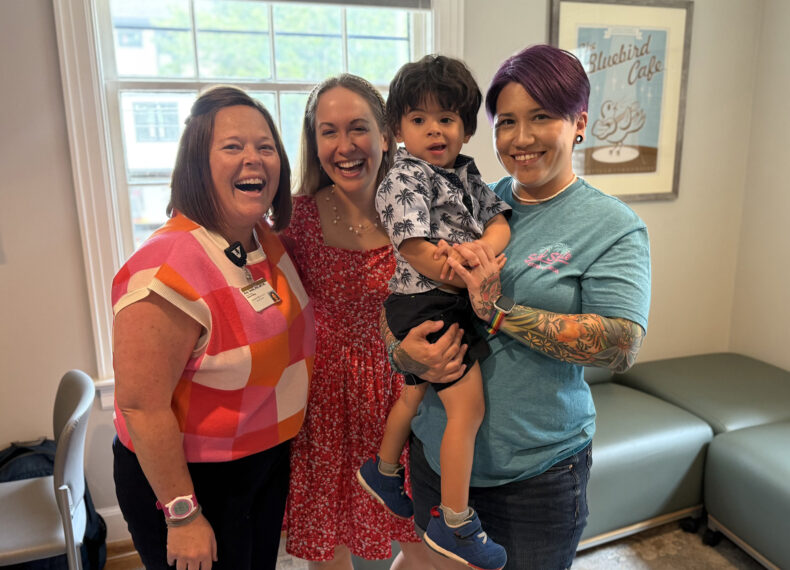
Jess Chan brought her 2 1/2-year-old son, Kai, to the Music Cognition Lab for a study, knowing the benefits of his time there would go both ways.
“We were really interested in helping them out, and then also benefiting him, hopefully improving his communication skills,” said Chan, noting that by the end of the 16-week program — which she described as “always child-led” — Kai had “really improved in a lot of different areas.”
Chan said her son now communicates with more gestures and will often grab his parents’ hands or show them what he wants to do — something Chan suspects he picked up while in the lab’s program.
“I feel like they gained a lot of information by working with him … and he got the benefit from working with a therapist one-on-one twice a week,” Chan added. “That was very beneficial to him. I think their program and study did have a large impact on his improvement.”
And it’s not just families and the greater scientific community who benefit. Researchers and facilitators themselves find a great deal of fulfillment in the work for a variety of reasons.
“One of the great things about being a researcher is that we’re always learning,” said Lense. “I think music is something that touches everybody’s lives in some way. It’s a part of our humanity; we use music in so many different ways. I think it’s really rewarding to realize the ways in which we engage with music to impact our health and development.”
They also deeply appreciate the privilege of working with people of all ages and abilities — and there’s certainly a special place in their hearts for working with kids.
“I came from a very clinical background,” said Smith. “Coming here, I get to use my clinical skills. The translational piece is what’s really my passion — getting what we’ve learned back out to people in the form of an intervention. I can sit behind a computer and write manuscripts all day, but when I get to come into this room and play with kids, that’s the most fun.”
Chan praised Smith’s ability to connect with kids, sharing that Smith and Jess Knoble, MT-BC, a fellow music therapist who works with children at the lab, played guitar for Kai and sang him songs.
“Sometimes they would mention his name in the song, and right away he would start dancing,” Chan said. “If he was upset, it helped calm him down.”
Kai’s musicality has come home with him. He enjoys playing his drums and guitar with his family, which Chan thinks is due in part to the exposure he received to music during his sessions at the lab. And as the researchers would be quick to point out, anyone can be musical in any number of ways.
“You enjoy listening to music, that’s musicality. You sing a lullaby to your child, that’s musicality. You take music lessons, that’s musicality,” said Lense. “It’s not just about being a performer; it’s about how we use music in our everyday life.”
If you or someone you know are interested in learning about musicality and joining in on the fun, this year’s open house is the perfect place to start. Mark your calendar for August 28th at 5 p.m. for a trip to Music Row. RSVPs are optional but appreciated. Those interested can also email musichealth@vumc.org with any questions.
The open house is sponsored by the Department of Otolaryngology-Head and Neck Surgery at VUMC and The Curb Center for Art, Enterprise and Public Policy at Vanderbilt University.


