


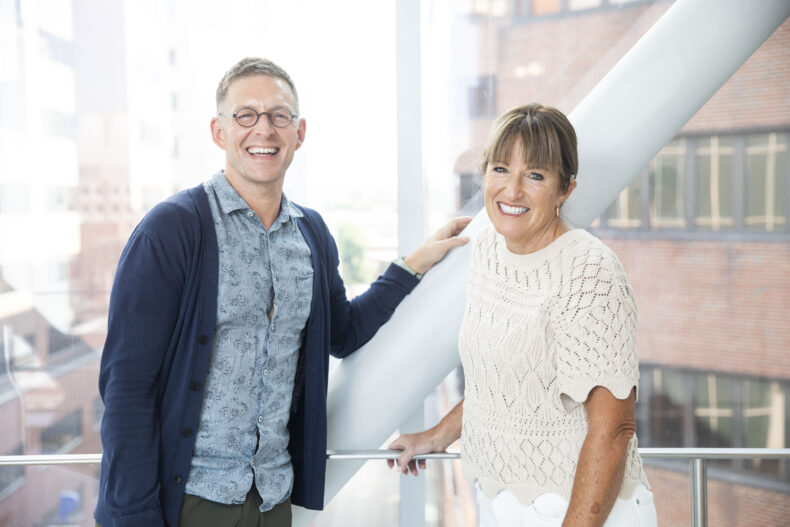
 Audiologist Jonathan Neukam and Jennifer Pack worked as a team to optimize Pack's cochlear implant. (photo by Susan Urmy)




In 2024, Jennifer Pack of Smyrna, Tennessee, underwent cochlear implantation at Vanderbilt University Medical Center. The procedure, which involves the insertion of a neuroprosthesis to restore the sense of hearing, put an end to decades of struggling with hearing loss.
After progressively losing her hearing as a teenager, Pack navigated life with the help of hearing aids. But as she got older, life got busier — read: four children and a full-time job as a realtor — and the strain of hearing loss became more pronounced.
At the most difficult points, Pack felt mentally exhausted, estimating that she only had about 40% of her hearing comprehension capability. And in her life circumstances, that didn’t cut it. Not being able to take down precise addresses for her real estate clients or fully hear her children was not an option. It was time to find a solution.
Upon learning she was eligible for a cochlear implant, Pack’s audiologist referred her to VUMC, where she met her surgeon, Marc Bennett, MD, MMHC, professor and executive vice chair of the Department of Otolaryngology-Head and Neck Surgery, and learned about the procedure. She was pleased to be coming to an institution she knew she could trust.
“Vanderbilt has a reputation of being exceptional in this department,” Pack said. “They are very well respected nationally and internationally, so that gave me a lot of confidence.”
Pack was just as eager to help the greater good as she was to receive her own device. When she was asked if she’d like to participate in a study on cochlear implantation, she said yes.
“My father is a retired medical researcher, so I was raised with an eye toward data and information,” Pack explained. “I said, ‘What can I do to help?’ … I was relying so much on data and other people’s experiences to make my own decision, so I wanted to be part of contributing that for people in the future.”
As it turned out, opting into the research was the catalyst for bringing another impactful person into her life: a VUMC research audiologist.
Research sets the stage
Jonathan Neukam, AuD, CNIM, CCC-A, a research audiologist at the Vanderbilt Bill Wilkerson Center, studies cognitive effects and constraints in cochlear implant users in the Cochlear Implant Cognition and Communication Lab under the co-direction of Terrin Tamati, PhD, assistant professor of Otolaryngology-Head and Neck Surgery, and Aaron Moberly, MD, associate professor of Otolaryngology-Head and Neck Surgery.
Pack was enrolled in a study examining the combined effect of electric and acoustic stimulation. The complicated nature of this research means that enrolled participants often have the research audiologist take over their clinical cochlear implant follow-ups, which Neukam did.
Thanks to remote programming technology for Pack’s devices, she can take advantage of Neukam’s flexible schedule to set up additional remote clinical time to ensure the settings on her devices are correctly adjusted.
Neukam was initially unfamiliar with the process of remote programming but was eager to learn.
“That’s one of the things I love about him: He was like, ‘I’ll figure it out,’” Pack said. “So he learned what software he needed; he got it installed; and I was able to sit at my kitchen table and communicate with him in real time as he made adjustments to my devices.”
Despite not having hearing loss in common, Pack and Neukam connected over their shared knowledge and dedication to her treatment.
“I don’t have a cochlear implant, so I’m coming at this process from a different perspective,” Neukam said. “Every patient’s journey is unique, and I rely on hearing from them about their experiences to complete my understanding of their situation and to help hone my ability to care for them. Having that kind of relationship with a patient helps improve my existing knowledge about the device and how it works to restore the sense of hearing.”
“He’s so willing to troubleshoot anything,” Pack said. “I think this is common with researchers: They want to find solutions; they want to problem-solve.”
Not just for deaf people
One problem researchers want to solve is why only about 11% of people who could be helped by a cochlear implant receive one.
Neukam and Tamati are tackling that conundrum with mixed-methods research. Through interviews with patients who have been implanted and, like Pack, are eager to help the next generation of candidates for the technology, Neukam and Tamati hope to learn more about the barriers to patients receiving cochlear implants.
They are also eager to examine the ways people were motivated to receive cochlear implants.
“You can’t really talk about barriers unless you talk about facilitators as well,” Neukam said. “The candidacy criteria have changed dramatically over the last 20 years. More people are eligible because of that.”
Pack sees a lack of education as the largest barrier to more people taking advantage of cochlear implants.
“My preconceived idea was that cochlear implants are for deaf people, and I didn’t understand that they’re also for hearing-impaired people,” Pack said. “It’s rare enough that people don’t have a lot of firsthand experience with it. … And so when I think about the barriers to recipients, education is key.”
“This is how we become who we are.”
Pack lauded Neukam’s proactive approach to improving her cochlear implant experience. She said he’d always follow up after making adjustments to make sure things were running smoothly.
“I just feel like he goes so far above and beyond his responsibilities,” she said. “That’s the kind of guy that he is.”
Now about a year after receiving cochlear implants, Pack is considerably more connected with the community of people who have them. And should any of her peers ask for a recommendation for where to receive their audiology care, they’re sure to hear that VUMC is the place to go.
“I’m just the biggest fan of Vanderbilt,” Pack said. “I would not have been so comfortable moving forward anywhere else, just knowing that they’re going to give me the best available care based on the best information.”
“One of the most satisfying parts of my career is seeing … how people have truly turned their entire lives around just because they’re able to hear again,” Neukam said. “Hearing is essentially identity. This is how we become who we are.”


