


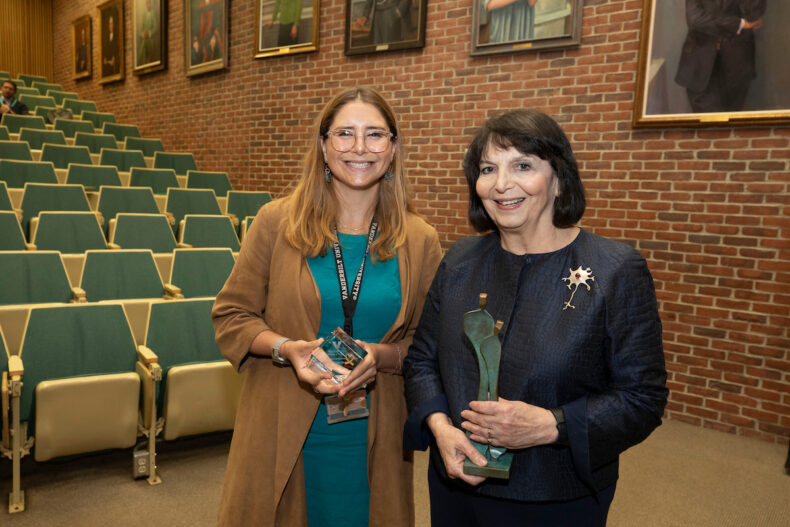
 The 2025 Vanderbilt Prize Student Scholar, Kimberly Bress, left, poses with her mentor, Vanderbilt Prize winner Huda Akil, PhD. (photo by Susan Urmy)




On Sept. 11, Huda Akil, PhD, the 2025 recipient of the Vanderbilt Prize in Biomedical Science, began her Discovery Lecture at Vanderbilt University Medical Center with a challenge.
“I’m at the stage of life where I want to use what I know for the greater good,” the internationally known neuroscientist said. “We’re doing amazing things in neuroscience, but we’re not helping people who are really struggling with brain-related disorders.
“We’re living in what I call ‘The Second Pandemic,’ which is kind of a dark time for humanity,” she continued. “The mental health crisis has been looming for a while, but it has accelerated in many ways. Science can do something in the here and now, and that needs to be communicated.”
Akil, whose research at the University of Michigan and Michigan Neuroscience Institute has helped reveal the fundamental nature of anxiety, depression, pain and addiction, did not dwell on tragedy, except to note the recent upsurge in depression and anxiety, particularly among young people.
Her lecture — titled “How Can Science Help with the Mental Health Crisis?” — provided a neurobiological perspective on stress and resilience, that elusive quality which enables some people to rise above adverse circumstances, while others are crushed by defeat and despair.
In their research, Akil and her colleagues breed rats based on how they react to stress and novelty. “High-responders” seem to embrace frequent, unpredictable changes in their environment, while “low-responders” fearfully recoil from change.
The goal of the research is to understand the genetic and developmental basis of differences in temperament (mood and behavioral tendencies), and how these differences affect one’s vulnerability to anxiety, depression and substance abuse.
It also is an exploration of the biological basis of resilience to stress. Is resilience merely the absence of vulnerability, or does it have its own biology?
For example, Akil and her colleagues discovered that a naturally occurring protein, fibroblast growth factor 2 (FGF2), is a natural antidepressant molecule that is lower in the brains of humans who are depressed. In animal models, it can reduce depression and anxiety behaviors.
Using their selectively bred animal lines, the researchers showed that FGF2 is naturally more plentiful in the brains of high-responding, risk-taking animals. When FGF2 is administered to newborn, low-responding rats, they grow up to be less fearful and more social.
This suggests that “FGF2 is a resilience factor,” Akil said. “Resilience can be induced, even in those very genetically anxious animals.”
These findings provide further evidence that genetics is not destiny. There are multiple types of vulnerability and resilience, she noted. Environmental factors, such as social support, can change outcomes.
Akil described her long-running study at the University of Michigan where she and her colleagues found that the COVID-19 pandemic “had a profound and sustained impact on the freshmen population.”
The social isolation that resulted from pandemic-related shutdowns was a major source of stress. Yet there were individuals with a high degree of genetic risk for depression and anxiety who proved to be resilient to the combined stress of entering college during a pandemic.
“We are not capturing the effect of social isolation,” Akil said. “How can we use our understanding … so that experiences are not cumulatively going in the wrong direction?
“We need to think more about prevention,” she said. “It my hope that together we can move toward a richer, more nuanced ‘Science of Resilience.’”
Prior to Akil’s remarks, the 2025 Vanderbilt Prize Student Scholar, Kimberly Bress, an MD-PhD candidate mentored by Akil, briefly described her dissertation research, which applies functional magnetic resonance imaging to study facial expressions (nonverbal communication) in people with autism spectrum disorder.
Akil’s lecture was sponsored by the Offices of the Chief Scientific and Strategy Officer at VUMC and the Dean of the School of Medicine Basic Sciences. More information about the Vanderbilt Prize can be found on the VUMC Office of Research website at www.vumc.org/oor.