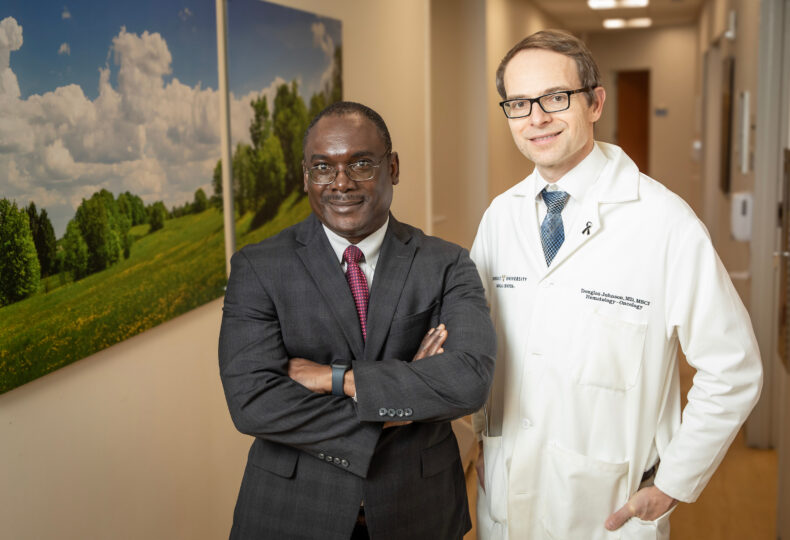

Douglas Johnson, MD, MSCI, professor of Medicine, is clinical director for melanoma and associate director for Translational Research at Vanderbilt-Ingram. He holds the Susan and Luke Simons Directorship.
Q: What is tumor-infiltrating lymphocyte therapy?
A: It’s a therapy where a patient’s tumor is removed, and white blood cells in the tumor — tumor-infiltrating lymphocytes, or TILs — are isolated, “supercharged” and given back to the patient so they can hopefully eliminate the tumor. It’s a little bit like CAR-T therapy, but in CAR-T therapy the white blood cells are engineered to specifically target the cancer, and with TILs there’s no genetic engineering. TILs are already in the tumor, recognizing and targeting something in the tumor; the idea is to boost their number and activity.
Q How many TIL therapies are there, and what kind of cancer can be treated with TIL therapy?
A: There is just one approved TIL therapy — lifileucel; it’s a first-in-class treatment. Right now, it’s only approved for advanced melanoma. It’s the first approved cellular therapy for a solid tumor.
Q: Which patients with melanoma are eligible for lifileucel?
A: Patients with metastatic melanoma who have already been treated with other available therapies, including immunotherapies and targeted therapies for a particular mutation, are eligible. The patients go through a battery of tests to make sure their heart, lung and kidney function are all in good shape. And they must have a tumor that can be safely removed by a surgeon, and that’s at least two-thirds of an inch in size.
Q: What happens during TIL therapy?
A: After the tumor is surgically removed, it gets sent to a company that isolates the TILs and treats them with growth factors to expand and “supercharge” them. That takes three to four weeks. When the TILs are ready, we give the patient high-dose chemotherapy similar to a stem cell transplant or CAR-T therapy. Then the patient is admitted to the hospital to receive the TILs followed by three days of high-dose interleukin-2, a growth factor. If everything’s OK after that, they can leave the hospital. In most places, patients are hospitalized from the start of chemotherapy up to about 30 days after treatment. We minimize time in the hospital by monitoring patients daily in the clinic and giving them wearables to track heart rate and other vitals. This is a real strength of
Vanderbilt-Ingram Cancer Center.
Q: What are the side effects of TIL therapy?
A: The TILs themselves have basically no side effects. The side effects come from chemotherapy, which can cause low blood counts, GI toxicities and hair loss. The high-dose interleukin-2 is also a very potent drug that causes low blood pressure and fever and can strain the liver and kidneys. We monitor patients very closely while they’re getting those treatments.
Q: How effective is TIL therapy?
A: About a third of patients are responding to treatment, which is not as high as we’d like. But when patients do respond, the response is very often durable, and patients are effectively being cured. It’s a complicated and toxic treatment, but when it works, it can be absolutely transformative.
Q: What’s next for TIL therapy?
A: Theoretically, this is the kind of treatment that can be used for any kind of cancer. Clinical trials of TILs for lung and cervical cancer are the furthest along. There are also efforts to get TILs from biopsies or from blood and to modify the TILs so the high-dose interleukin-2 isn’t required. I think the current version of TIL therapy is version 1.0, and I think we’re going to have many different versions over time. There’s a potential future where a majority of solid tumor patients are able to get these therapies and have them be curative in a percentage of patients.