


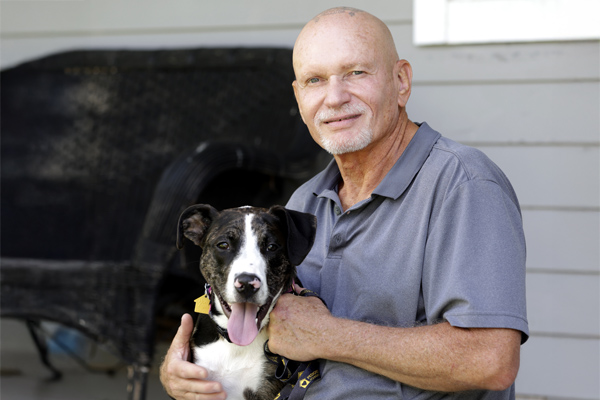
 Former Shade Tree Clinic patient Mark Patterson at home with his dog, Fin. (photo by Donn Jones)




When Mark Patterson was released from a Tennessee state prison in 2024, he was sicker than he’d ever been in his life.
Patterson, now 65, had been cycling through a 26-year pattern of substance abuse, encounters with law enforcement for nonviolent offenses, and incarceration. While imprisoned, he had been diagnosed and successfully treated for neuroblastoma, a cancer that begins in immature nerve cells throughout the body.
He’d survived two heart attacks, and he had high blood pressure and advanced liver cirrhosis. And that’s just what he knew about.
This felt different. Patterson could barely crawl out of bed. He was scared, and imprisoned or not, his deteriorating health left him unable to envision any future.
“It was really getting me down,” he said. “I had no idea how I would make it.”
Once released, Patterson went to live at a halfway house west of Nashville. The home wasn’t prepared for a resident with extreme medical needs, so they told him he had to leave.
That’s when he was connected with Dismas House, a residential reentry program in Nashville serving men released from state correctional facilities and county jails. Dismas House has an informal partnership with Shade Tree Clinic, the Vanderbilt University School of Medicine (VUSM) medical student-run clinic that provides free, high-quality care to uninsured individuals in Nashville.
Dismas House staff contacted Shade Tree Clinic leaders to see if Patterson might be eligible to receive care there and if they had room for him on their roster of 300 patients. After reviewing his case, the answer was “Get him here.”
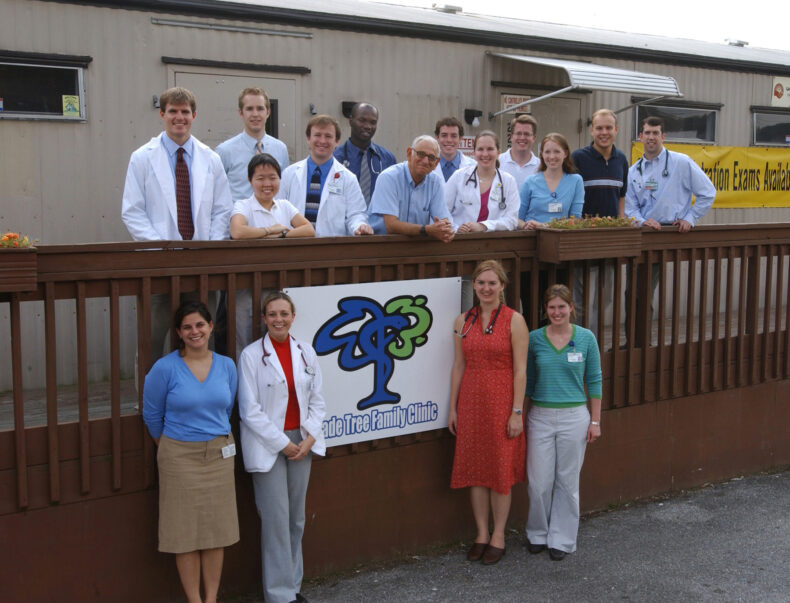
Marking a remarkable milestone
In 2025, Shade Tree Clinic marks two remarkable decades of providing comprehensive medical care and bridging gaps to vital resources to improve the health outcomes for, to date, more than 4,000 uninsured individuals like Patterson, while also generating innovative research and developing generations of socially minded medical practitioners.
Robert Miller, MD, a Vanderbilt pulmonologist, served as the clinic’s faculty medical director from opening day until his retirement this year. Dana Guyer, MD, one of the first student executive directors, remembered an early conversation with him.
“Sara [Corr] and I started telling him about the plans for the free clinic and all the things we had done so far,” she said. “We told him that lots of things were coming together but that we still needed a director. In his very gentle way, he paused and then said, ‘I’d be interested in that role.’ From that point on, he was deeply invested, and Shade Tree could not have been supported by a more conscientious, passionate and wise leader.”
Miller quickly saw that the environment for learning at Shade Tree was unlike what medical students experience in other settings.
“This has really been one of the most nurturing clinical settings for students to learn clinical medicine,” he explained. “Students are comfortable at Shade Tree, where they care for a complicated panel of patients along with VUMC faculty. The relationship between students and faculty is more relaxed than on the Main Campus.”
VUSM medical student volunteers spend more than 10,000 hours annually leading the clinic’s operations, and more than 90% of all medical students volunteer in some form at the student-run clinic during their years at VUSM. Nearly a quarter of all medical students serve in leadership roles.
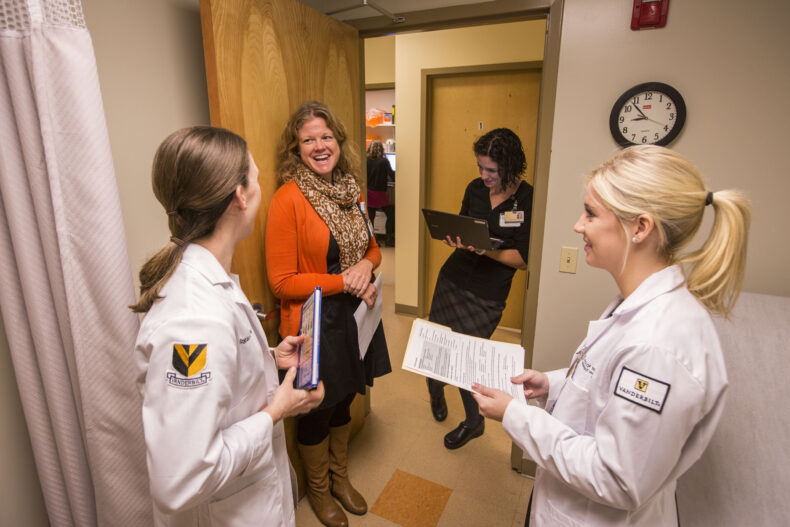
This hands-on clinical experience helps students better understand how health care needs intersect with social, economic and cultural differences, Miller said.Medical students collaborate with an interdisciplinary group of nursing, pharmacy, dietetic, social work, law and genetic counseling students, and faculty who also put in considerable hours providing care and consultations at Shade Tree Clinic.
Through the Middle Tennessee Medical-Legal Partnership of the Legal Aid Society of Middle Tennessee and the Cumberlands, two attorneys set up shop at Shade Tree Clinic monthly, and Vanderbilt University Law students come on Saturdays during the school year to address patients’ unmet needs for civil legal services.
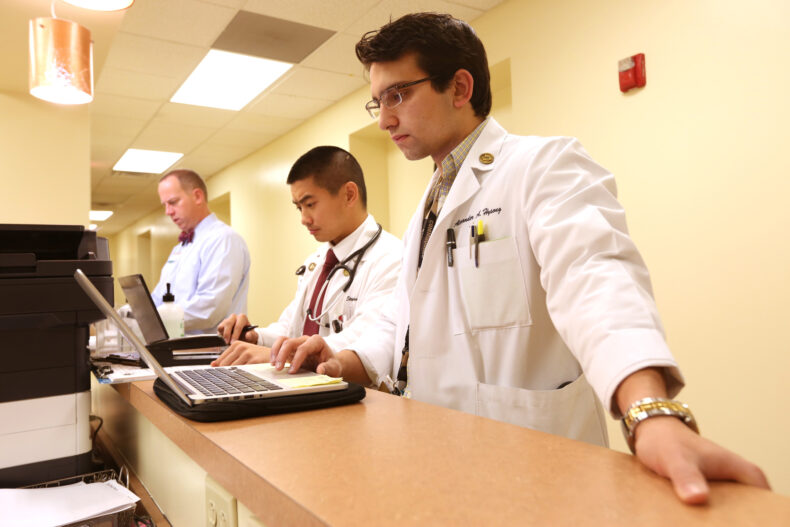
Integrated with Vanderbilt University Medical Center
The clinic is closely integrated with Vanderbilt University Medical Center, and patient care is documented in VUMC’s electronic health record system, Epic. This means if specialty care or surgical procedures are necessary at other Vanderbilt Health sites, all members of a Shade Tree Clinic patient’s care team can easily stay informed and participate.
In 2015, Dara Dixon, MSN, RN, clinic manager for the Zerfoss Student Health Center at Vanderbilt, began assisting the Shade Tree Clinic to ensure it meets compliance and regulatory standards, as well as other important operational details. As the Student Health Center runs on a similar no-fee model, Dixon’s experience as a problem-solver has often proven invaluable.
“I try to be as available to them as I can on an ad hoc basis,” Dixon said. “If something’s not going right, or they need some ideas, then they tap me. The medical students running the clinic take a lot of pride in this, and they want to do the right thing. I tell them, ‘This is the workflow at other Vanderbilt clinics, and I think this is how we can do it at Shade Tree.’ They take it and run with it.”
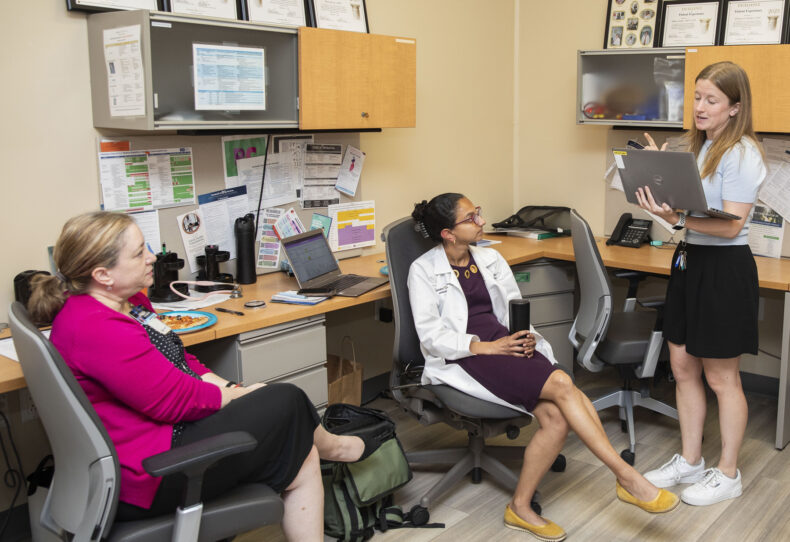
Medical students in the lead
This year, third-year medical students Callie Frey and Sarah Pennebaker share the duties of executive director of the clinic; both began volunteering as first-year students. They handle all calls to the clinic and help work through any patient care or operational issues that arise.
On a heavy day, they can receive upward of 20 voicemails, in addition to multiple texts back and forth with patients. And then there are the weekly meetings: case presentations to the executive board, along with finance, pharmacy, specialty clinic, and laboratory meetings.
“Sarah and I work 20 to 40 hours a week for Shade Tree, and I would 100% do it again,” Frey said. “This experience might not be something that gets you the highest honor or the best residency, but I believe it’s the reason Vanderbilt stands apart. I’m so glad that I lucked into getting into a program that had a Shade Tree attached to it. I have no words for how valuable this is.”
A population ready for care
At the time the clinic was founded, the state of Tennessee was experiencing a wave of newly uninsured individuals. In 2005, in response to the burgeoning cost of TennCare — the state’s expanded version of Medicaid — the state disenrolled some adults who were not eligible for traditional Medicaid. This left an estimated 300,000 adults without insurance and without access to affordable medical care. Miller began advocating in every corner about the need to make sure these individuals didn’t fall through the cracks.
So, when the doors of a double-wide trailer just off Dickerson Pike were opened that first day in September 2005, they knew the patients they needed to reach were out there. Shade Tree Clinic founders had an optimistic “if we build it, they will come” attitude. Initially designed to be a walk-in, community-based clinic, they hoped their efforts to spread the word about the clinic in the surrounding neighborhoods would pay off. Twenty years later, there is no doubt it has.
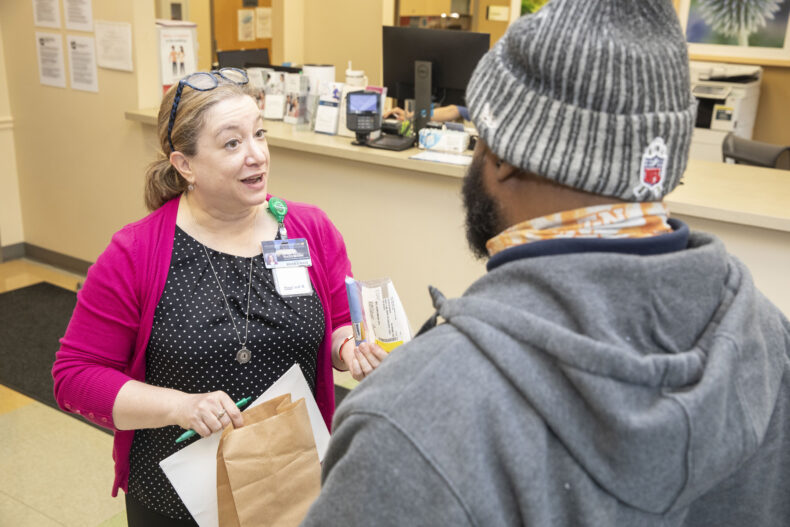
Miller remembered the first patient seemed a bit startled to be greeted by 10-15 excited VUSM medical students and several faculty volunteers. It didn’t take too many weeks before a line was at the clinic’s check-in desk.
“They really just needed someone to care,” said Sara Corr, MD, one of the first student executive directors. “And I think because we weren’t on campus, it didn’t have as much of a fear factor for them. We were just some nice young men and women who were there to help them.”
Model shift to primary care medical home
Over the past two decades, Shade Tree Clinic has evolved to meet the changing needs of its community. A few years after opening, the clinic’s operating model as a walk-in clinic transformed into a primary care site that serves as the medical home for nearly 300 uninsured adult and adolescent patients in the Nashville area. This model that manages a patient’s health longitudinally — until chronic issues are resolved or health insurance is secured — is unique among medical student-run clinics.
Currently, 268 adults and 26 adolescents receive medical care, connections to social services, pro bono consultations with attorneys, referrals to specialty care including mental health, diagnostic imaging, lab services and health education at Shade Tree Clinic. The site averages 75-80 primary care visits monthly, with specialty clinic visits as need dictates.
Early on, the clinic leadership realized the individuals coming through the doors often had complex medical issues that require specialized intervention, such as the need to diagnose and treat obstructive sleep apnea, the need for elevated care for a chronic urological issue, or even a surgical intervention.
“When the clinic opened, we didn’t anticipate the complexity of this panel of patients and did not anticipate the need for specialty care,” explained Miller, “We knew we had to expand services.”
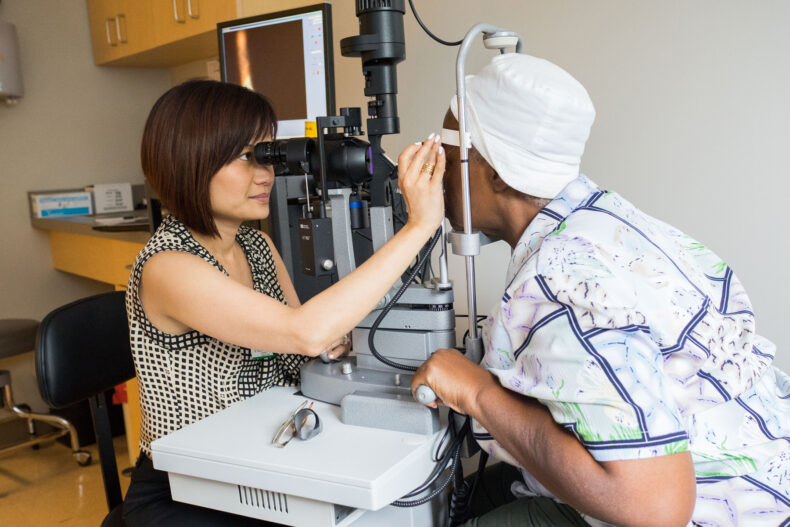
Because of this, 14 specialty clinics are now offered at Shade Tree Clinic: pediatrics, which serves uninsured adolescents ages 13-17; dermatology; gastroenterology; gynecology; neurology; sleep medicine; ophthalmology; retinal screening; physical therapy/orthopaedics; urology; psychiatry; rheumatology; ultrasound; and weight and metabolism.
Clinic leadership also monitored emerging health care needs not being met in the community. For instance, a Vanderbilt nurse practitioner specializing in wound care established a monthly clinic to treat patients with chronic wounds. Another example is the Shade Tree Early Pregnancy Program (STEPP), a clinical partnership between VUSM and Vanderbilt University School of Nursing that provides early prenatal care.
“We regularly encountered pregnant patients who were uninsured were finding too many barriers to getting prenatal care, even though they were actually eligible for insurance,” Miller said. “Our purpose for setting up the STEPP Clinic was to encourage expectant women to come to us for an initial medical examination and sign up for insurance and referral for pregnancy care through the nurse-midwifery practice at Vanderbilt.”
“The model that Shade Tree adopted was that instead of patients going to the specialty clinics, the specialty clinics came to them,” said then VUSM Associate Dean for Medical Students Bonnie Miller, MD, MMHC (and wife of Robert Miller). “I still think that’s brilliant.”
Holistic care for better outcomes
Shortly after opening, the Shade Tree Clinic team realized addressing only medical needs was not enough. There were other forces at play that impacted patients’ well-being. Lack of safe shelter, food insecurity, substance abuse, chronic hunger, untreated mental health issues, past and ongoing trauma, stress caused by the inability to provide for their family — the list was long. The executive board decided that a dedicated licensed clinical social worker was needed to conduct psychosocial assessments and connect patients to sorely needed resources.
In January 2008, Shannon Jordan, LCSW, was hired, and today she spends two-thirds of her time as a social worker at Monroe Carell Jr. Children’s Hospital at Vanderbilt and one-third working with Shade Tree patients. At the clinic, Jordan works in tandem with a group of about 10 medical, nursing and law students who are learning how to better treat the whole person.
“During an assessment, I’m finding out about their barriers, resources and resiliencies — what is working and what is not,” Jordan said. “If there are untreated mental health issues, I see if we can refer them to the Mental Health Cooperative in Nashville or to Centerstone. If there’s domestic violence, we can connect them to the resources of the Metro Nashville Family Safety Center. We have many people who have not seen a dentist in years. We have a wonderful relationship with Interfaith Dental Clinic where we can refer them.”
Jordan teaches the students about TennCare and Medicare and how to help individuals transition from no health insurance to coverage. They learn who can qualify for the federal Supplemental Nutrition Assistance Program (SNAP). They learn how to advocate for individuals and appeal rejections.
“I tell them that while getting a patient’s history and physical, they need to be comfortable asking about things like access to food, homelessness and safety,” she said. “And to ask it in an appropriate manner and not be afraid of what their answer might be. Then, they can say, ‘I appreciate you letting me know that at this time you don’t have a place to stay. I’m going to ask our social worker to follow up with you about that.’”
Connected to the community
From its early days, Shade Tree Clinic students and faculty also fostered close connections with the community, beyond medical care. When a local youth football team and cheerleaders lacked uniforms, clinic staff organized fundraisers to provide them. Their efforts extended to creating a community vegetable garden, holiday food drives with donated turkeys from VUMC employees, and vaccination outreach for individuals experiencing homelessness. Students also contributed fresh produce from the Vanderbilt Educational Garden Initiative.
The clinic’s impact also includes the long-running Shade Tree Clinic swim school, now named the Howard Fuchs Swim Program in honor of the late Vanderbilt rheumatologist who volunteered there. His wife, Catherine Fuchs, MD, the Bixler-Johnson-Mayes Professor of Psychiatry and Behavioral Sciences, serves on the clinic’s board and helped establish an adolescent psychiatry clinic in 2023, further strengthening Shade Tree’s commitment to holistic community care.
Medication dispensary aids compliance
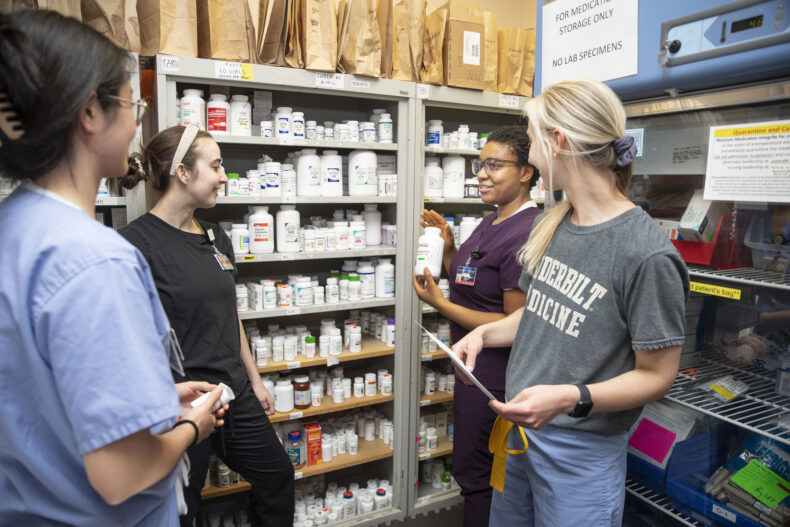
Shade Tree Clinic is unique among U.S. student-run medical clinics in that it has an on-site dispensary, operated by pharmacy, medical and nursing students and overseen by a licensed pharmacist.
This allows patients to pick up medications, free of charge, and removes the potential compliance barrier of having to travel to another location. Patients are also offered vaccinations free of charge whenever possible, and diabetic patients receive free glucometers and test strips.
Medications are often cost prohibitive for those who are uninsured, leading to poor health outcomes. For example, the out-of-pocket cost of a three-month course of treatment for hepatitis C ranges from $22,000 to $95,000 without insurance. These direct-acting antivirals are oral medications with a 95% cure rate. If untreated, hepatitis C can lead to liver cancer, liver failure and death.
Volunteer pharmacists, as well as pharmacy residents and now a pharmacy fellow from the Nashville campus of the University of Tennessee Health Science Center (UTHSC) College of Pharmacy, take shifts at the clinic, educating patients, answering questions and ensuring medications are properly dispensed. The pharmacy team also partners with medical students to do medication reconciliation reviews to ensure patients are taking the proper medications at the right intervals.
“I’m extremely grateful that Vanderbilt Medical School has this opportunity,” said Tracy Hagemann, PharmD, professor of Pharmacy Practice and associate dean for the UTHSC College of Pharmacy. “It’s an excellent learning model for our students and an excellent care model for our patients, too. In the 11 years I’ve been at UT, my highlight has been being able to participate in Shade Tree Clinic and work with and get to know these students.”
More than 300 common medications are maintained in the dispensary, excluding narcotics, depressants, hallucinogens or potentially addictive or psychoactive medications. Medical students also help patients enroll in patient assistance programs, which provide low-cost or free medications to uninsured individuals.
Career-changing impact
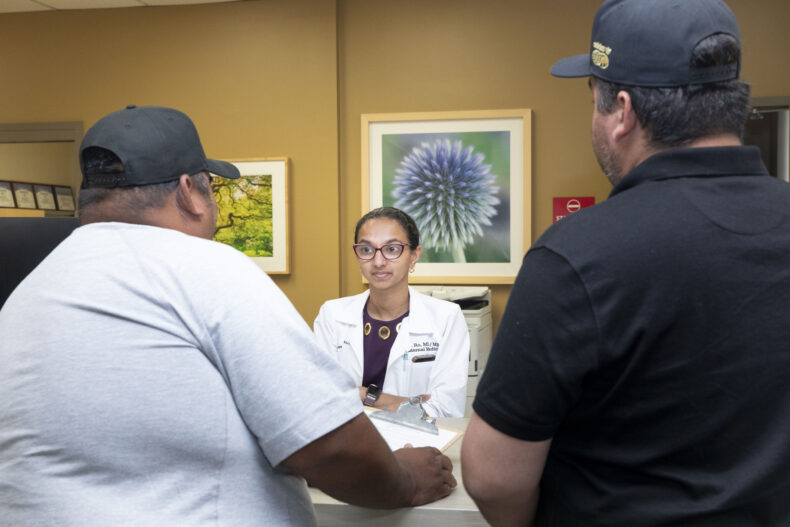
Cooper Lloyd, MD, MPH, served in multiple roles at Shade Tree Clinic while a VUSM student, ultimately becoming a member of the executive board. Then, as an assistant professor of Medicine and Pediatrics at VUMC, she served as a medical director for the clinic for three years. She continues to serve on Shade Tree Clinic’s board of directors.
Today, Lloyd is associate medical director at TennCare where she leads strategic clinical initiatives and policy development. Volunteering at Shade Tree Clinic has had a profound impact on her career, something that VUSM leaders have heard often.
“I came to medical school passionate about global health,” Lloyd said. “Shade Tree opened my eyes to the compelling health and social needs of our neighbors right here in Nashville. This reframing led me to pursue a public health degree during medical school and a residency focused on underserved primary care in urban settings. In my work now in health policy at the state level, I am focused on improving the health and lives of Tennesseans.
“I think daily about not only the medical needs of people across our state, but also their behavioral health and social needs — a perspective I first learned at Shade Tree. I try to consider where there are barriers in our system of care and how to address them. My experience at Shade Tree inspired me to focus on improving health in my home community; now, 15 years later, with many more tools under my belt, I am continuing to try to work toward that important goal.”
Building evidence for student-run clinics
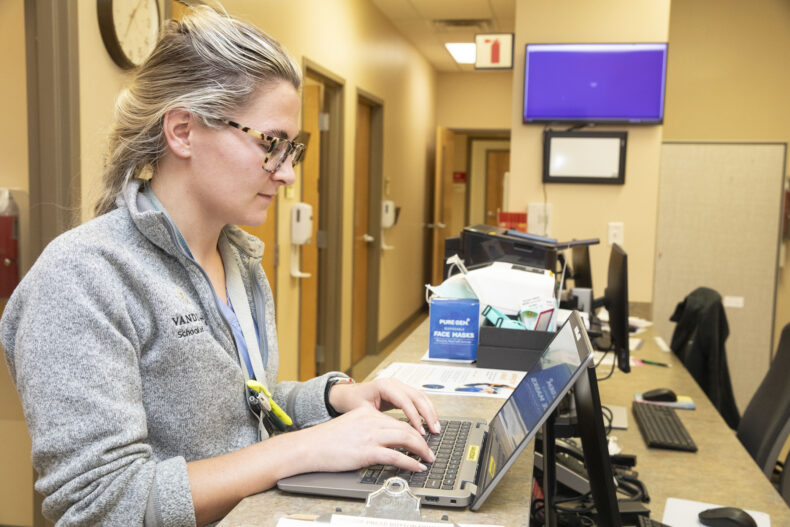
In line with its affiliation with research-centric VUSM and VUMC, several studies have been published by Shade Tree medical student and faculty volunteers to further build evidence that student-run clinic models improve medical outcomes and lives. Medical students have also presented their research at national conventions.
Examples include a paper detailing Shade Tree’s innovative model of providing access to prenatal care to underinsured and uninsured patients published in the Journal of Midwifery & Women’s Health, and a study in the Journal of Genetic Counseling in 2024 that showed how a partnership between the clinic and genetic counseling training programs can improve patients’ access to genetic medicine.
Impact on Curriculum 2.0
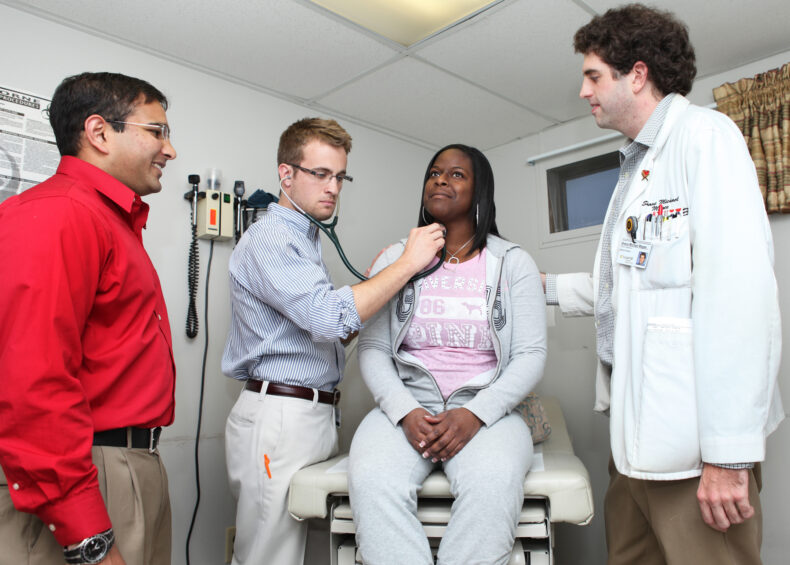
When a completely revised VUSM medical education model known as Curriculum 2.0 was fully implemented in 2013, a key change was an increased emphasis on the patient care experience and case-based learning beginning in year one for medical students. Also, in the previous curriculum, medical students fulfilled their core clinical clerkships (pediatrics, obstetrics and gynecology, neurology, psychiatry, medicine and surgery) during their third year; in Curriculum 2.0 students complete these rotations earlier during their second year. These changes were heavily influenced by Shade Tree Clinic, Bonnie Miller said.
“Scott Rodgers had come on as associate dean for Medical Student Affairs, so I wasn’t necessarily doing the one-on-one interviews with the medical students when they were senior students, but I still interacted very closely with them,” Bonnie Miller said. “Hearing students say, ‘Shade Tree was the most important part of my medical education,’ was eye opening for me.
“Here we were working on the curriculum and doing all this revision, with all of the headache and anxieties and everything that went into that … and in the end, students were saying Shade Tree was most important. It wasn’t even part of the required curriculum. The clinic became one of the major principles, if not driving forces, behind Curriculum 2.0.”
“The clinic has become so important to the students, and it’s kind of a badge of honor for the Medical Center that they support and are committed to Shade Tree Clinic,” said Robert Miller.
“Shade Tree became an excellent learning laboratory because the medical students ran the clinic,” said Bonnie Miller. “They learned what made it work, and they learned what really threw a wrench in the gears and gummed things up. There was no place in the curriculum at the time where they learned that as well as actually doing it at Shade Tree.”
Unprecedented institutional support
While there are estimated to be more than 400 medical student-run or student-involved medical clinics in the United States, few have the backing and generous support from its parent institution that Shade Tree Clinic enjoys, Robert Miller said.
“We’ve had the full backing of Vanderbilt University Medical Center, and I don’t know of another student-run clinic in the country that has that kind of support,” he said. “This has been so important because patients are easily referred for specialty care, and faculty provide seamless care for Shade Tree patients. And all patient care, inpatient and outpatient is provided without patients receiving a big bill.”
“Shade Tree wouldn’t be what it is without the support the Medical Center has provided,” said Bonnie Miller. “The imaging, the laboratory services, even surgical procedures when they’re necessary. There’s just been incredible generosity on the part of the Medical Center. It’s also one of the things that makes Shade Tree Clinic stand out — that they can provide that remarkable continuum of care. It’s been quite remarkable, and it’s something to be enormously proud of.
“If I look back on my 20 years in the dean’s office, 1999 to 2019, there’s a couple of things that stand out as real milestones. Of course, Curriculum 2.0 is one, but Shade Tree Clinic is right up there.”
A tale of transformation
Today, Patterson credits Shade Tree Clinic for giving him back a life truly worth living.
As soon as he walked through the door, he said he knew he was among others who were there for him not just as a patient but as a person.
“When I first got out of prison, it seemed like I was over there every time they were open,” Patterson said. “They checked me over from head to toe. They got me help immediately and connected me to all the resources I needed.”
As his medical concerns were addressed one by one, he was seen by Vanderbilt specialists in dermatology, urology, gastroenterology, cardiology and hepatology.
Joy Justice, a co-student director of Shade Tree’s Dermatology Clinic, quickly noticed unusual growths on his legs that once biopsied were diagnosed as squamous cell carcinoma. Patterson was referred for surgical removal of the tumors, and topical chemotherapy was prescribed. He needed to keep his skin covered and protected during this process, but he didn’t have appropriate clothing to do so. Shade Tree Clinic found him what he needed.
Patterson now lives in an apartment and works as a part-time delivery driver. He is also dually enrolled in Medicare and Medicaid, thanks to the assistance of the social work team at Shade Tree Clinic. When the weather obliges, he’s likely to be found teeing up at Ted Rhodes Golf Course, enjoying a hobby he never thought he would be able to take up again.
In 2025, he transitioned off the patient roster at Shade Tree Clinic — a hopeful goal for every patient seen there. Patterson now receives his primary care at Vanderbilt Primary Care North One Hundred Oaks where he coincidentally sees a physician he met at Shade Tree Clinic, Babatunde (Bobby) Carew, MD, assistant professor of Medicine.
Patterson’s positive transformation due to Shade Tree doesn’t end with his significant health improvements. He also has a new buddy, thanks to the clinic.
When the Shade Tree Behavioral Health team heard Patterson talk about his loneliness and anxiety as he reentered society after incarceration, they wrote a letter that allowed him to get a legally defined emotional support animal.
Patterson went to a Nashville animal shelter and soon locked hearts with an adorable hound, a Catahoula leopard dog named Fin. The gentle puppy, with his boldly dappled coat and energetic spirit, has made lonely days a thing of the past for Patterson.
“I’ve never been happier in my life than I am right now … I know for a fact I wouldn’t be alive today if it weren’t for Shade Tree,” Patterson said. “This is the best shape I’ve been in in years! I’m so grateful to everyone who helped me.”


