


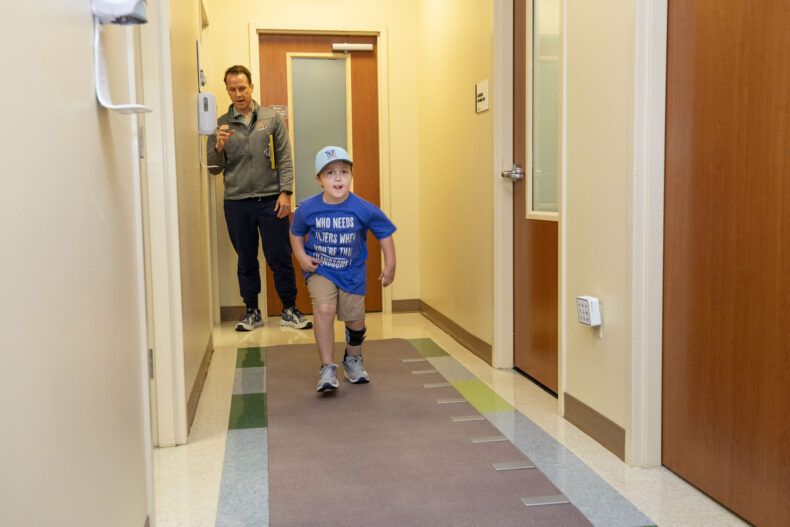
 Hoyt Summerville walks on the GAITRite device while Ken Swantek PT, DPT, looks on. (photo by Susan Urmy)




Children with gait abnormalities are typically evaluated by having a physical therapist observe them as they walk. However, the thin gray mat that 5-year-old Hoyt Summerville bounded down recently during her evaluation was something entirely new to Monroe Carell Jr. Children’s Hospital at Vanderbilt’s pediatric rehabilitation clinic.
The mat, a portable, single-layer, pressure-sensitive walkway, takes precise measurements and collects data to measure multiple parameters of gait. Therapists use the data to inform their physical therapy program and even design custom orthotics, a new form of precision and personalized therapy.
A donor recently gifted the device, called the GAITRite, to Monroe Carell’s Pediatric Rehabilitation Services. The clinic, located at Vanderbilt Health One Hundred Oaks, brings together physical, occupational and speech therapists to assess, consult and treat children, from infants to young adults. They may be recovering from an injury or surgery or coming to the clinic with developmental disabilities. The team’s goals: to improve function and quality of life, restore independence and promote healing.
GAITRite works as a diagnostic tool, said Laura Flynn, PT, a Rehabilitation Services manager.
“As physical therapists, there is a lot of information we can gather visually while working with our pediatric patients,” she said. “But the GAITRite gives us hard, concrete data. This is very helpful for us.”
Flynn said the mat can be used to analyze data such as gait pattern, such as how long patients spend on the left foot versus the right foot, the distance they swing their legs and how much weight each leg is bearing. For example, if the mat indicates the patient favors one leg versus the other, the physical therapists can design a program to work on that.
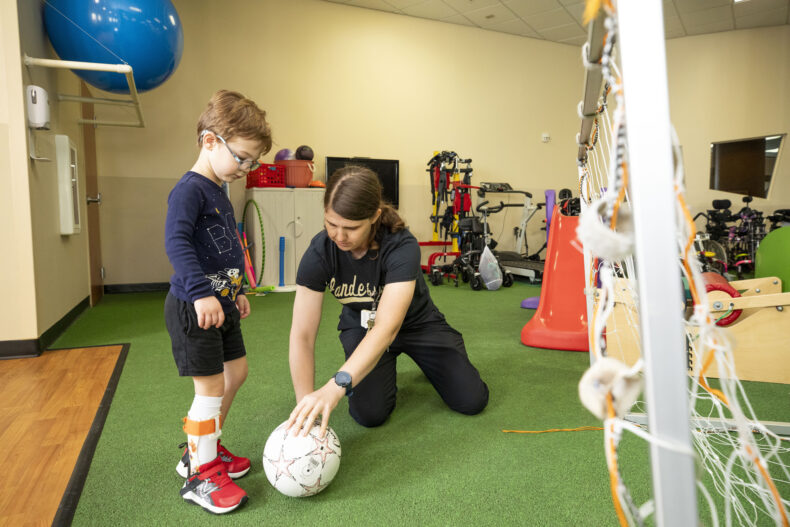
Therapists, working with a vendor, can design 3D-printed custom orthotics for patients, such as flexible leg braces. Then, they can observe a patient walking on the mat with and without the orthotic device to determine how much it is helping.
“It’s giving us a lot of great information, not only helpful to us as Vanderbilt, but helpful to the greater community of physicians and therapists who are treating patients with conditions such as cerebral palsy,” Flynn said.
Hoyt’s mom, Jamie Summerville, said her son has been going to physical therapy for most of his life. She first noticed abnormalities when he was 7 months old, and he missed his developmental milestones. He began therapy, but it was a while longer before he was diagnosed with a perinatal stroke, a stroke that happened when he was in utero. After birth, Hoyt also had seizures that affected his gait.
The Summerville family, who live in Huntsville, Alabama, began coming to Monroe Carell for care. At another hospital, Hoyt recently had a selective dorsal rhizotomy (SDR), a surgery that reduces spasticity, or muscle contractions and stiffness, in the lower body by selectively clipping certain sensory nerve endings in the spinal cord that send abnormal signals to the muscles. The operation is expected to help Hoyt in the long term, but in the short term, he must learn how to walk again in physical therapy.
“The GAITRite is also going to be used to compare walking patterns before and after the SDR procedure, providing a way to objectively analyze the impact of surgery on the patient’s gait,” said Macey Martin, PT, a coordinator with Rehabilitation Services.
Summerville was impressed with the GAITRite. Thinking back on Hoyt’s physical therapy journey, she can see why it would be useful.
“To see his gait, how it’s changed — if it’s changed or better or worse after certain events — I think it would be fantastic,” she said.
“We are extremely grateful for the donor’s generosity, which has made it possible to provide the GAITRite system for our clinicians and families,” said D.J. Kennedy, MD, professor and chair of the Department of Physical Medicine and Rehabilitation. “This system significantly improves our ability to provide complex gait analysis for surgical and rehabilitation evaluations and tracking outcomes, improving the lives of the children and young adults we treat as Physical Medicine and Rehabilitation physicians at Monroe Carell Jr. Children’s Hospital at Vanderbilt. The system is already in high demand and receiving very positive feedback from families.”


