


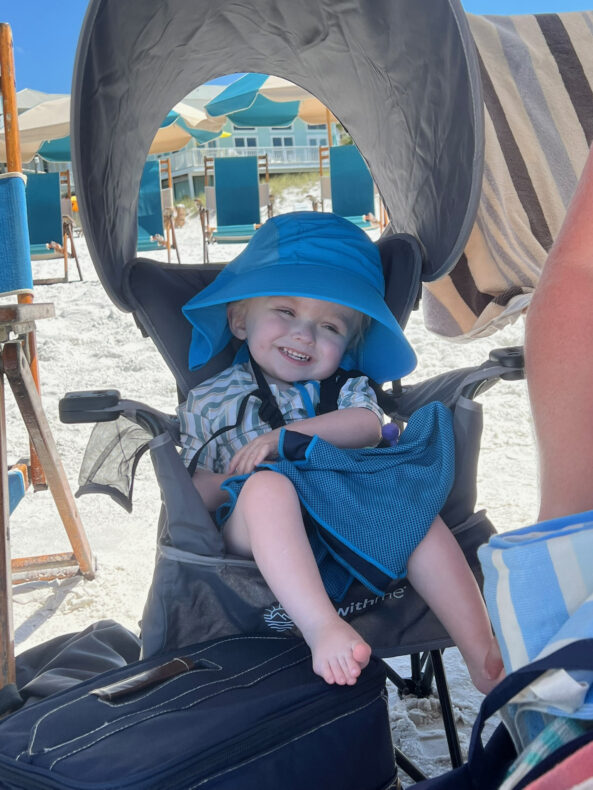
 Sebastian Brook is what his parents call ‘the exception.’




Waiting can be unforgiving, except when it turns out to be a blessing.
And even better — a miracle.
On Aug. 20, 2023, Tim and Robyn Brook brought their 2-month-old son, Sebastian, home to say goodbye surrounded by his two older brothers and family.
As minutes turned into hours, and days became weeks, the family wasn’t sure of next steps. So, they began having monthly birthday celebrations to mark the unexpected milestones.
“I don’t know what else to call it,” said Robyn Brook. “He’s a miracle.
“When people ask us about it, we are not really sure what to say except that he kind of did his own thing and beat the odds against him. Sebastian is definitely the exception.”
Diagnosed prenatally with severe hydrocephalus and tetralogy of Fallot, the Brooks knew they were in for a potentially rocky medical journey.
Severe hydrocephalus is a rare condition where there is extra fluid in and around the brain causing pressure that can damage the tissue. Tetralogy of Fallot, a set of four congenital heart defects, causes problems with the heart’s ability to pump oxygen-rich blood to the body.
Born at 34 weeks gestation June 8, 2023, Sebastian was admitted to the Neonatal Intensive Care Unit (NICU) at Monroe Carell Jr. Children’s Hospital at Vanderbilt. While his prognosis was not clear, he was stable.
At 1 month, he developed meningitis, a serious infection of the membranes surrounding the brain and spinal cord. Sebastian was placed on a ventilator. His hydrocephalus required a shunt, and he underwent multiple neurosurgery interventions to treat the meningitis.
But he was not getting better. There was concern that the infection would not be survivable, and the medical team asked the Brooks to think about what they wanted for the time that was left.
“They said they would continue to try things if we wanted,” said Robyn Brook. “We discussed that we wanted to bring him home to be with his brothers, Oliver and William. We wanted to be in a more comfortable environment. He had only been in a hospital.”
The palliative care team, which had been involved in Sebastian’s care before he was born, worked with the NICU, the Neonatal and Pediatric Transport team, and a local hospice to bring Sebastian home. He would be transported with a breathing tube and ventilator, which would be removed at home by the palliative care team.
When Sebastian arrived on that first day at home, Oliver and William showed him their rooms and favorite toys, and the family spent time outdoors — something they were not able to do while hospitalized.
The boys also participated in memory-making activities with members of the palliative care team.
After a few hours at home, it was time. Sebastian was extubated, removing the breathing tube that connected him to the ventilator. Usually, a patient will pass away within minutes to hours.
“We just can’t explain it,” said Molly Casey, MSN, APRN, CPNP-AC/PC, pediatric palliative care nurse practitioner at Monroe Carell. “Sebastian was comfortable; the family was doing OK; and hospice was on board. I left their home knowing that all the tools were in place that the family needed.
“I fully expected that Sebastian had hours left to live. I mean, we stopped the antibiotics to treat his meningitis, and he lived. I’m so happy he surprised us!”
Initially Sebastian was sent home on a pain pump, received nutrition through a nasogastric tube and used oxygen as needed.
Over time, those supplemental devices were no longer necessary.
“We were taking it one day at a time,” recalled Robyn Brook. “We never knew what the next day was going to bring.”
A few months after going home, Sebastian was readmitted to Monroe Carell to have a new shunt placed to drain the fluid from his brain.
A year later, in October 2024, he graduated from hospice and underwent a tetralogy of Fallot repair soon after.
“He’s doing more than what we expected. What anyone expected,” said Tim Brook. “He’s definitely surprising us. His skills are developing.
“And he is the one child in our household who likes the food that we cook,” he said chuckling.
Sebastian, now 2 1/2, takes one medication for seizures, participates in several therapies (physical, occupational, speech, feeding and intervention) and is meeting milestones his family and medical teams were uncertain that he would achieve.
“Maybe the reason he survived and is thriving is because of the great care at Monroe Carell with great nurses who stood up for him,” said Robyn Brook, who is very thankful for the many care teams at both the hospital and clinics.
“And all the love he’s been surrounded with,” she added. “Seeing him happy makes me smile. And he’s really happy. Sometimes I can hear him laughing to himself, and we aren’t even in the same room.”
This year, the family will share its third Christmas together.
“For us, the takeaway is that prediction is hard,” admitted Michaela Ibach, MD, assistant professor of Clinical Pediatrics and part of the palliative care team at Monroe Carell. “Prognostication is challenging. After he showed what he was capable of, we wanted to give him the best chance of surviving as long as possible. We couldn’t be more thrilled with the outcome.”
For now, the family continues to be amazed by their miracle baby and enjoys their interactions with Sebastian, especially when he points to the places on his body he wants to be tickled.
“He has so much character,” said Tim Brook. “The hardest days are behind us.”
Special note from the Brook family
“There were a few neonatologists who stood out including Dr. Emily Morris, Dr. Emily Bird and Dr. Kevin Louie played a big part in his care. There was also a fellow named Dr. Manjari Pophale, who really has been so sweet, and she still asks his NICU primaries for updates and to see photos. We’ve been told that she cries happy tears every time she sees photos of him, which just shows how deeply she cares.
Child life- Katherine Bennett. I can’t put into words how wonderful she is. She is a gift to Vanderbilt and to all of the patients and families of the NICU. She went above and beyond for Sebastian and his brothers.
NICU primaries were Sarah Hoppestead, Rachel Clausen and Taylor Tully. They were such a blessing. I knew that Sebastian was in excellent hands at times when we would need to leave to go rest. And felt comfortable that they would advocate for him just as hard as we would. We are so grateful for them.
And of course Michaela, Molly and the rest of the palliative care team. They were wonderful and hold a special place in our hearts. I always look forward to running into them when we have appointments at Vanderbilt.
And the neurosurgery team with Dr. Wellons and Haley Vance (NP) have been on the ride with us since day 1 and were always available when we had questions or concerns.”


