



Each year an estimated 2.8 million Americans experience traumatic brain injury (TBI), and 11.4 million adults live with a TBI-related disability. In Tennessee, 1.3 million people have had a TBI, which doesn’t include others with an acquired brain injury (ABI) from causes such as stroke, anoxia (lack of oxygen to the brain), tumor damage and infection.
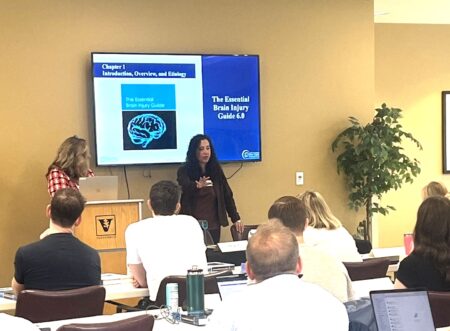
Because of the prevalence of brain injury, the dynamic and life-altering nature of its effects, and the complexity of the long-term care required, Vanderbilt Health clinical providers and researchers recently took part in a two-day training toward becoming a certified brain injury specialist (CBIS), a program of the Brain Injury Association of America (BIAA).
“Traumatic brain injury is a complex and life-altering condition that requires timely, skilled and compassionate care, which we always seek to deliver at Vanderbilt Health,” said Mayur Patel, MD, MPH, professor and Chief of Acute Care Surgery, “Comprehensive training empowers our clinicians to recognize subtle brain injury symptoms and provide tailored, evidence-based care from acute treatment through long-term recovery.
“This expertise improves communication, coordinates interdisciplinary support, and ensures that the often-overlooked cognitive and emotional impacts of TBI are effectively addressed. We are grateful for this partnership between BIAA, Stallworth, and Vanderbilt Health that strengthens our collaboration of care for those affected by TBI.”
The CBIS training took place at the Vanderbilt Stallworth Rehabilitation Hospital in Nashville and included physical therapists, occupational therapists, speech-language pathologists, nurses, teachers, case managers, social workers and researchers from throughout Tennessee, as well as participants from Kentucky and New York. Twenty-three of the 35 trainees were from Vanderbilt Health. While this BIAA certification program has existed for nearly 30 years, currently there are only 75 CBIS in practice in Tennessee.
“Proper education about brain injury improves diagnostic accuracy, standardizes assessment and treatment, reduces complications, and supports better functional outcomes for patients,” said Yelena Bodien, PhD, assistant professor of Surgery in the Division of Acute Care Surgery and an investigator with the Critical Illness, Brain Dysfunction and Survivorship Center at Vanderbilt Health. “We are proud that our Vanderbilt Health clinical and research teams recognize the importance of increasing their knowledge in this area.”
CBIS training covers the cognitive, psychological and social consequences of brain injury; behavioral approaches for managing challenging behaviors and promoting positive skills; and techniques for effectively working with families of individuals with brain injury.
“What this means for patients is that a certified brain injury specialist has gone through extra training and has advanced knowledge to really understand the anatomy of the brain, the brain injury journey, the related social work to meet the needs of these individuals, and the issues throughout life these patients might encounter,” said Stacy Mulder, executive director of the Tennessee Chapter of the BIAA. “Also, a certified brain injury specialist is aware of and can help individuals with brain injuries and their families connect with additional resources to navigate their rehabilitation and fully support their continued healing and quality of life. “
The BIAA refers to ABI as a highly prevalent “hidden epidemic” that is a chronic, dynamic condition rather than a one-time event, requiring lifelong management to prevent further decline. It is a leading cause of death and long-term disability, with many acquired brain injury cases going undiagnosed or untreated. One of the most alarming BIAA statistics is that roughly 40% of children and 60% of adults who experience TBI never receive care for this injury.
Ily Davis, who suffered a traumatic brain injury in 2016 when she was just three years old, spoke to the CBIS trainees to share her experience. She was unresponsive when she was brought to Monroe Carell Jr. Children’s Hospital at Vanderbilt, and her years’ long recovery has included speech and memory challenges. Davis described her recovery as “a long, sometimes confusing, journey of learning how to think, feel and function again.”
“People often focus on the moment the injury happens, but the harder part is everything that comes after,” she shared with the CBIS trainees. “Recovery isn’t just physical. It’s memory, emotions, focus, and sometimes trying to explain what’s wrong when you don’t even have the words yet, especially as a kid. Some days I felt normal. Other days, I felt frustrated, confused or just different.
“And no one could really see it. That’s the tricky part about brain injuries. A lot of the hardest things are invisible. When doctors are patient, when they believe me, it helps me believe in myself, too. … If there’s one thing I hope you take away from meeting me today, it’s this: Behind every scan, every chart and every diagnosis, is a person trying to feel like themselves again. A person whose life can be shaped not only by what you know, but how you care.”
For more information on brain injury, including resources and education, visit www.biausa.org/find-bia/tennessee.