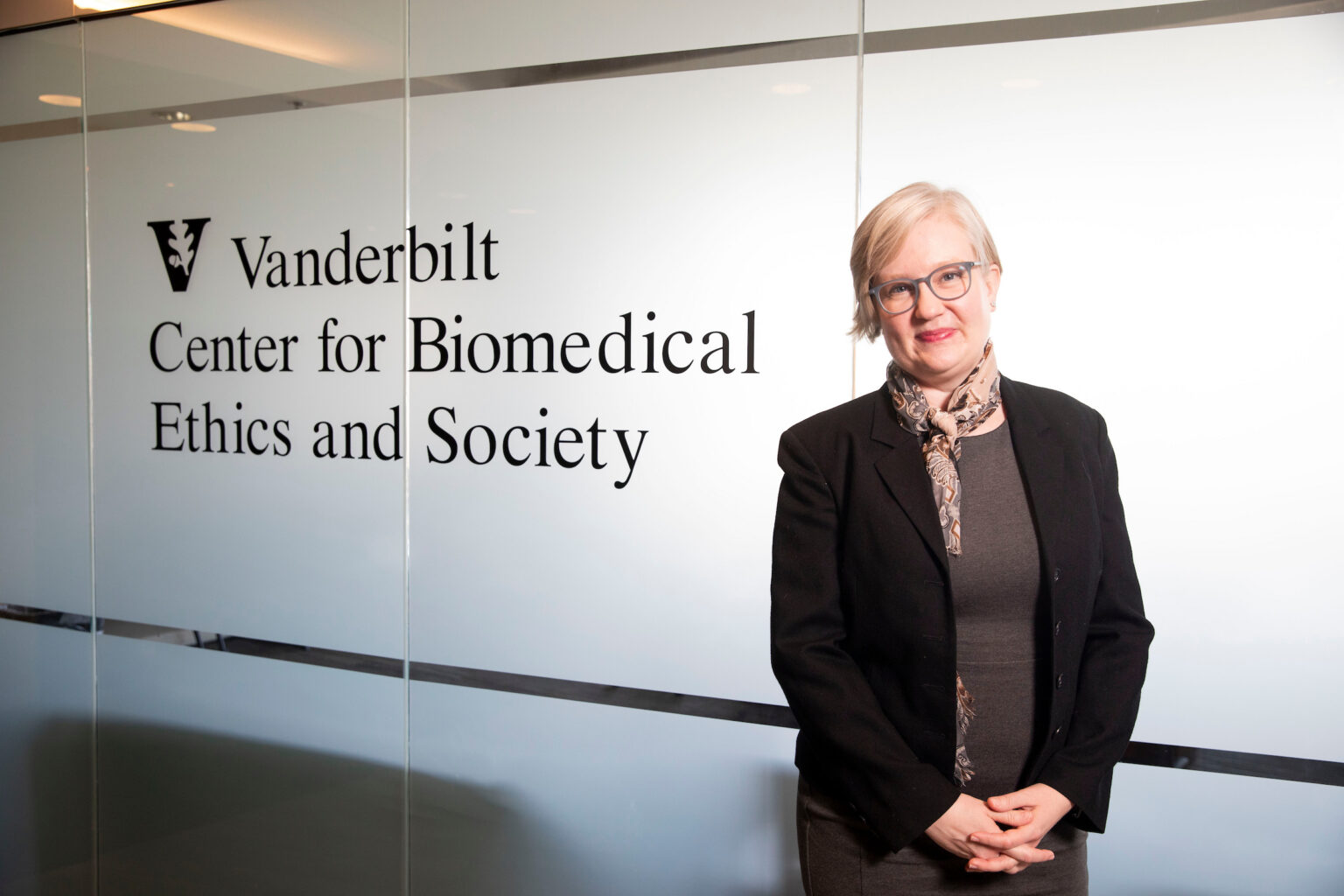
 Susannah Rose, PhD (photo by Susan Urmy)

Susannah Rose, PhD, an expert in the ethical integration of new technologies, including artificial intelligence, in health care, has been appointed director of the Center for Biomedical Ethics and Society at Vanderbilt Health, effective July 1.
Rose, associate professor of Biomedical Informatics and Health Policy, will succeed Keith Meador, MD, ThM, MPH, the Anne Geddes Stahlman Professor of Medical Ethics, who has directed the center since 2012.
Established in 2006, the center promotes the development of personalized and patient-centered care at Vanderbilt Health through nationally recognized research, clinical ethics consultation, and education that addresses the ethical, legal and social implications of medicine, health care and health policy.
“Dr. Rose brings rare breadth and credibility at the intersection of biomedical informatics, health policy and ethics,” said Josh Peterson, MD, MPH, professor and chair of Biomedical Informatics.
“She is a leader in Vanderbilt Health’s responsible AI efforts,” Peterson said. “Her appointment … reflects both her scholarly excellence and her practical, patient-centered approach to translating innovation safely into care.”
“I am honored to contribute to the leadership efforts aimed at strengthening our exceptional community,” said Rose, who joined the Vanderbilt University faculty in 2023.
In addition to being a world-class health care system, Vanderbilt Health has the nation’s largest biomedical informatics department and has established pathways to move research into clinical operations through its close partnership with HealthIT (information technology).
“To do this safely, we have one of the most innovative and robust AI governance and innovation committees in the U.S,” she added.
Rose said she would continue in her current roles as vice chair of the Artificial Intelligence Committee at Vanderbilt Health and executive director of the AI Discovery and Vigilance to Accelerate Innovation and Clinical Excellence (ADVANCE) Center in the Department of Biomedical Informatics.
“The Center for Biomedical Ethics and Society will leverage these unique opportunities among our colleagues to catapult us into being a world leader in bioethics and technology integration with clinical care, education and research,” she said.
Rose, who is from Bowling Green, Ohio, attended Furman University in Greenville, South Carolina, where she established and led the Bioethics Club. She later earned a Master of Science in social work from Columbia University.
She worked as a clinical social worker and researcher at the Memorial Sloan Kettering Cancer Center for nearly a decade, while completing a master’s degree in bioethics at Union College/Albany Medical Center. In 2010, she earned a PhD in health policy, with a concentration in ethics, from Harvard University.
Rose was completing postdoctoral fellowships at Harvard and the Program in Cancer Research Outcomes Training at Massachusetts General Hospital when she was recruited to the faculty of the Department of Bioethics at the Cleveland Clinic.
Beginning as a clinical ethicist and researcher at the Cleveland Clinic, she later served as director of Bioethics Research and Policy in the Department of Bioethics, scientific director of Research in the Office of Patient Experience, and Associate Chief Experience Officer.
Rose has published and presented widely on the diffusion of the ethics of technology integration in health care, conflicts of interest in medicine, and clinical bioethics. She also co-authored two books on helping patients and families cope with cancer.
Currently, her primary funded research focuses on the ethical evaluation and deployment of artificial intelligence within health care systems and for the public. Her robust research program has been funded by many sources, including the National Institutes of Health and The Greenwall Foundation.
She is principal investigator of a $7.3 million project awarded in 2024 by the Advanced Research Projects Agency for Health to create and test the Vanderbilt Chatbot Accuracy and Reliability Evaluation System (V-CARES).
The goal is to develop a system that can detect errors, omissions and inappropriate answers given by medical “chatbots,” AI-generated responses to patients’ online queries of critical health topics that are delivered via text or speech.
Bioethics education provided through the Center for Biomedical Ethics and Society extends beyond medicine and public health into business, law, divinity, philosophy and the humanities.
To that end, Rose co-leads the Ethics Immersion Program for Vanderbilt medical students, teaches a course in public health ethics in the medical school’s Master of Public Health program, and has begun a course on AI in health care at the Owen Graduate School of Management.
“Ethics and values,” she said, “are embedded fundamentally in every decision.”