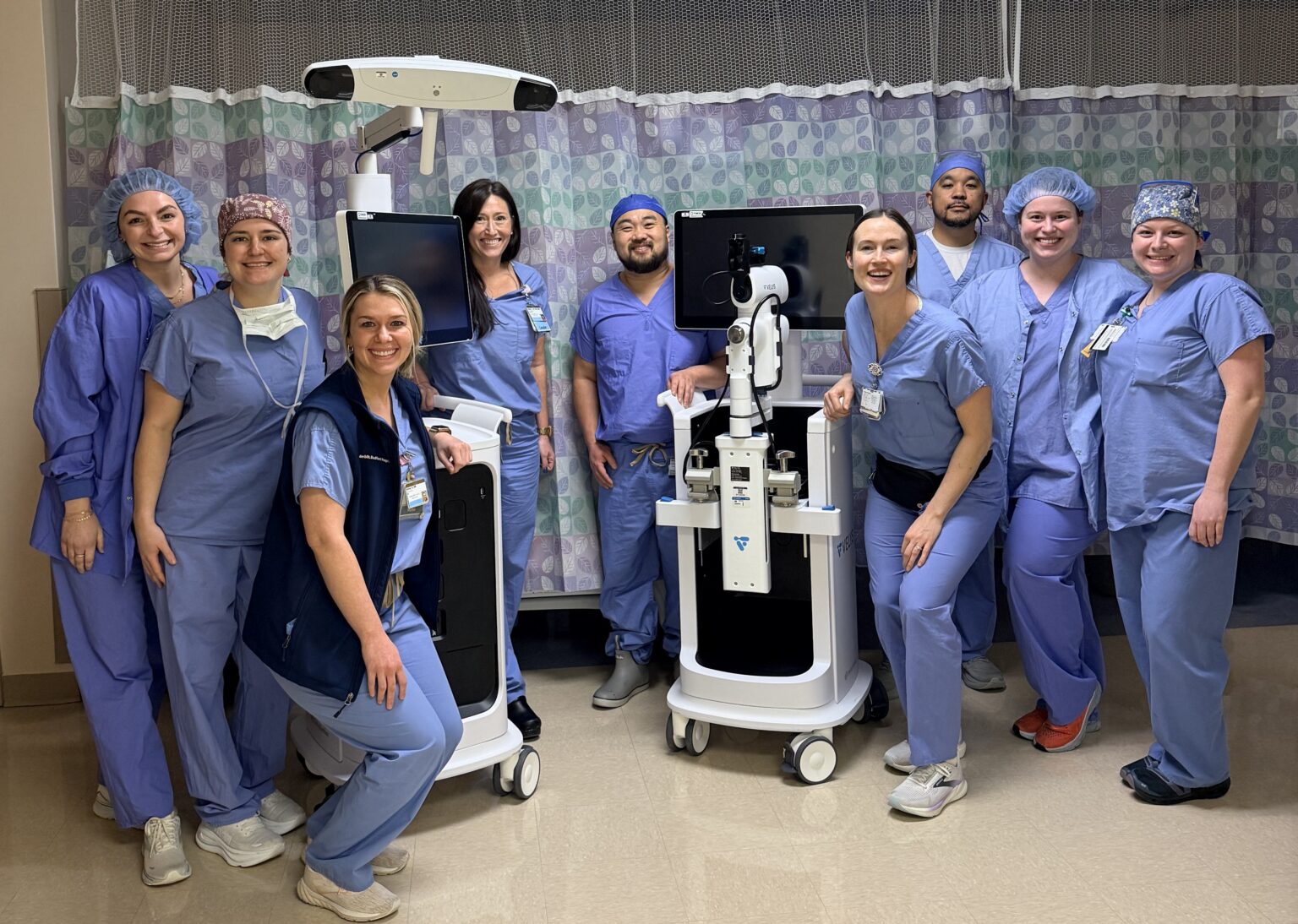
 Eric Barlow, DO, center, and his team with the DePuy VELYS system after the first robotic-assisted total knee surgery at Vanderbilt Bedford Hospital. (submitted photo)

Wanda Briggs’ left leg was in pain for two years. It started out gradually with arthritis and deteriorated to the point where it swelled twice the size of her right leg and couldn’t bend.
“I couldn’t walk very far because my leg hurt so bad,” she said. “It was just miserable.”
Briggs met with several doctors before she was referred to Eric Barlow, DO, a Vanderbilt Health orthopaedic surgeon who suggested Briggs have a total knee replacement using the robotic-assisted DePuy VELYS system.
“Dr. Barlow sat down and actually talked to me,” Briggs said. “He told me that I had bone spurs in my leg and no cartilage at all. He took the time to explain everything, which I appreciated greatly.”
Barlow told Briggs to think about the surgery. She called him later and agreed to what became the first robotic-assisted total knee replacement at Vanderbilt Bedford Hospital.
“People always wonder if a robotic-assisted knee surgery is better than a conventional knee surgery, and I think many surgeons would say it’s a tool that allows us to be more accurate and precise in what we’re doing for our patients,” Barlow said.
According to Barlow, in a robotic-assisted knee surgery, small probes are added to the bone to allow surgeons to map out the anatomy and joint movement of the knee “in real life, in real time.” The VELYS system is a surgeon-controlled device that supports alignment, balance and implant positioning.
“And with that information, we’re able to calculate range of motion and see where the deficits and imbalances are,” he said. “So, before we make cuts, we can manipulate the knee on the computer screen to see what we need to do to better provide a total knee implant that will address a patient’s specific needs and hopefully provide a better outcome.”
Briggs was surprised by her lack of pain when she woke up from the surgery.
“I kept waiting for the pain to come, and it never did like I was expecting,” she said. “They had me up and walking, putting full weight on my legs the same day, even walking up and down stairs. It was wonderful. I couldn’t do that before the surgery. God put me in the right place at the right time with the right doctors at the right hospital.”
Barlow, who performed robotic-assisted total knee surgeries in private practice before joining Vanderbilt Health, said 1 in 5 patients can be unhappy with their knee surgery, possibly because components aren’t positioned correctly, or the knee isn’t balanced as well as possible.
“These robotic knee surgeries allow us to be more precise,” he said. “It allows us to know, within a millimeter, if our cuts are accurate. It allows us to rotate the components to a half degree. You just don’t have that same kind of accuracy with conventional instrumentation.
“It’s our way of trying to do better, not only for our profession, but also for our patients. At Vanderbilt Bedford, we have a lot of patients from Murfreesboro, Franklin, Columbia, Tullahoma and Winchester — I even see people from Huntsville occasionally — and they can all receive cutting-edge care close to home.”