



Zhongliang Zu, PhD, research associate professor of Radiology and Radiological Sciences in the Vanderbilt University School of Medicine, has been awarded two federal research grants totaling $3.5 million to enhance molecular imaging technology and improve the diagnosis of stroke.
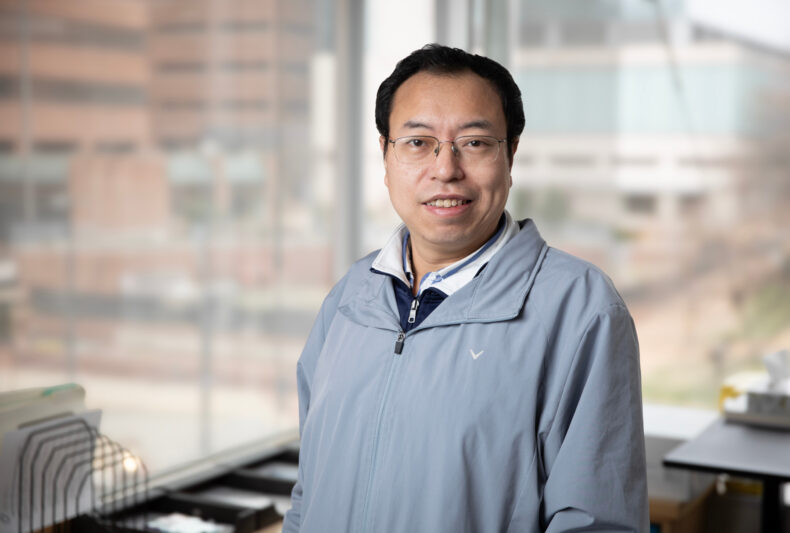
Zu, an investigator in the Vanderbilt University Institute of Imaging Science (VUIIS), has advanced the application of molecular and functional magnetic resonance imaging (MRI) to improve diagnosis of tumors, ischemic stroke, and neurological and muscular disorders.
“VUIIS is an international leader in imaging research with outstanding faculty and facilities,” said Daniel Brown, MD, the Carol D. and Henry P. Pendergrass Professor and chair of Radiology and Radiological Sciences. “Dr. Zu’s successes in the current hypercompetitive environment demonstrate the high level of work being performed by this group.”
“Professor Zu continues to develop highly innovative methods for improved assessments of diseases, and his contributions are well-recognized internationally,” added VUIIS Director John Gore, PhD, holder of the Hertha Ramsey Cress Chair in Medicine.
“Professor Zu continues to develop highly innovative methods for improved assessments of diseases, and his contributions are well-recognized internationally. It is encouraging that his work will continue to be supported by NIH, especially at a time when external funds are increasingly hard to obtain.”
“I am particularly excited about the opportunity to integrate advanced computational techniques with MRI to improve its diagnostic capabilities,” Zu said.
“Many diseases, including tumors, are characterized by alterations in various metabolites and macromolecules that play critical roles in disease progression,” he said. “Noninvasive imaging of these molecular profiles offers immense potential for improving diagnostic accuracy and guiding clinical decision-making.”
One of the two National Institutes of Health research project grants will support development of a novel machine learning method to enhance pH imaging, a promising metabolic marker for ischemia (lack of blood flow).
The grant (R01NS140757), which will provide $1.9 million over five years, was awarded July 30 by the National Institute of Neurological Disorders and Stroke of the NIH. The goal is to enable earlier identification — and treatment — of areas of the brain affected by stroke.
The other grant (R01EB036574; $1.6 million over four years) was awarded Aug. 11 by the National Institute of Biomedical Imaging and Bioengineering to leverage deep learning to enhance molecular MRI technology.
Zu, who earned his PhD in Medical Physics from Peking University in Beijing in 2008, joined the Vanderbilt faculty in 2012. He also is a research associate professor of Biomedical Engineering in the School of Engineering.
Last year, Gore, Zu, and their colleagues reported a significant advance in functional MRI that may improve early diagnosis and treatment of Alzheimer’s disease, bipolar disorder and other disruptions of normal brain function.


