


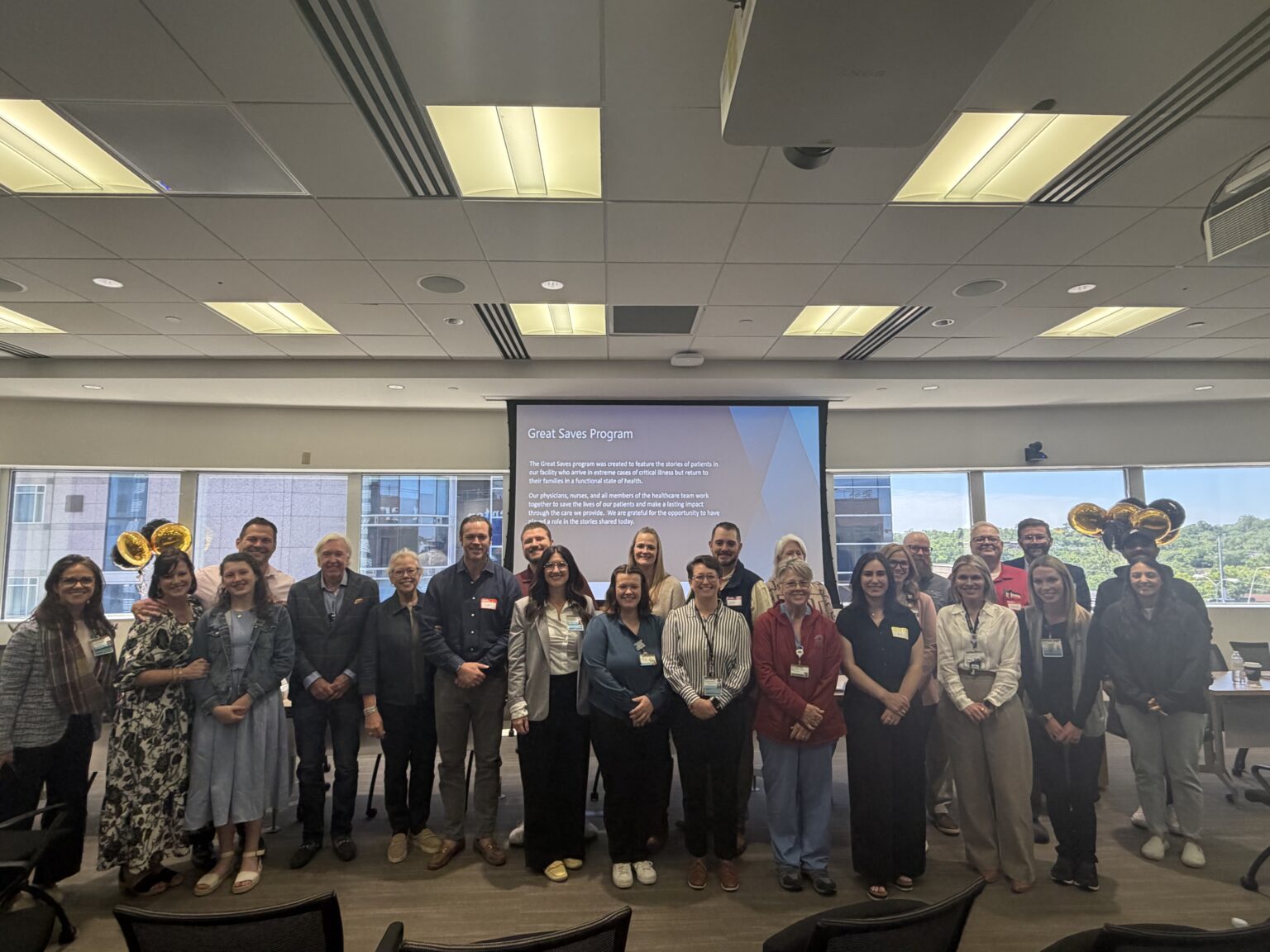
 Former patients and staff gathered at Vanderbilt University Hospital for an emotional event that is a glimpse into what it's like to be an incredibly ill patient who makes a remarkable recovery. (submitted photo)

Seven former patients of Vanderbilt University Hospital (VUH) recently gathered on the Main Campus for “Because of You: A Great Saves Celebration,” celebrating the survival of patients who arrived in extreme cases of critical illness and have now returned to functional states of health. They came to share their incredible stories and to thank physicians, nurses and other members of their care teams — people who see them in their worst health but may not see them again after they have recovered.
Though the event has been hosted by various units in recent years, this was the first VUH-wide Great Saves event. The event was specifically scheduled to celebrate National Nurses Week to honor the work nurses do every day.
Kyle Mullicane described spending 38 days in the intensive care unit at VUH in 2019 due to acute necrotizing pancreatitis, acute renal failure, acute respiratory failure and abdominal compartment syndrome. He was in a coma for 12 days and had five surgeries in nine days. And somehow, he was able to leave the hospital in time to walk his daughter, Harper, for her first day of kindergarten. His medical journey led him to change careers, from sales to advanced emergency medical technician PRN for Vanderbilt LifeFlight.
“In a weird way, I’m thankful for the whole experience,” he said. “I wouldn’t wish it on my worst enemy, but I’m thankful that it happened to me because it let me experience life in a way that I wouldn’t have before, and I certainly wasn’t before. It’s given me the opportunity to help others.”
Owen Canavan recalled exercising in his gym in west Nashville in 2017 when a vehicle plowed into the storefront and pinned him against the wall. He was rushed to Vanderbilt Health’s Level 1 trauma center, where doctors raced to save his leg. He said he not only survived, but he is healthier and stronger than he was before the accident. He now participates in the trauma center’s Peer Survival Program, where he helps others with stories like his navigate their recovery, which has also helped with his own recovery.
“It’s been an unbelievable journey, and I’m just thrilled to be in this place, and I owe it all to the team here,” he said.
Nick Kimbro was investigating as the deputy chief and fire marshal for the city of Tullahoma, Tennessee, one night in September 2024 when the ground gave way beneath his feet and he fell into a hole filled with embers, causing second- and third-degree burns. He was rushed to the Vanderbilt Burn Center, where he received debridement and skin grafting procedures. Today, he can spend time with his family at home, and he thanked his care team, friends and family for making it possible. And he has a new relationship with the burn center.
“This event, even though it closed a lot of doors for me, it’s opened up a lot of doors and opened up a lot of opportunities, not just for me, but for emergency responders in my area,” he said. “I’m incredibly thankful for all of my friends and family that supported us throughout the event.”
Kayla Valdivia was involved in a fire at her home in December 2024, where she suffered burns to 36% of her body. She now has returned to work and assists the Chattanooga Fire Department to bring burn prevention awareness to the community.
“I’m so grateful to be here, and I’m so grateful to the (care) team,” she said. “They were absolutely amazing. They made every step of the process so much better than it could have been, especially after losing everything in that fire and having to go through two skin graft surgeries. It’s definitely a miracle that I turned out as well as I did, and I’m very grateful to every one of you.”
Ken Howe suffered second- and third-degree burns from an electrical fire at his house. He and his wife were taken to VUH, where his wife later died. But he survived after many days in the hospital receiving treatment for his burns.
“I’m thankful to be alive. I’m thankful I had the last 15, 20 minutes I had with my wife. … I believe she heard me say, ‘Baby, I love you,’” he said.
And he thanked the staff who helped him through a long recovery, especially the mundane aspects of self-care. “It’s just those little thoughtful (things), the haircuts, the shaves, you know, just, you know, mundane, everyday things that mean so much that we can’t say enough.”
Zach Lloyd was a healthy 37-year-old pastor who went into critical lung failure after contracting COVID-19 in October 2020. He spent 95 days on ECMO, or extracorporeal membrane oxygenation, which can temporarily take over for the heart and lungs of critically ill patients. He primarily needed it for his lungs, which were badly damaged by the coronavirus. He ended up receiving a double lung transplant that saved his life.
After 124 days in the hospital, he returned to his home in East Tennessee. He said he is grateful to be alive for “everyday opportunities” to be with his family, like watching his daughter play basketball, birthdays and Christmases.
“All those really small little moments, what I call mundane moments of life that sometimes get shuffled around … transplant opened up my eyes to those small things,” he said. “I’m very, very thankful for all of that.”
David Guirguis is a 30-year-old man with a rare genetic condition that causes his blood to clot easily. He developed a major clot in the vein leading to his liver. He developed liver cancer that returned several times, requiring not one but two liver transplants after complications with the first transplant.
“I had a lot of issues, and it was just a very, very tough time,” Guirguis said. “But Vanderbilt made it that much better. I don’t think I would be anywhere near the condition I’m in or even alive if it wasn’t for Vanderbilt… So, thank you to everybody.”
The Great Saves event was organized by Tanna Walker, MSHA, RN, NE-BC, Director of Nursing Practice for VUH, along with Rebekah Bell, Senior Associate for Nursing Operations at VUH, as well as their VUH colleagues.
“This event is a celebration of the incredible recoveries made possible through the efforts of our nurses and multidisciplinary teams,” Walker said. “It provides an opportunity for health care workers to see the life-changing impact of their dedication and for patients and families to find healing and connection through shared stories. Especially during Nurses Week, these stories inspire us and refill our cups.”