


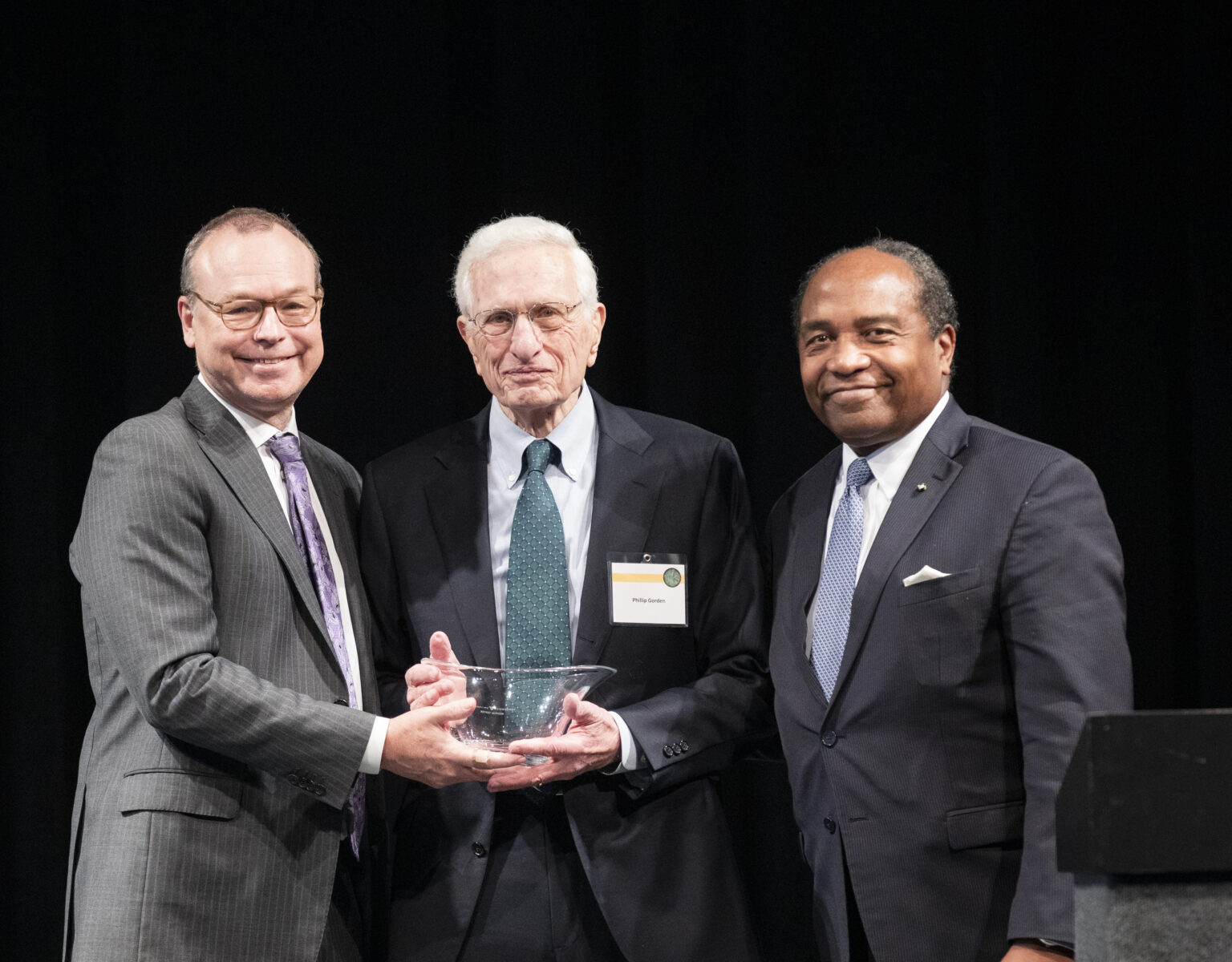
 Phillip Gorden, MD, center, receives the Vanderbilt Diabetes Center Lifetime Achievement Award in 2023, presented by Griffin Rodgers, MD, MACP, right, director of the National Institute of Diabetes and Digestive and Kidney Diseases, and Jeffrey Balser, MD, PhD, President and CEO of Vanderbilt Health. (file photo by Susan Urmy).

Phillip Gorden, MD, a 1957 Vanderbilt University (VU)undergraduate, 1961 School of Medicine (VUSM) alumnus, and director emeritus of the National Institute of Diabetes and Digestive and Kidney Diseases (NIDDK) died on June 23. He was 91.
“We were saddened to learn of Dr. Gorden’s passing. He was a giant in the field of diabetes, metabolism and obesity research for more than 50 years. We are very proud of his lifelong affiliation with the School of Medicine and our medical center, and for all that he contributed to our nation’s understanding of this challenging disease,” said Jeff Balser, MD, PhD, President and CEO of Vanderbilt Health and Dean of Vanderbilt University School of Medicine. “Our thoughts are with our colleagues Drs. Joan and Lee Gorden and their family as we mourn this loss.”
During medical school, one of Dr. Gorden’s key role models at Vanderbilt was Grant Liddle, MD, the first Chief of Endocrinology who later served as Chair of the Department of Medicine. After graduating from VUSM, Gorden completed a residency followed by a fellowship in metabolism at Yale, where his passion for research was ignited.
He joined the National Institutes of Health (NIH) in 1966 as a senior investigator at the National Institute of Arthritis and Metabolic Diseases, a precursor of the NIDDK. He became a clinical director there in 1974.
After a two-year sabbatical at the University of Geneva to further his research on hormone receptors, Dr. Gorden returned to the NIH in 1978, and after several leadership positions in the NIDDK’s diabetes branch, became the NIDDK’s seventh director in 1986. He remained in this role until 1999. Dr. Gorden retired in 2022, after 55 years of service to the NIH.
“Dr. Gorden was a wonderful physician, scientist, leader, and person,” said Alvin C. Powers, MD, the Joe C. Davis Professor of Biomedical Science and professor of Medicine in the Division of Diabetes, Endocrinology and Metabolism at Vanderbilt Health. “He was an extraordinary mentor, enabling the careers and lives of many who have gone on to become leaders and mentors. His immense impact was felt throughout science and medicine. Just as striking were his humility and personal touches, which made each person he met feel special.”
Dr. Gorden contributed significantly to many areas of science including describing the mechanism of insulin action, identifying the insulin receptor and its role in glucose homeostasis, and studying the proinsulin molecule, which led to the production of biosynthetic insulin.
His work on severe forms of insulin resistance led to breakthroughs in treating lipodystrophy, a rare disease characterized by the loss of fatty tissue. Based on clinical trials led by Dr. Gorden and his team, the U.S. Food and Drug Administration approved leptin for the treatment of generalized lipodystrophy in 2014. His team also conducted the first radiation therapy for acromegaly, a growth-hormone disorder.
As NIDDK director, Dr. Gorden oversaw the launch of several landmark, multicenter clinical trials that helped shape diabetes treatment and management, including the Diabetes Complications and Control Trial, the Modification of Diet in Renal Disease Study and the Diabetes Prevention Program. Under his leadership, NIDDK also funded the establishment of multisite research centers across its mission areas, including kidney and urologic diseases, cystic fibrosis, and obesity and nutrition.
In 2018, he was honored with the John Phillips Memorial Award from the American College of Physicians (ACP) for “outstanding, lifetime work in clinical medicine,” particularly in diabetes, lipid metabolism and insulin resistance. The same year, Dr. Gorden was awarded a Mastership from the ACP for his “significant contributions to medicine and advancing patient care.”
He received VUSM’s Distinguished Alumni Award in 1990, and in 2023, he was honored with the Vanderbilt Diabetes Center Lifetime Achievement Award. This honor was co-presented by Balser and Griffin Rodgers, MD, MACP, director of the NIDDK, with additional remarks from Daniel Diermeier, PhD, Chancellor of Vanderbilt University.
Balser called him “a quintessential example of Vanderbilt’s commitment to the tripartite mission of education, research and patient care.”
“Phil is truly one of the NIH’s most conscientious and accomplished leaders and scientists,” Rodgers said of his former colleague. “He instilled compassion, integrity and wisdom into everything that he did, whether treating patients or conducting groundbreaking research, or leading one of the NIH’s largest institutes. He really set an example that few match but to which we can all certainly aspire.”
C. Ronald Kahn, MD, past president of Joslin Diabetes Center and the Mary K. Iaccoca Professor of Medicine at Harvard Medical School was a long-time friend of the Gorden family.
“Phil was truly a unique physician scientist and mentor,” Kahn said. “His style conveyed all the best traits of a southern gentleman, clinical and research scholar, and friend to both his colleagues and his trainees. Already, in just the few days since his passing, literally dozens of emails have come from around the world remembering his great character and support for those in his laboratory, as well as in other laboratories and universities, and how much it impacted their lives.”
Dr. Gorden grew up in northeast Mississippi as an only child; his father was a Ukrainian immigrant who operated a dry goods store with his wife. His path to Vanderbilt was incidental: He met someone in neighboring Tupelo, Mississippi, who had attended VU, and on their glowing recommendation, he decided to apply.
He called his first undergraduate years “the most difficult time” of his life, but he found his stride. He then applied and was accepted into VUSM, the last student selected in a class of 50.
During an interview in 2000 for the Endocrine Society Oral History Collection, just after stepping down from the NIDDK, Dr. Gorden didn’t point to hours testifying before Congress in the eternal quest for funding or his years heading a federal agency as the high point of his career. Instead, he spoke of his extraordinary joy in working in the clinical space with patients.
“I’ve always enjoyed being with patients, seeing patients and those weird opportunities when you really have a chance to do something for somebody is an exhilarating feeling that can only be described when you’ve experienced it,” he said. “When you can either tell someone about the course of their disease that is positive and beneficial or that you have elucidated a new mechanism that offers a therapeutic opportunity.
“When you can do that, then you sort of have vibration between you and the patient; that is a feeling that really, I think, can only happen to people who are involved in clinical medicine or clinical research. I think for me that has been clearly the highlight of everything that I’ve done.”
Dr. Gorden is survived by his sons, Lee Gorden, MD (Joan Gorden, MD), a 1990 graduate of VUSM, and Jed Gorden, MD (Sara Manetti), a 1997 graduate of VUSM, and his grandchildren, Isaac, Eliana and Satchel. He is preceded in death by his wife of more than six decades, Vivian, whom he married just before his third year at VUSM. Vivian died just weeks before Dr. Gorden’s passing.
His funeral was held June 26 at The Temple, Congregation Ohabai Sholom, in Nashville, and details regarding a celebration of life will be announced at a later date.