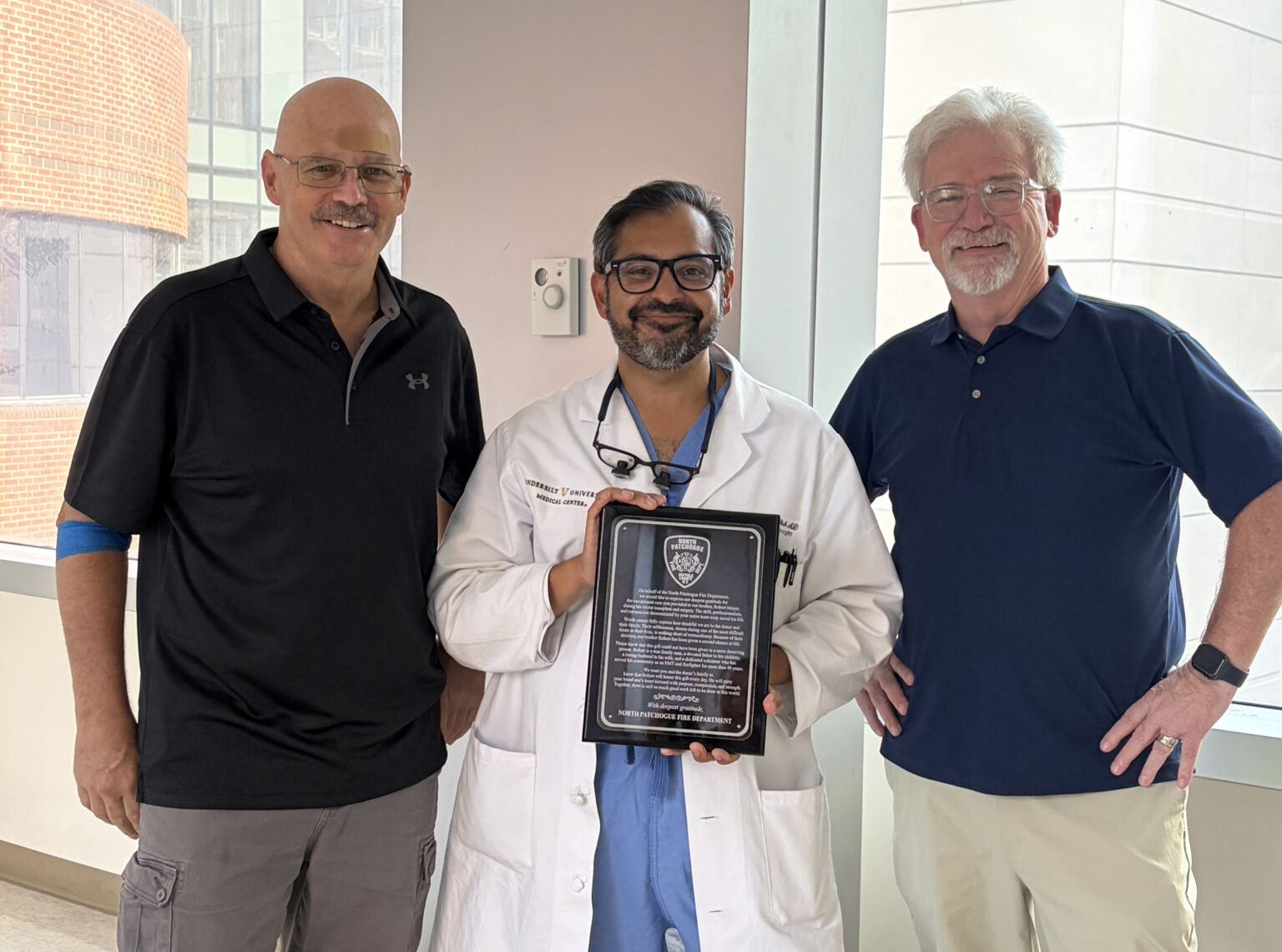
 Ashish Shah, MD, center, holds a plaque of appreciation from the North Patchogue Fire Department in Long Island, New York. Bob Meyer, left, is a volunteer firefighter for the department who received a heart transplant at the Vanderbilt Transplant Center, performed by Shah. Jim Hawley, BSN, RN, right, is a former Vanderbilt nurse who made his old friend, Meyer, aware of the Vanderbilt Transplant Center.

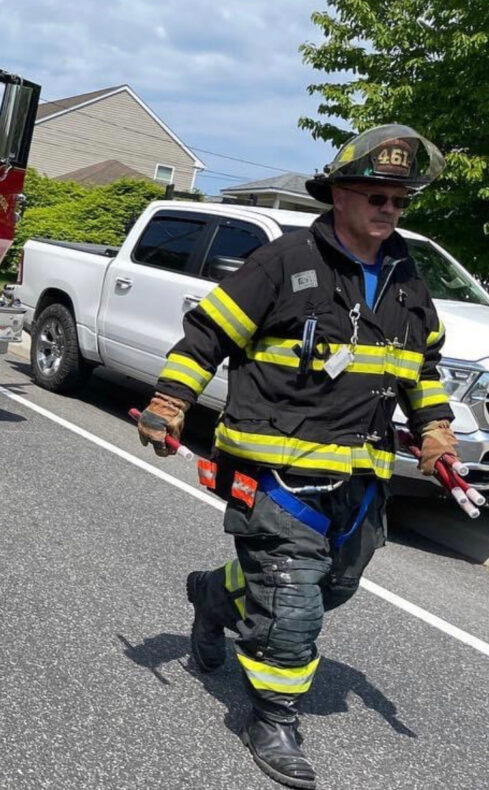
In more than 40 years as a volunteer firefighter with the North Patchogue Fire Department on Long Island in New York, Bob Meyer has been in the middle of a lot of life and death situations.
A couple of years ago, he was facing his own. Meyer, also a retired corrections officer, needed a heart transplant after a procedure to repair an aortic aneurysm at a local hospital was unsuccessful, and his heart was damaged. “Basically, they told me my heart wasn’t going to get any better,” he said.
He got on the heart transplant list locally in New York, knowing that he would likely have to become very sick before he would qualify for a donor heart, if a matching one could be found. He had no way of knowing at the time that a chance encounter would point him to the Vanderbilt Transplant Center, and he would receive a new heart nearly 1,000 miles away.
Jim Hawley, BSN, RN, at the time a Vanderbilt Health nurse, was playing in a charity golf tournament in New York that he goes to every September. Every year, he drops by the firehouse where he was a volunteer in the 1980s. This time, he ran into his old buddy, Meyer.
“Bobby walked in, and he didn’t look good,” Hawley recalled. “He had just a grayish color to him, and I noticed he had a PICC (peripherally inserted central catheter) line in his arm and something infusing. I said, ‘Dude, what happened?’”
Meyer explained that he needed a new heart. It stayed on Hawley’s mind after returning to his job at Vanderbilt LifeFlight’s Cardiac Transfer Center. He ran into Ashish Shah, MD, Professor and Chair of Cardiac Surgery, and told him about his friend’s situation. Shah told Hawley that Meyer could be “dual-listed” — placed on the transplant list at Vanderbilt Health as well as the health system in New York — which could give him a chance to get a heart faster.
Two weeks later, Meyer was at Vanderbilt Health getting tested to be considered for a transplant in Nashville. But there was a catch: When a heart is available, a patient typically only has a few hours to grab their bags and head for the hospital for a transplant. New York would be too far away.
It happened that Meyer had a brother who had just moved to Chattanooga, Tennessee, a two-hour drive from Nashville. So, in April 2025, Meyer moved in with his brother and began traveling to appointments at Vanderbilt Health each month.
Events began to move more quickly. Meyer was getting sicker and sicker, and when he showed up for his scheduled doctor’s appointment in January 2026, his heart was in such poor condition that he was admitted to Vanderbilt University Hospital. Meyer would need to stay in the hospital until a suitable organ could be found.
Less than two weeks later, the Vanderbilt Transplant Center found a matching organ, and Meyer received his lifesaving heart transplant at Vanderbilt Health. His surgeon was Shah, who holds the Alfred Blalock Directorship in Cardiac Surgery.
“As part of our mission as the world’s largest heart transplant program, we understand how important access to Vanderbilt Health and the heart program is to these desperately sick patients,” Shah said. “Our patients new to Vanderbilt Health get the vital link they need, thanks to our pretransplant coordinators: Emily Firsich, MSN, RN; Cayce Ray, BSN, RN; Kristie Stewart, BSN, RN; and Leah Swafford, BSN, RN. This is unique to our program, and Mr. Meyer is a powerful example of just how critical the pretransplant team is to our success.”
During his recovery, Meyer stayed at the C. Wright Pinson Hospitality House, which provides low-cost lodging for families and long-term patients receiving medical treatment at Nashville-area hospitals, including Vanderbilt Health. It was near the Vanderbilt Dayani Center, where Meyer received rehab services and regained his strength after the transplant.
“Everything was just super, with the way it was set up,” he said.
Meyer also made friends at the hospitality house who were going through similar medical journeys.
In April, Meyer was well enough to return to his home in New York, where he lives with his wife, Maritza, and sons, Robert and Ryan. He returns to Vanderbilt Health monthly for appointments.
“I feel really good,” Meyer said. “Everybody’s kind of amazed at how I look and how I feel so quickly.”
And it all happened because he ran into an old friend at the firehouse.
“The timing of the whole thing was just crazy,” Hawley said. “If I don’t go in the firehouse at that time, if I’m not working down here at Vanderbilt, if Bob and I don’t have a history together …”
Meyer said, “I’m glad that I did run into him, and it worked out the way it did.”
Now, it’s Meyer spreading the word about the Vanderbilt Transplant Center.
“I ran into a guy when I was on vacation,” he said. “He was having some heart issues and stuff, and he lived in Virginia. And I said, ‘Listen, if you’re ever thinking about a heart transplant … I would definitely look into Vanderbilt.’”