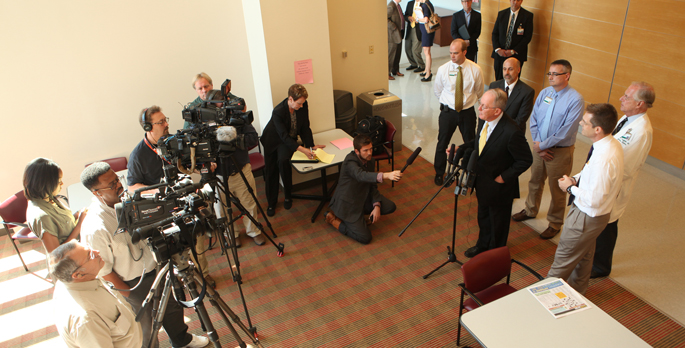
John Howser, Vanderbilt Health’s Chief Communications Officer and longtime communications leader, announced plans to retire in March 2027 after nearly 40 years at Vanderbilt.
Howser’s career began behind the camera as a Medical Center photojournalist and grew into leadership of the organization’s communications strategy, shaping how employees, patients, community members and journalists understood Vanderbilt Health’s mission and impact.
During the last 15 years, Howser has led the Office of News & Communications through some of the Medical Center’s most transformative moments, including its 2016 separation from Vanderbilt University, the implementation of the eSTAR electronic medical records system, regional expansion of the health system, and the COVID-19 pandemic.
“I could not have asked for a better adviser and communications partner,” said Jeff Balser, MD, PhD, President and Chief Executive Officer of Vanderbilt Health and Dean of Vanderbilt University School of Medicine. “Throughout the years, John has been instrumental in positioning Vanderbilt Health as a leader in academic medicine and helping us navigate the ever-changing media landscape.”
An ‘All-Access Pass’
Howser’s Vanderbilt career began in 1987 as a staff photojournalist, eventually leading him through a series of communications leadership roles to his position as Chief Communications Officer for the Medical Center.
Howser describes his career as “an all-access pass to the Medical Center’s history.” He has scrubbed in to observe groundbreaking surgeries, supported 10 White House visits, photographed Nobel Prize winners, met celebrities, spent overnight shifts in the emergency department, flown on LifeFlight and worked with thousands of Vanderbilt Health physicians, nurses and employees along the way.
“I’ve been in every crevice and corner of the Medical Center over the years,” Howser said. “Every day has been an exciting race against the clock.”
News & Communications: Helping Vanderbilt Health Meet the Moment
As Vanderbilt Health’s national prominence grew, so did the Office of News & Communications. Today, the Medical Center generates more than 100,000 earned media placements annually and has accumulated more than 1.6 million favorable media mentions across local, national and international news outlets.
From groundbreaking research discoveries and clinical innovations to major institutional milestones, Howser and his team have connected thousands of Vanderbilt Health experts with audiences across Tennessee, the nation and the world.
“The individuals comprising our team in the News office are the very best at what they do, and their support has made it possible for me to serve in this role. I have been fortunate to have worked with many of them for decades. That only happens in a great organization like this,” said Howser.
Over the span of Howser’s career, Vanderbilt changed the way it told its story to meet the evolving media landscape. The rise of 24-hour cable news led to the creation of Vanderbilt’s satellite television studio. As reality television and documentary programming gained popularity, Vanderbilt participated in dozens of national productions. And as audiences increasingly turned to digital platforms for news, the Office of News & Communications developed an industry-leading news website.
During the COVID-19 pandemic, Vanderbilt Health became one of the nation’s most visible sources of information. Through thousands of media interviews and expert appearances, Vanderbilt physicians helped explain the science behind the rapidly evolving public health crisis. William Schaffner, MD, Professor of Health Policy and Medicine, became one of the country’s most recognized voices on the pandemic. Howser and his team coordinated an unprecedented volume of media activity during that period, making it the busiest stretch in Vanderbilt Health’s media relations history.
Howser also helped bring Vanderbilt Health stories to broader audiences, offering viewers a rare window into the lives of Vanderbilt patients and caregivers through series such as “Trauma: Life in the E.R.,” “Resident Life,” “Emergency Level One” and “Last Chance Transplant.” These documentaries and reality series highlighted the complexity and humanity of academic medicine.
“John’s impact extends far beyond communications,” said John F. Manning Jr., PhD, MBA, Chief Operating Officer and Corporate Chief of Staff. “For decades he has helped Vanderbilt tell its story with integrity, compassion and credibility. He understands this institution’s history as well as anyone and has dedicated his career to helping others see the extraordinary people and work that make Vanderbilt special.”
For Howser, that work became deeply personal as Vanderbilt’s mission intersected with his own life.
‘Vanderbilt saved my life’
Of all the stories Howser helped tell during his career, none became more personal than the story of Vanderbilt’s Transplant Center.
In 2003, Howser was diagnosed with an autoimmune liver disorder. Under the care of longtime Vanderbilt physician David Raiford, MD, Howser managed the disease for nearly two decades while continuing to lead communications efforts for the Medical Center.
One of the most meaningful projects of his career was “Last Chance Transplant,” a Discovery+ documentary series that followed Vanderbilt’s Transplant Center and the patients whose lives depended on a transplant. What few viewers knew was that while the series was being filmed, Howser was waiting for a transplant himself.
As Howser’s disease progressed, he was placed on Vanderbilt’s transplant waiting list. By the time the series aired, he was facing end-stage organ failure, and a transplant became his only chance for survival.
For months, he waited for a donor organ and the call that could save his life.
That call came on May 10, 2022.
“Not only did coming to work here change my life, Vanderbilt also saved my life,” Howser said. “Without the extraordinary care I received here, I would not be alive today.”
That experience left him with a renewed appreciation for Vanderbilt Health’s mission and the generosity of organ donors.
“I’ve always been grateful to work alongside the best physicians, nurses and staff in the world,” Howser said. “And when your life depends on them, you understand in a very personal way how remarkable they are.”
Howser said he looks forward to spending more time with his wife, Blayne, and poodle, Nick, while remaining grateful for the colleagues, patients and caregivers who shaped his Vanderbilt career.