


Hand trauma is one of the most common injuries in military settings, often significantly impairing service members’ ability to perform essential tasks. Serious hand and wrist injuries are also estimated to account for 10% to 30% of all emergency department visits in the United States.
Protecting the hand, while also supporting safe function, is especially important in environments where evacuation to skilled medical care can be delayed. Time and materials needed for plaster casting are also limitations when caring for hand injuries.
This led to the creation of an innovative orthopaedic brace called the GRASP Hand system that addresses these challenges. It was developed through a multiyear collaboration among members of the Department of Plastic Surgery’s Division of Hand and Upper Extremity at Vanderbilt Health and faculty and student creator/designers at the Wond’ry, Vanderbilt University’s Center for Innovation and Design.
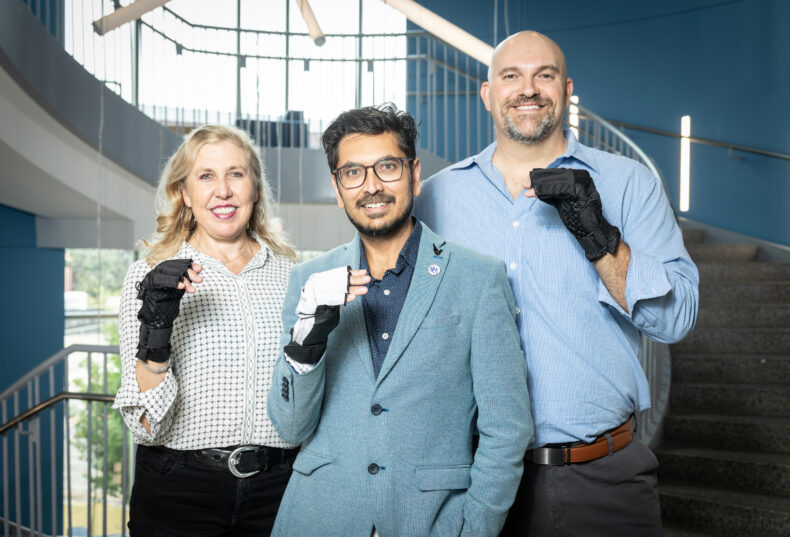
“The concept for the GRASP Hand system came about when I realized that we are still immobilizing injured hands with splints or casts the same way we did 15 years ago,” said Justin Stehr, OTR/L, CHT, WCC, an occupational therapist at the Plastic Surgery Clinic at Vanderbilt Health One Hundred Oaks. “I knew we could improve this and come up with a system that protects the hand, maintains an acceptable alignment for healing, and permits mobility of the fingers.”
Stehr began brainstorming ideas with Panambur (Lax) Bhandari, MBBS, Assistant Professor of Plastic Surgery and Orthopaedic Surgery and Director of Limb Reconstruction at Vanderbilt Health. Former Vanderbilt Health plastic surgeon Wesley Thayer, MD, PhD, now Chief of Plastic and Reconstructive Surgery at VCU Health in Virginia, recognized the technology’s value for military use and connected the pair with Department of Defense opportunities.
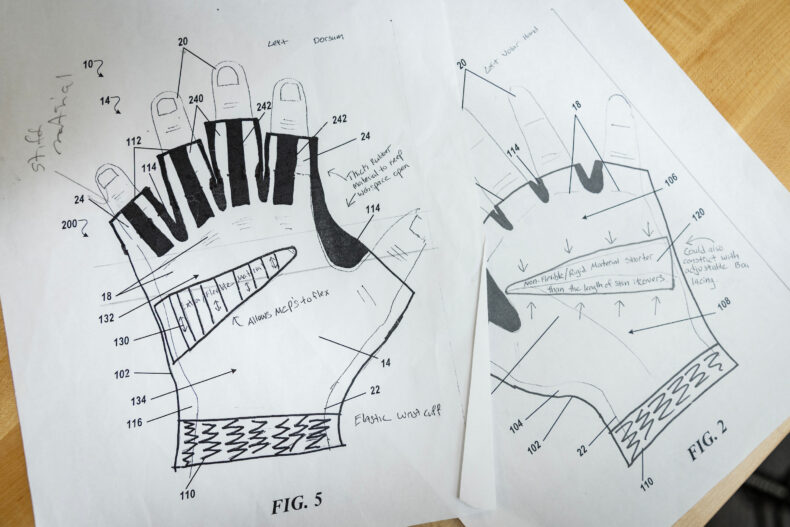
The GRASP Hand system can be applied quickly — even by those with no medical training — to stabilize and protect an injury while providing compression to reduce swelling. A unique feature is that it allows safe finger movement, while automatically returning the hand to an “intrinsic-plus position” when at rest.
This hand position places metacarpophalangeal joints (the knuckles) in flexion (bent toward the palm) and the interphalangeal joints (finger joints) in extension to preserve ligament length and minimize stiffness during healing. If these ligaments become shortened, prolonged hand disability can occur.
“We see a lot of patients who come in with a splint or cast that runs all the way from the elbow to fingertips when they have a fracture in the hand,” Bhandari said. “Patients who remain in this type of immobile splint tend to develop an issue with stiffness caused more by the splint than the injury itself.
“I told Justin we could create something much more helpful. Vanderbilt is a great place for this type of translational research. When we have an idea to execute, there is support along every step of the way.”
Stehr and Bhandari had a winning concept, but putting together a prototype, much less a commercially viable device, was outside their skill sets.
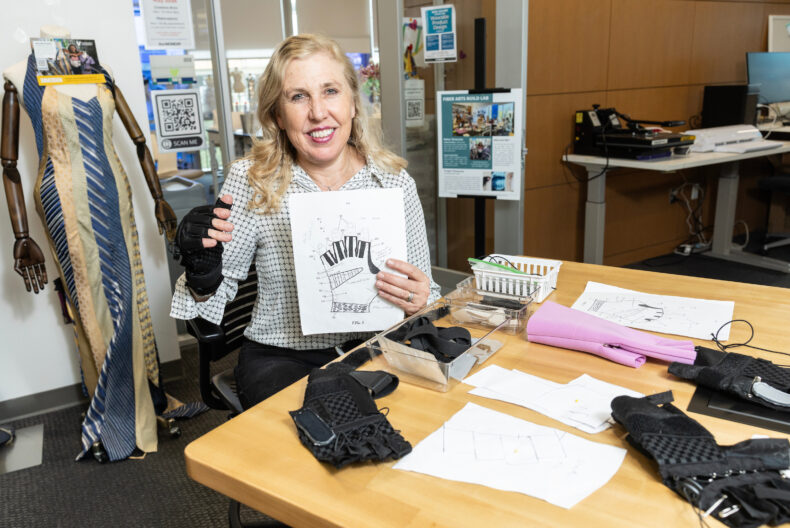
Philip Swaney, PhD, at the Vanderbilt Center for Technology Transfer and Commercialization (CTTC), worked with the team on commercialization of their concept, including filing a patent application for their idea. He also introduced them to Alexandra Sargent Capps, Director of the Fiber Arts Build Lab at the Wond’ry, the innovation, design and entrepreneurship center at Vanderbilt.
“I walked in one day, begged for help, and she said yes,” Stehr said. “At that time there was no funding, just her willingness to help a couple of guys trying to get a glove to patients.”
Capps listened to their goals and began creating. She stitched together stretchy yet supportive fabrics with a system of hooks and eyes, elastic cords with lock-pulls to cinch the hand into the correct position, and small, rigid plates inside strategically placed pockets to stabilize and protect the hand.
“I’m trained as a costume designer, so all of these materials are based on things I used in the theater,” Capps explained. “The main glove is made from a knit fabric — actually a cosplay fabric — with an overlay pattern that gives it a bit more structure.”
The group received an Innovation Catalyst Fund grant from the Vanderbilt Office of the Vice Provost for Research and Innovation in 2025 to support development of the device and a second grant in 2026 to support the pilot manufacturing and clinical validation. The group also received business coaching and advice on Food and Drug Administration regulatory affairs and clinical development from faculty and staff at the Brock Family Center for Applied Innovation.
After many months of fabric sourcing and fine-tuning, and assistance from student designers, the product has already been put to the test. The clinical team published the results of a pilot feasibility study of the GRASP Hand system in the journal Military Medicine, the international journal of AMSUS, the Society of Federal Health Professionals.
The pilot trial involved eight surgeons applying the GRASP Hand system in an outpatient setting. GRASP had significantly reduced application time compared to plaster splinting (23.5 seconds versus 359 seconds) and more consistent joint positioning with less user variability. Maintenance of proper hand positioning was comparable between the plaster splint and GRASP, and no complications or device failures were observed.
A broader clinical study using the brace to stabilize metacarpal fractures for Vanderbilt Health patients has begun. A field test of the GRASP Hand system is also being considered in partnership with an Army military unit at nearby Fort Campbell.
And there has been remarkable support to get the GRASP Hand system on the market so it can be used more widely. A startup company, Velyra Medical Inc., founded by Stehr, Bhandari and Thayer, has been launched to commercialize the GRASP Hand system. The group has received assistance from CTTC and the Vanderbilt Innovation Corps, which serves as the institutional home for Vanderbilt’s leadership of the NSF Mid-South I-Corps Hub that is dedicated to creating impact through commercializing technology and launching innovation-driven enterprises.
Stehr participated in the Sullivan Family Ideator Program, a joint program between the Wond’ry and the Vanderbilt Innovation Corps, for initial customer discovery and market validation. The GRASP team also participated in the Vanderbilt Innovation Corps’ Builder Program, de-risking the business model and informing go-to-market strategy. Stehr also recently received a microgrant to support the work for winning the Mid-South Hub Open Mic pitch competition.


